Skip to content


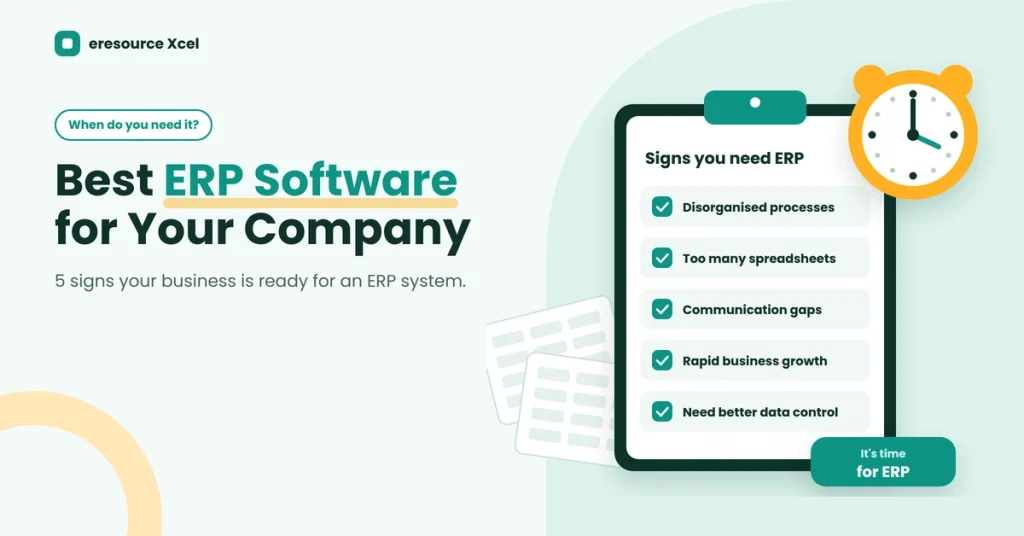
Best ERP Software for Your Company: When Do You Need It?
As a business grows, its operations can become more complex. Communication gaps may also increase between departments.
At this stage, businesses need better ways to manage information and daily processes. ERP software can bring important business functions together and improve operational visibility.
But how do you know when your company needs an ERP system?
Several signs can help you identify the right time to adopt ERP software.
When Is the Right Time to Get ERP Software?
The best way to identify the right time for ERP is to review your business operations.
If employees spend more time managing spreadsheets and paperwork than handling core business activities, consider an ERP system.
Similarly, growing communication gaps can indicate that your current systems no longer support your business needs.
An ERP solution can connect departments and provide a central source of business information.
1. Your Business Processes Are Becoming Disorganized
Business growth often creates new processes and responsibilities.
Without an integrated system, employees may manage information through separate tools. As a result, teams may struggle to maintain consistent processes.
ERP software can connect different business functions. It can help teams manage information through a centralized system.
This approach can reduce process gaps and improve coordination between departments.
2. You Spend Too Much Time on Spreadsheets
Multiple spreadsheets may work for a small business.
However, spreadsheets can become difficult to manage as the organization grows. More employees may need access to the same information.
Teams may also create separate spreadsheets for sales, purchasing, inventory, finance, and other activities.
An ERP System can bring these processes into one integrated platform.
Instead of managing multiple files, employees can work with shared business information.
3. Communication Gaps Are Increasing
Poor communication can affect business operations.
For example, the sales team may need information from inventory. The finance team may also need updated sales and purchasing data.
Without an integrated system, employees may spend extra time requesting and verifying information.
ERP software connects departments and improves information flow. Therefore, teams can access the information they need more easily.
4. Your Business Is Growing Rapidly
Business growth brings new challenges.
As your company adds customers, employees, products, locations, or transactions, manual processes can become harder to manage.
An ERP system can support growing operations by bringing key processes together.
You can also add relevant ERP modules as your business requirements change.
5. You Want Better Control Over Business Data
Business leaders need accurate information to make informed decisions.
Separate systems can make it difficult to understand the complete business picture. Data may exist across spreadsheets, applications, and different departments.
An ERP solution provides a centralized platform for business information.
Managers can use this information to monitor operations, identify issues, and make better decisions.
Common Misconceptions About ERP Software
Some businesses believe that ERP software costs too much. Others think ERP implementation takes too much time.
However, modern ERP solutions can offer flexible options for different business sizes.
Businesses can select the modules that match their current requirements. This approach can help control unnecessary costs and system complexity.
ERP software can also scale as business needs change.
Therefore, companies should evaluate their actual requirements instead of assuming that ERP is too expensive or complicated.
How to Choose the Right ERP Software
Choosing an ERP system requires careful research.
First, identify your business requirements. Then, compare available ERP solutions and review the features that each provider offers.
You should also research different ERP vendors before making a decision.
Consider factors such as:
Required ERP modules
Business size and industry
Implementation requirements
Scalability
User experience
Integration capabilities
Support and maintenance
Total cost of ownership
Cost matters, but it should not become the only factor in your decision.
A suitable ERP system should support your current operations and future business growth.
Consider Cloud-Based ERP Software
A cloud-based SaaS (Software as a Service) system can reduce initial infrastructure requirements.
Cloud ERP can also provide software updates and maintenance through the service provider.
For growing businesses, this model can offer flexibility and easier access to ERP capabilities.
However, businesses should still evaluate security, support, integration, scalability, and pricing before choosing a cloud ERP solution.
Take Time to Select the Right ERP System
Choosing ERP software requires careful planning.
Do not select a system only because it has many features. Instead, focus on the features that match your business processes.
Talk to ERP vendors, compare solutions, and understand the implementation process.
You should also consider how easily employees can learn and use the system.
The right ERP solution should support your business without creating unnecessary complexity.
Benefits of Implementing ERP at the Right Time
Choosing ERP at the right stage can help businesses:
Improve operational visibility
Reduce manual work
Connect business departments
Improve data accuracy
Reduce spreadsheet dependency
Support business growth
Improve decision-making
Standardize business processes
Manage resources more effectively
Conclusion
Business growth can create new operational challenges. When spreadsheets, disconnected systems, and communication gaps start affecting productivity, it may be time to consider ERP software.
The right ERP solution can connect business processes and provide better visibility across the organization.
Before choosing a system, identify your requirements and compare different ERP vendors. Also, consider scalability, usability, support, implementation, and total cost.
With careful planning, businesses can choose an ERP system that supports both current operations and future growth.
Also Read – ERP for Plastic industry