Why Is ERP Software Used in the Manufacturing Industry?
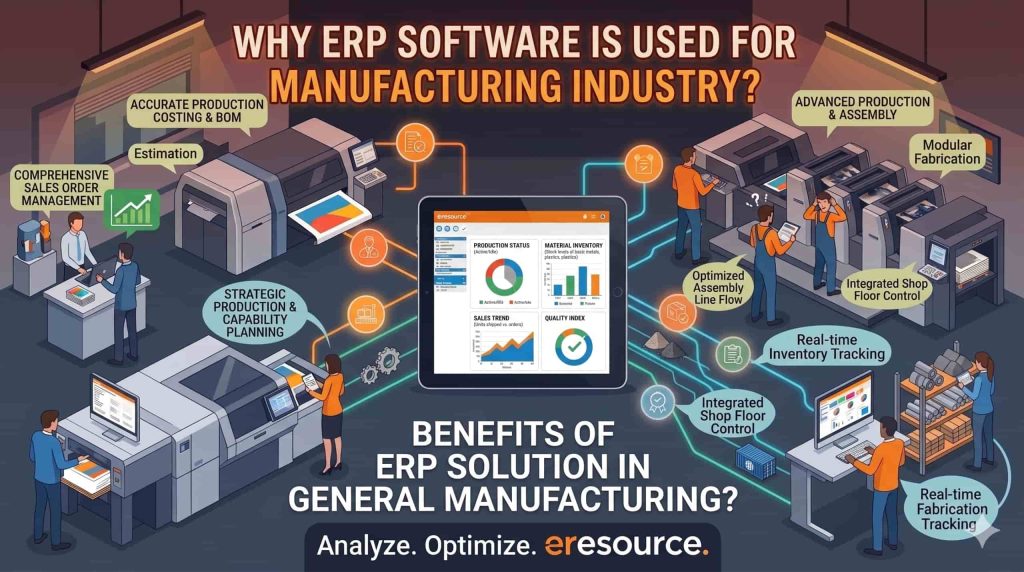
Manufacturing companies need every department to work together efficiently. Manufacturing ERP software connects sales, planning, production, quality, billing, inventory, and accounts through one integrated system. As a result, teams can access the same real-time information instead of maintaining separate spreadsheets or disconnected records.
By bringing core manufacturing processes into one system, ERP software reduces duplicate data entry, minimizes delays, improves data accuracy, and helps manufacturers make faster decisions. More importantly, every hour saved through better coordination can improve productivity and contribute to higher ROI.
What Does ERP Software Do in Manufacturing?
An ERP system creates a single source of truth for the entire manufacturing operation. Instead of moving information manually between departments, employees can update and access data within the same system.
For example, when a customer places an order, the information can move from sales to production planning, material planning, production, quality, dispatch, billing, and accounting without repeated data entry.
This connected workflow helps manufacturers maintain better control over costs, inventory, production schedules, and customer commitments.
6 Core Manufacturing Processes ERP Software Streamlines
1. Sales and Order Management
ERP software connects sales orders with current inventory, production capacity, and delivery schedules. Therefore, sales teams can check available resources before committing to a delivery date.
The system also keeps customer orders, quotations, pricing, and delivery information in one place. This reduces communication gaps between sales and production.
2. Production Management
Once the company confirms a sales order, the ERP system can generate or trigger the required production workflow. Production supervisors can then monitor work orders, job progress, machine activity, and output from a central system.
As a result, management gets better visibility into actual production versus planned production without waiting for month-end reports.
3. Material Requirement Planning (MRP)
Material Requirement Planning helps manufacturers determine what materials they need, how much they need, and when they need them.
Instead of relying on manual calculations or assumptions, the ERP system uses demand, inventory levels, production requirements, and existing orders to support purchasing and production decisions.
Consequently, manufacturers can reduce material shortages, avoid unnecessary purchases, and improve inventory planning.
4. Quality Management
Quality management becomes easier when manufacturers build inspection checkpoints directly into their ERP workflow.
Teams can record inspections at incoming, in-process, and final stages. They can also connect quality records with batches, suppliers, products, and machines.
This traceability helps quality teams identify problems faster and maintain consistent documentation throughout the production process.
5. Billing, Invoicing, and Dispatch
ERP software can connect dispatch information with invoicing. Once the company completes a shipment, the system can use the relevant transaction data to support invoice generation, e-invoicing, and e-way bill processes.
Therefore, employees do not need to enter the same information repeatedly. This approach can reduce billing errors and mismatches between dispatched goods and invoices.
6. Accounting and Financial Management
A manufacturing ERP system connects operational transactions with accounting. As transactions move through purchasing, production, inventory, sales, and dispatch, the system can update relevant financial records.
This integration gives finance teams better visibility into costs, revenue, inventory valuation, and product profitability.
Moreover, accurate and timely data can make month-end reporting and financial reconciliation more efficient.
How Does Manufacturing ERP Improve Coordination?
The biggest advantage of ERP software in manufacturing is connected information.
Sales can see order status. Production can view planned requirements. Purchasing can check material needs. Quality teams can access inspection records. Finance can track financial transactions.
Instead of asking another department for the latest update, employees can access information from the same system.
In other words, one system connects the entire manufacturing workflow and reduces the gaps between departments.
Why Choose a Web-Based ERP System for Manufacturing?
A web-based manufacturing ERP allows authorized users to access business information through an internet-connected device. Depending on their permissions, employees can work from laptops, tablets, or mobile devices without relying on a local office computer.
This approach can be particularly useful for manufacturers operating across multiple locations or plants.
Key advantages include:
Access from anywhere: Supervisors can update production information directly from the shop floor.
Real-time visibility: Management can review production, inventory, sales, and financial dashboards remotely.
Multi-plant coordination: Businesses can manage multiple facilities through a connected ERP environment.
Lower infrastructure requirements: Companies can reduce the need for on-site server infrastructure and maintenance.
Centralized data: Teams work with the same information instead of exchanging multiple spreadsheet versions.
Easier updates: The ERP provider can manage system updates and maintenance centrally.
Also Read: Construction ERP Software
What Happens When a Manufacturing Company Does Not Use ERP?
Consider a manufacturer that manages inventory through separate spreadsheets.
The purchase team may not have the latest stock information. Meanwhile, production may not know whether the required material has arrived. At the same time, sales may commit to a delivery date without seeing the current production schedule.
These disconnected processes create delays and increase the risk of errors.
For example, when employees repeatedly exchange spreadsheets, emails, or manual reports, information can become outdated before another department receives it. Consequently, teams spend more time verifying information instead of acting on it.
A manufacturing ERP system addresses this coordination problem by giving authorized users access to the same up-to-date information.
What Results Can Manufacturers Expect from ERP Software?
Manufacturers can use ERP software to improve several areas of their operations, including:
Better process automation
Faster information flow
Reduced duplicate data entry
Improved data accuracy
Better production visibility
More efficient material planning
Stronger inventory control
Improved traceability
Better financial visibility
Remote and multi-location access
Greater operational efficiency
Improved ROI potential
However, the actual results depend on factors such as the company’s processes, implementation approach, user adoption, ERP configuration, and quality of data.
For a detailed breakdown, read our companion guide: 8 Benefits of ERP for the Manufacturing Industry.
Also Read: ERP Software in Nigeria
Frequently Asked Questions About Manufacturing ERP Software
Why is ERP software important for the manufacturing industry?
ERP software is important because manufacturing depends on coordination between sales, planning, production, quality, inventory, billing, and accounting. An integrated ERP system connects these processes and gives teams access to shared, up-to-date information.
Which processes does ERP streamline in manufacturing?
Manufacturing ERP software can streamline sales order management, production planning and execution, material requirement planning (MRP), inventory management, quality control, billing, e-invoicing, dispatch, and financial accounting.
Is web-based ERP suitable for manufacturers?
Yes. A web-based ERP can be suitable for many small and mid-sized manufacturers because authorized users can access the system from connected devices. It can also support centralized data management across multiple locations.
What should manufacturers look for in an ERP system?
Manufacturers should evaluate features such as Bill of Materials (BOM), production planning, MRP, work orders, shop floor management, inventory control, quality management, purchasing, sales, accounting, reporting, and integration capabilities.
The right ERP should also match the company’s manufacturing process, business size, implementation requirements, and future growth plans.
Which ERP is best for the manufacturing industry?
There is no single ERP that is best for every manufacturer. The right choice depends on the company’s processes, industry requirements, number of plants, users, budget, integrations, and scalability needs.
An industry-focused solution such as eresource Xcel can be considered by manufacturers looking for features designed around manufacturing workflows, including BOM, production, shop floor, material planning, and quality management.
Take Control of Your Manufacturing Operations
Manufacturing becomes more efficient when every department works with the same information.
With manufacturing ERP software, businesses can connect sales, planning, production, quality, inventory, billing, and accounting within one integrated platform. As a result, teams can reduce manual work, improve visibility, respond faster, and make decisions using current business data.
Ready to see how an ERP system can fit your manufacturing operations?
Register for a Free Demo of eresource Xcel today.
Frequently Asked Questions
Why manufacturers use ERP software
Why is ERP software important for the manufacturing industry?
Because manufacturing runs on coordination between sales, planning, production, quality, billing, and accounts. ERP connects all six on one real-time system — something spreadsheets and standalone software cannot do at scale.
Which processes does ERP streamline in manufacturing?
Sales order management, production execution, material planning (MRP), quality control, billing and e-invoicing, and financial accounting — all integrated on a single database.
Is web-based ERP better for manufacturers?
For most small and mid-sized manufacturers, yes — it requires no server investment, is accessible 24/7 from any device including on the shop floor, and updates are handled by the vendor.
Which ERP is best for the manufacturing industry?
An industry-specific system like eresource Xcel, which is purpose-built for manufacturers with BOM, shop floor, and quality workflows included — rather than a generic ERP customized afterwards.