What is Manufacturing ERP Software? A Complete Guide
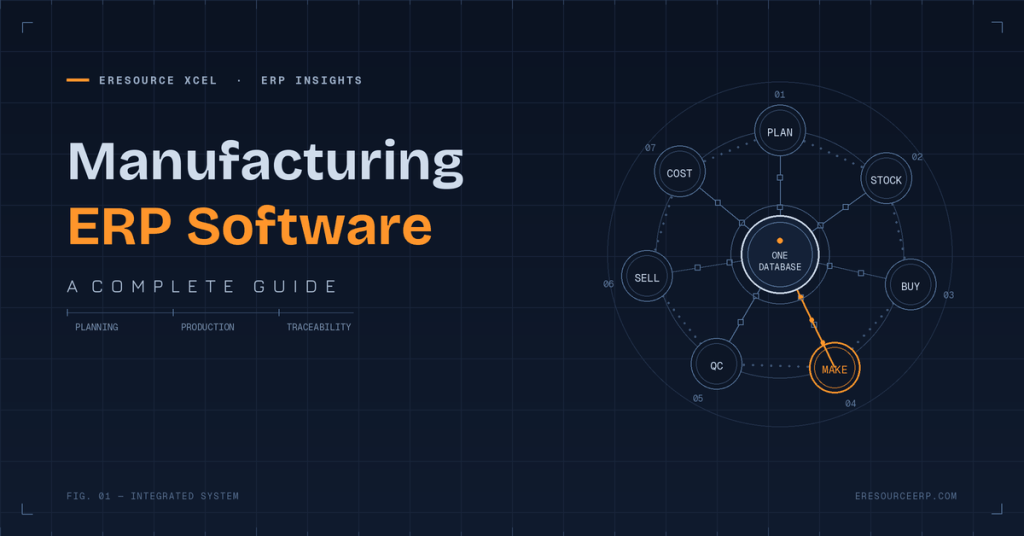
Manufacturing ERP software is a business management system built specifically for manufacturers. It connects every core function of a factory — production planning, inventory, procurement, shop floor execution, quality control, sales, and finance — into one integrated platform with a single shared database.
Instead of each department working in its own software and reconciling data manually, everyone works from the same real-time information. An order entered by sales instantly updates production schedules, material requirements, and financial projections.
How is Manufacturing ERP Different from Standard ERP?
A generic ERP manages finance, HR, and sales for any type of business. A manufacturing ERP adds the production layer that generic systems lack:
- Bill of Materials (BOM) — multi-level product structures with every raw material, component, and sub-assembly
- Production planning and scheduling – capacity-based plans that match orders to machines, manpower, and materials
- Material Requirement Planning (MRP) – automatic calculation of what to purchase or produce, and when
- Shop floor control – real-time tracking of work orders, machine utilization, and operator output
- Quality management – inspection checkpoints at inward, in-process, and final stages with full traceability
If your business makes things, these functions are not optional add-ons – they are the core of the system.
Key Modules of a Manufacturing ERP System
Production Planning & Control
Converts sales orders and forecasts into achievable production plans. Tracks every work order from release to completion, so planners see delays the moment they occur — not at month-end.
Inventory & Warehouse Management
Real-time stock across raw materials, work-in-progress, and finished goods, with batch/lot tracking, reorder automation, and multi-location visibility.
Purchase & Supplier Management
Links procurement directly to MRP output. Purchase orders are raised against actual requirements, with supplier rating, rate comparison, and delivery tracking built in.
Sales & Dispatch
From quotation to invoice on one screen, with credit control, dispatch planning, and e-invoicing/e-way bill compliance for Indian manufacturers.
Quality Control
Inspection plans, sampling, rejection handling, and CAPA — with every result traceable back to batch, supplier, or machine.
Plant Maintenance
Preventive maintenance schedules, breakdown logging, and calibration tracking that keep unplanned downtime to a minimum.
Finance & Costing
Real-time ledgers, GST compliance, and – critically for manufacturers – accurate product costing that shows the true margin on every item you make.
7 Benefits of Manufacturing ERP Software
- One version of the truth – no more conflicting numbers between production, stores, and accounts
- Lower inventory costs – accurate MRP typically cuts excess stock and stock-outs simultaneously
- On-time delivery – realistic scheduling against actual capacity, not guesswork
- Full traceability – trace any defect back to its batch, supplier, machine, and operator in seconds
- Faster month-end closing – transactions post to the ledger in real time
- Regulatory compliance – GST, e-invoicing, and audit trails generated automatically
- Data-driven decisions – live dashboards for management instead of week-old spreadsheets
Who Needs Manufacturing ERP?
Manufacturing ERP fits discrete manufacturers (engineering goods, electronics, machinery, OEM, LED, industrial equipment) as well as process manufacturers (chemicals, food, pharma, paints). The trigger point is usually the same: when spreadsheets and disconnected software can no longer keep pace with order volume, and coordination errors start costing real money.
Cloud vs On-Premise Manufacturing ERP
Cloud ERP runs on the vendor’s servers and is accessed through a browser – lower upfront cost, automatic updates, and access from anywhere including the shop floor via mobile. On-premise ERP runs on your own servers – full control, one-time licensing, suited to companies with strict data-residency policies. Modern web-based systems like eresource Xcel support both models, so the choice follows your IT strategy rather than restricting it.
How to Choose the Right Manufacturing ERP
- Industry fit first — a system architected for manufacturing beats a generic ERP customized afterwards
- Implementation track record — ask for go-live timelines and references from factories like yours
- Local compliance — GST, e-invoicing, TDS should be native, not bolted on
- Scalability — adding a plant or product line shouldn’t mean re-implementation
- Total cost — compare 5-year cost including support, not just license price
eresource Xcel: Manufacturing ERP Built for Indian Manufacturers
eresource Xcel™ is a web-based, AI-powered manufacturing ERP designed exclusively for manufacturers — every BOM structure, shop floor workflow, and quality checkpoint purpose-built over two decades of serving Indian and Middle East manufacturing companies. It covers the complete operational lifecycle from planning and sourcing to production and delivery, with guaranteed on-time implementation.
Frequently Asked Questions
Common questions about manufacturing ERP software
What does ERP stand for in manufacturing?
ERP stands for Enterprise Resource Planning — software that integrates production, inventory, purchasing, sales, quality, and finance into one system with a shared database.
What is the difference between MRP and ERP?
MRP (Material Requirement Planning) calculates what materials to buy or make and when. ERP includes MRP but extends across the whole business — finance, sales, quality, maintenance, and HR.
How much does manufacturing ERP software cost?
Cost depends on user count, modules, and deployment model. Web-based systems like eresource Xcel are priced for small and mid-sized manufacturers, with cloud options that remove upfront infrastructure cost. Request a quote for exact pricing.
How long does it take to implement a manufacturing ERP?
With an industry-specific, ready-to-use system, most implementations go live within a few months. Generic ERPs requiring heavy customization can take a year or more.