ERP Implementation: When, Why and How to Implement ERP Successfully
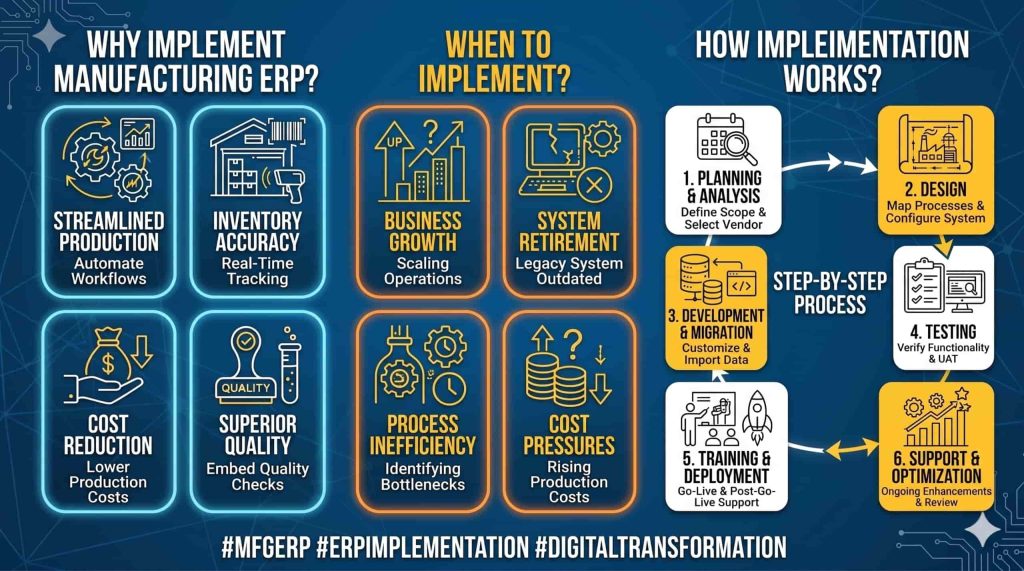
A successful ERP implementation starts with careful planning. Businesses should first understand their current processes, goals, resources, and ERP readiness.
A structured approach can reduce implementation risks. It can also help employees adopt the new ERP system with greater confidence.
What Is ERP Implementation?
ERP implementation is the process of introducing ERP software into business operations. It connects departments, processes, data, and workflows through one system.
For manufacturing businesses, a methodical manufacturing ERP implementation should begin with an ERP readiness audit.
The audit helps a business understand its current position. It should review several important areas, such as:
Current business performance
Future business plans
Investment capacity
Company culture
Human resources
Business expectations
ERP objectives
Existing business processes
The company can then review the audit findings. Management should evaluate the recommendations before starting the implementation.
Why Is an ERP Readiness Audit Important?
An ERP readiness audit gives businesses a clear starting point. It helps identify process gaps before implementation begins.
Businesses should not reject ERP simply because the audit reveals challenges. Instead, they should address those challenges before implementation.
Legacy systems often create fragmented processes. ERP can help businesses connect these processes through one integrated platform.
Therefore, companies should focus on business process improvement and proper ERP adoption.
Create an ERP Implementation Blueprint
Every ERP project needs a clear implementation plan. The blueprint should define the major activities and expected outcomes.
It should cover:
Data migration
ERP configuration
Master data preparation
Process analysis
User training
Testing
Go-live planning
Post-implementation support
The project team should also assign time to each activity. A realistic schedule helps the team manage the project more effectively.
Focus on ERP Master Data
Master data plays a major role in ERP implementation. Therefore, businesses should give enough time to prepare and validate it.
The team should identify, clarify, and validate important master data. It should also test the data before the ERP system goes live.
Key master data can include:
Item master
Customer master
Vendor master
Product information
Tax information
Pricing information
Accounting information
Poor master data can create problems after go-live. Therefore, businesses should not rush this stage.
Plan User Training Alongside Implementation
User training should start during the ERP implementation process. Employees need time to understand new processes and system functions.
eresource recommends practical ERP training for users. One useful approach involves visiting an actual ERP implementation site.
Users can observe real workflows in such environments. This practical experience can make ERP concepts easier to understand.
In addition, companies should provide regular training and knowledge updates. Continuous learning can reduce user resistance and improve adoption.
Prepare Users Before ERP Go-Live
Go-live requires careful preparation. The organization should prepare users for possible issues and process changes.
The implementation team should test the ERP system before the final launch. Users should also understand their roles and responsibilities.
A gradual approach can help employees build confidence.
For example, one manufacturing company introduced a small number of daily ERP transactions first. Users completed selected transactions in ERP without entering them into the legacy system.
The ERP system then generated the required documents and reports. Users compared the results with their existing process.
This approach helped users understand the ERP workflow. It also reduced resistance to the new system.
Should You Implement ERP Module by Module?
Businesses often ask whether they should implement ERP modules one at a time. There is no single approach for every organization.
The right strategy depends on several factors:
ERP readiness
Available internal resources
Consulting support
Number of business locations
Business requirements
Implementation timeline
Project budget
Some organizations may choose a phased rollout. Others may implement several modules together at one location.
A practical approach is to implement the required modules at one site first. The company can then expand the ERP system to other locations.
ERP Implementation and Business Process Reengineering
Business Process Reengineering, or BPR, often creates questions during ERP implementation.
Some companies ask whether they should complete BPR before implementing ERP. Others prefer to introduce BPR during ERP implementation.
BPR focuses on improving business processes. ERP provides the technology platform that supports those processes.
Therefore, businesses should connect BPR with their ERP strategy. The implementation team can identify process improvements during the ERP project.
The company should also involve users in this process. User training can help employees understand why new processes matter.
How ERP Supports Business Process Improvement
ERP implementation can encourage businesses to review existing workflows. Teams can identify unnecessary steps and improve process efficiency.
This review can create a smoother transition to the new ERP system.
However, businesses should avoid making too many changes at once. A structured approach can help employees adapt more easily.
The goal should remain simple: improve processes while implementing the ERP system.
Key Factors for Successful ERP Implementation
A successful ERP project requires more than software installation. Businesses need a clear strategy and strong project management.
The key factors include:
Conduct an ERP readiness audit
Create a detailed implementation plan
Prepare master data carefully
Set realistic timelines
Train users early
Test the ERP system thoroughly
Prepare users for go-live
Monitor implementation progress
Manage business process changes
Provide post-implementation support
These steps can help businesses reduce implementation risks and improve ERP adoption.
Conclusion
ERP implementation requires careful planning and active user involvement. Businesses should start with a readiness audit and create a clear implementation blueprint.
Master data, user training, testing, and go-live preparation also need proper attention. Furthermore, companies should connect ERP implementation with business process improvement.
With the right strategy, businesses can make ERP adoption smoother. They can also improve process visibility, user confidence, and long-term business performance.
You can also explore ERP system solutions and understand how ERP can support different business requirements.
Also Read – ERP for packaging industry