ERP Implementation and ROI: How the Right Go-Live Protects Your Returns
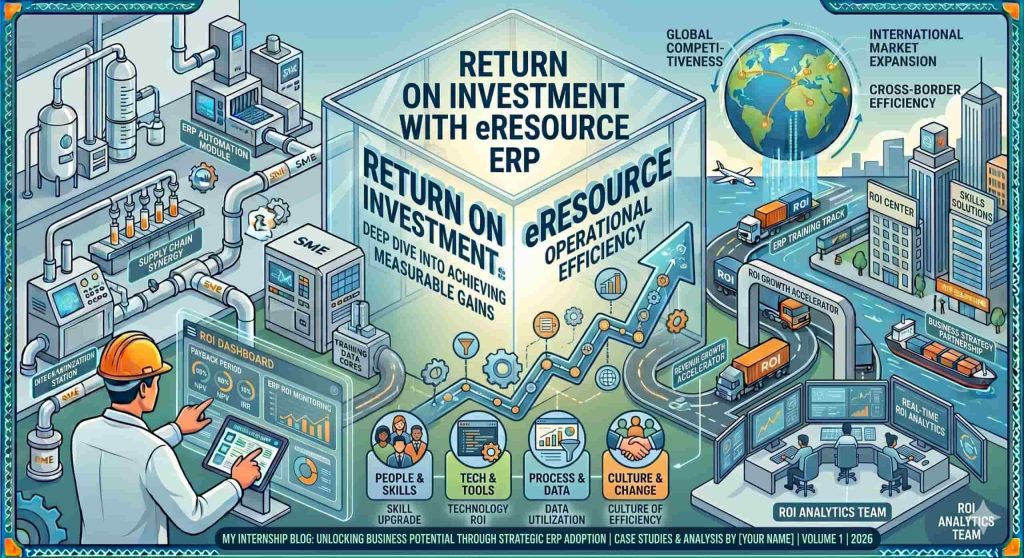
Successful implementation of ERP is not the only objective of the eresource project management team. The real goal is to help your business achieve a return on investment (ROI) in the shortest possible time. After all, an ERP that goes live but delivers returns slowly is still an expensive system. This article explains what ROI really means in an ERP project, the implementation issues that delay it, and how to protect your returns from day one.
ROI Is More Than Financial Gain
Return on investment does not only mean financial gain. It also shows up as:
- Growth in productivity and efficiency across departments
- Overall improvement in company performance
- Better transparency in daily operations
- Higher user satisfaction, because people work with one reliable system
Moreover, eresource ERP implementation brings together the people, materials, and processes of an organization. As a result, it often improves the working culture itself — a benefit no spreadsheet can deliver.
Want to put a number on these gains? Read our guide: How to Calculate ERP ROI
Common Issues in ERP Implementation
Most ROI delays come from three avoidable issues. Here is each one, with its fix.
“Our Business Is Unique” — The First Hurdle
Every organization has its own culture and structure. Therefore, teams naturally feel skeptical about ERP — they believe their business is too different for a packaged system. However, this concern rarely holds. The eresource ERP package incorporates the best industry practices, and we upgrade it continually to suit most industry segments.
Skipping the BPR Study
A thorough Business Process Re-engineering (BPR) study must happen before implementation begins. The study maps your current processes and adapts them where needed, so the go-live runs smoothly. Skip it, and users end up frustrated. Frustration leads to poor participation — and poor participation causes costly delays that eat directly into ROI.
Expecting the Package to Fit 100%
No ERP package fits an organization’s existing practices completely. Instead of resisting this, users should work with the implementation consultants and adapt to the package. This is not a compromise on business effectiveness. In fact, by accepting the package, your team adopts best-of-breed business practices — and that is what makes the new system succeed.
Set Realistic Expectations After Go-Live
Users should not expect their workload to reduce immediately after implementation. An ERP package is an enabling tool. It improves the flow of information and formalizes the business processes and workflow that already exist in your organization. In other words, it helps people do their jobs better — which may call for additional effort at first.
More information in the system does mean more structured work for some users. However, the benefit is clear: that information is properly stored, and other users can apply it to make better decisions. As information flow improves across the organization, the company performs better. Consequently, every user who contributed gains from a collectively improved way of working. This is where the real benefits of ERP compound year after year.
How eresource Protects Your Implementation ROI
The single biggest destroyer of ERP ROI is an implementation that runs late and over budget. Therefore, eresource follows a fixed-cost, guaranteed on-time implementation model, backed by a dedicated BPR study and structured user training. Your payback period stays protected, because the cost side of the ROI equation cannot quietly grow.
Also Read – Construction ERP Software in UAE
Also Read – Manufacturing ERP Software in UAE
Frequently Asked Questions
Common questions about ERP implementation and ROI
What is ROI in an ERP implementation?
ROI measures the value an ERP delivers against its cost. It includes financial gains along with improvements in productivity, efficiency, transparency, and user satisfaction.
Why do some ERP implementations fail to deliver ROI?
The most common reasons are skipping the business process (BPR) study, poor user participation, unrealistic expectations after go-live, and delays that increase implementation costs.
How can a business achieve ERP ROI faster?
Complete a BPR study before go-live, train users thoroughly, follow a fixed-cost and on-time implementation plan, and track the expected benefits after the system is live.
Does workload reduce immediately after ERP implementation?
Not immediately. ERP is an enabling tool, and entering complete information may need extra effort at first. The payoff comes as that information improves decisions and performance across the organization.