Every business wants its people to achieve more in less time. Yet staff often lose hours to retyping data, searching for files and waiting for approvals. Raising productivity with ERP tackles these losses at the root. Instead of patching each problem, it gives your whole company one connected system to work from.
In this post, we look at where productivity slips away and how eresource wins it back. We also share a few numbers to track, so you can measure the gains.
Where Productivity Slips Away
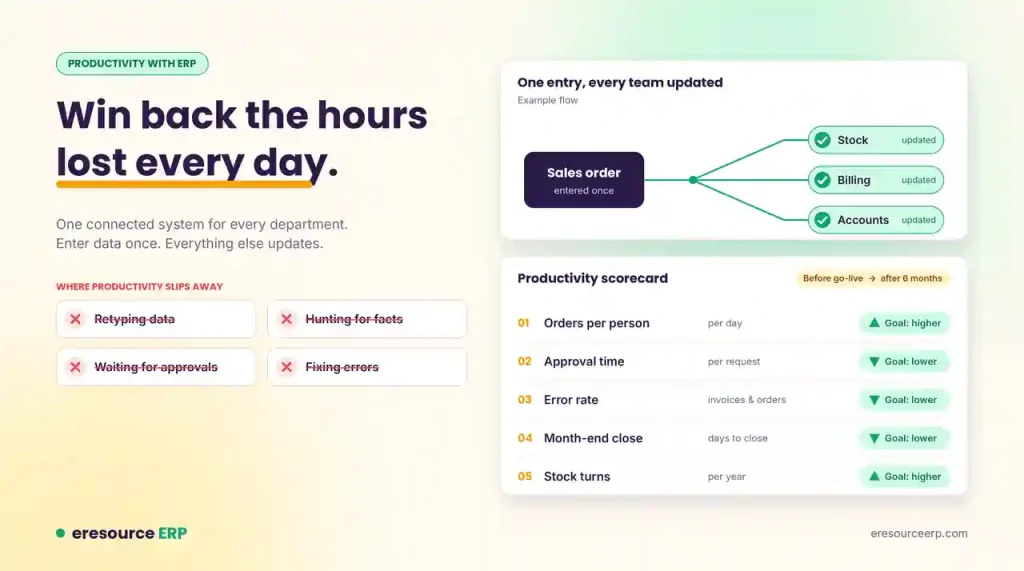
Most productivity losses hide in everyday tasks. Here are the most common ones:
- Retyping data: The same order goes into sales, stores and accounts by hand.
- Hunting for facts: Staff call or email other teams to find stock or payment status.
- Waiting for approvals: Requests sit in inboxes while managers travel.
- Fixing errors: Typing mistakes lead to wrong invoices and repeat work.
Each loss looks small on its own. Together, however, they can eat up a large share of every working day.
How to Raise Productivity With ERP
eresource puts every department on one shared database. So when someone enters an order, stock, billing and accounts update at the same moment. Nobody types the same data twice.
Moreover, the system captures accurate and timely data from every part of the business. Managers then use it to make faster, smarter decisions. Learn how real-time ERP puts today’s numbers in front of every team.
Productivity With ERP Across the Business
When ERP runs well, the effect shows up at every level of your operations:
- Leaner stock: You hold less inventory because you can see real demand.
- Fewer admin hours: Staff spend less time on paperwork and data entry.
- Better order and cash flow: Orders, invoices and payments move without delays.
- Faster replies: Teams answer customers using live data.
- Lower IT costs: One system replaces many separate tools.
- More time for growth: People focus on value-adding work instead of admin.
Faster Transactions Online
Today, a great deal of business happens online. Companies accept card and online payments, and they share orders and invoices digitally.
As a result, each transaction takes far less time. The steps behind it also run automatically, so staff do not have to push each one along. A web-based ERP like eresource forms the backbone for this kind of digital business. For the full picture, read about operational efficiency with ERP and eBusiness.
A Smoother Supply Chain
Leading firms keep improving the way they serve clients, and this lifts their profit margins too. To do that, they connect the whole supply chain.
In a connected chain, information, materials and money move quickly in both directions. For example, the purchase module raises orders from live stock and sales data. In turn, buyers and planners spend less time chasing suppliers. See how this also helps you reduce cycle time.
Know Your Customers Better
Customer loyalty changes quickly, because buyers can find better offers online in seconds. Therefore, you need to learn what each customer wants before a rival does.
A good CRM helps you track preferences and buying patterns. With eresource CRM built into the ERP, your sales team sees orders, payments and service history in one place. As a result, reps spend less time searching and more time selling. Learn more about ERP for sales teams.
Efficiency Comes Before Service
Personal service matters, but it cannot make up for slow, messy operations. Customers soon notice late orders and wrong invoices.
So build a strong base first. A well-run ERP improves efficiency and connects your information. Once that base is in place, every other effort, from sales to service, works better.
Work From Anywhere
Because eresource runs on the web, authorised users can reach the information they need from anywhere, at any time. In addition, the mobile ERP app lets managers approve requests on the go. So work keeps moving even when people are away from their desks.
How to Measure Productivity With ERP
Productivity compares what you produce with the time and effort it takes. To track your gains, measure these numbers before go-live and again after six months:
- Orders per person: How many orders each staff member handles per day.
- Approval time: How long a typical request waits for sign-off.
- Error rate: How many invoices or orders need correcting.
- Month-end close: How many days it takes to close the books.
- Stock turns: How often your stock sells and refills in a year.
Raise Productivity With ERP Using eresource
eresource has helped businesses do more with less effort since 2006. It also offers ready industry-specific editions that fit your sector from day one. To see it on your own processes, book a free ERP demo.
Also Read – ERP Software for Construction Industry
FAQs About Productivity With ERP
How does ERP improve productivity?
ERP puts every team on one shared database. So staff stop retyping data, find facts faster and wait less for approvals.
Where do businesses lose the most productivity?
Most losses come from retyping data, hunting for information, waiting for approvals and fixing errors.
Can managers approve requests away from the office?
Yes. The eresource mobile app lets managers approve requests on the go, so work keeps moving.
How do we measure productivity gains from ERP?
Track orders per person, approval time, error rate, month-end close and stock turns. Then compare them before go-live and after six months.
Does CRM help sales productivity?
Yes. With CRM inside the ERP, reps see orders, payments and service history in one place. So they spend more time selling.