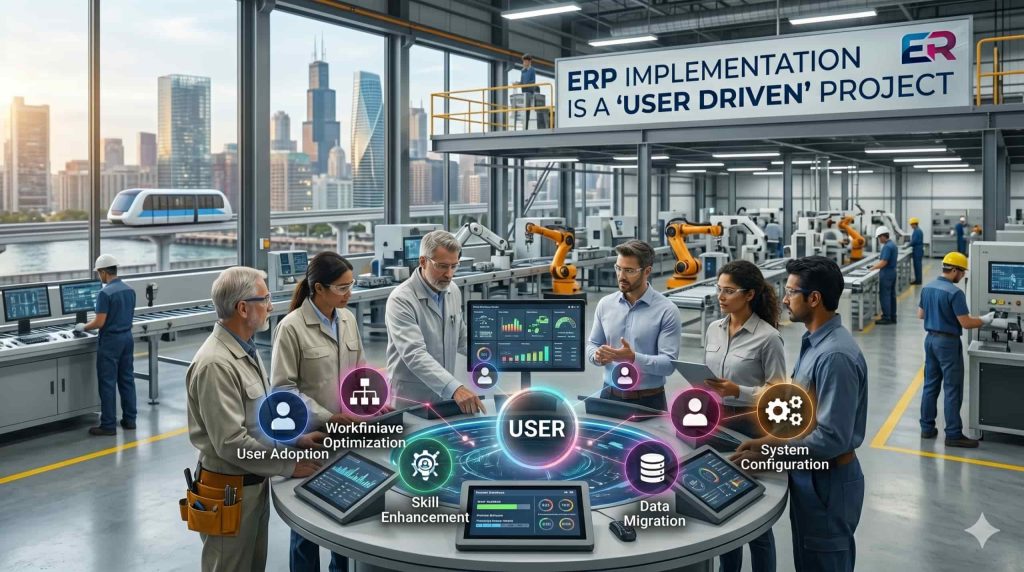
Why ERP Implementation Is a User-Driven Project
Software alone never decides the success of an ERP project. People do. The employees who run your processes every day — and the way they engage with the new system — determine whether the implementation delivers or disappoints. That is why eresource treats every ERP implementation as a user-driven project. This article explains what that means in practice: what users must accept, what consultants bring, and where management fits in.
What Users Must Accept First
Every organization has its own culture and structure, so teams naturally feel their business is too unique for a packaged system. However, a modern ERP package incorporates best industry practices and receives continuous upgrades to suit most industry segments. For the project to succeed, users must accept three realities early:
- No package fits 100%. Adapting to it is not a compromise — it means adopting best-of-breed business practices.
- No instant miracle. ERP is an enabling tool; workload may even rise at first, while information quality and decisions improve.
- A process study comes first. A dedicated BPR study before go-live prevents frustration, poor participation, and costly delays.
We covered these expectations in depth in ERP Implementation and ROI. Here, the focus is the people who make them work.
The Consultant’s Role: Expert, Not Owner
Consultants bring two things the organization lacks: industry experience and package expertise. With these, they help set user expectations at every level, always keeping the client’s overall business objectives in mind.
However, remember one thing: a consultant is an external agent. The organization’s business processes belong far more to the management team and the users than to any consultant. Therefore, a project that leaves everything to the consultant builds a system nobody owns.
How Consultants and Key Users Work Together
The right model pairs the consultant with key users from each department. Together, they:
- Understand the real needs of each process
- Analyze the business realities on the ground
- Design solutions that meet the company’s basic objectives
Then comes the harder part. Consultants must convince users that individual needs can be met by keeping the organization’s needs in mind. A system tuned to one person’s convenience fails everyone else; a system tuned to the organization serves each user better in the end.
Management Guides, Users Drive
The consultants and the management team share one responsibility: guide the users and facilitate the overall implementation. Management sponsors the project, removes roadblocks, and keeps objectives visible. Consultants supply the method. But the daily transactions, the data, and the adoption all come from users. In essence, successful ERP implementation is predominantly a user-driven project — and companies that staff it that way go live faster and get more from the system.
How eresource Runs User-Driven Implementations
eresource builds this philosophy into its fixed-cost, on-time implementation model. Key users join the project from the BPR study onward, structured training continues after go-live, and the web-based system makes information available to every authorized user from day one. The result: a system your people own, not one they merely tolerate.
Also Read – ERP Software for Furniture Industry