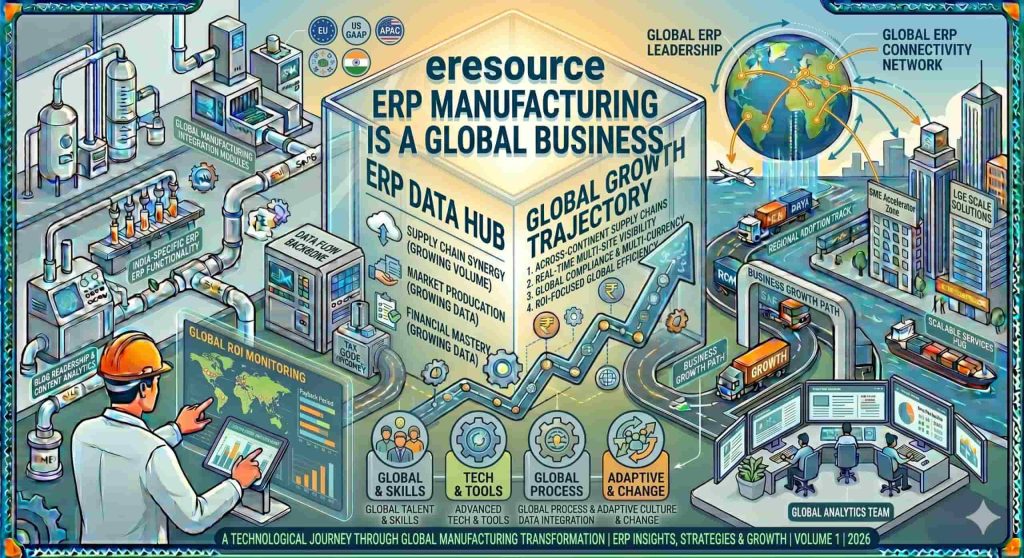
ERP for Global Manufacturing: How eresource Makes Manufacturing a Global Business
The speed of information flow has made manufacturing a global business. Today, a mid-sized factory in India competes for the same orders as giants abroad — because both now access the same quality of information. The computer changed how we conduct business, and it allowed small companies to grow into leaders in their industries. Consequently, the question is no longer “where can I get the information I need?” The question is “what do I do with all the information I have?” ERP for global manufacturing answers exactly that.
Same Data, Different Information
Different people need the same data in different forms. Shop floor workers need real-time information about the process and production. Executives need a different view of that same data for long-range planning and short-term deployment. Same data; different information. As databases grow larger every year, companies need a system that converts raw data into the right information for each role. ERP strives to do precisely this: it combines the functions of every application a company requires and integrates them all under one umbrella.
Managing Multi-Plant, Multi-Country Operations
Global manufacturing means balancing customer demands across multiple interrelated items and multiple plant locations. ERP adds financials, supply chain, distribution, and requirements planning for every site. Moreover, it supports intelligent resource planning against rapidly changing constraints — materials availability, market readiness, plant capacities, personnel certification, and business costs per location. In short, ERP lets decision-makers run an intelligent, agile, and responsive organization in the global marketplace.
Information Starts at the Machine
In modern manufacturing operations, information starts at the top and the bottom simultaneously. Data originates at the machines, the processes, and the workers. It shows what the plant is making, how and where, when the job will finish — and why it won’t be on time. With that visibility, managers act on problems before customers feel them.
Leaner Shipping and Distribution
ERP also makes a difference at the shipping end. Shipments can go direct, so they become smaller and cheaper. In addition, the company no longer needs to stock materials or finished units in bulk. Therefore, stock does not become obsolete, and nothing gets written off.
Sales Teams Need the Complete Customer Picture
Information matters even before manufacturing begins — in the sales effort. The sales cycle keeps getting faster, so information systems must keep pace. Every salesperson needs a complete view of all activity with a customer: sales history, trouble calls, service requests, repairs, and every enquiry in between. For teams serving overseas customers, product and customer information is the most valuable asset of all.
Web-Based ERP Breaks the Company Walls
ERP is not confined within the walls of a single entity. With a web-enabled ERP such as eresource, data flows out to suppliers and vendors, customers and prospects. What you learn can be shared with one person — or thousands — the moment you learn it. As a result, design and product development become collaborative processes without barriers of space and time. Everyone works as if they sit in the same office, regardless of where they actually are.
Levelling the Global Playing Field
eresource Infotech’s web-based ERP, with its real-time alert capabilities, has levelled the playing field. Company size matters far less when a mid-sized manufacturer puts the same product and customer-service information in its customers’ hands as any global giant. Furthermore, the organization can offer direct ordering and order management through the web-based system. This lowers the cost per order and frees the team to focus on customers instead of routine tasks.
Keep Up with Global Demands
Thanks to modern solutions like eresource ERP for manufacturing, manufacturers have a better-than-ever chance of keeping up with the rising demands their customers place on them — wherever in the world those customers are.
Also Read – ERP for Plastic Manufacturing Industry
Also Read – Best Trading ERP Software
Frequently Asked Questions
Common questions about ERP for global manufacturing
How does ERP support global manufacturing operations?
ERP balances customer demand across multiple plants and locations, with financials, supply chain, distribution, and requirements planning for every site on one integrated system.
Why is web-based ERP important for multi-location manufacturers?
A web-based ERP connects every plant, warehouse, and office on one live system, and extends data flows to suppliers and customers — so teams collaborate as if they sit in the same office.
Can a mid-sized manufacturer compete globally with ERP?
Yes. Web-based ERP levels the playing field by giving mid-sized companies the same quality of information, customer service capability, and direct-ordering facilities as much larger competitors.
What information does manufacturing ERP capture from the shop floor?
Data originates at the machines, processes, and workers — what is being made, how and where, when it will finish, and why a job may run late — giving managers real-time production visibility.