Skip to content


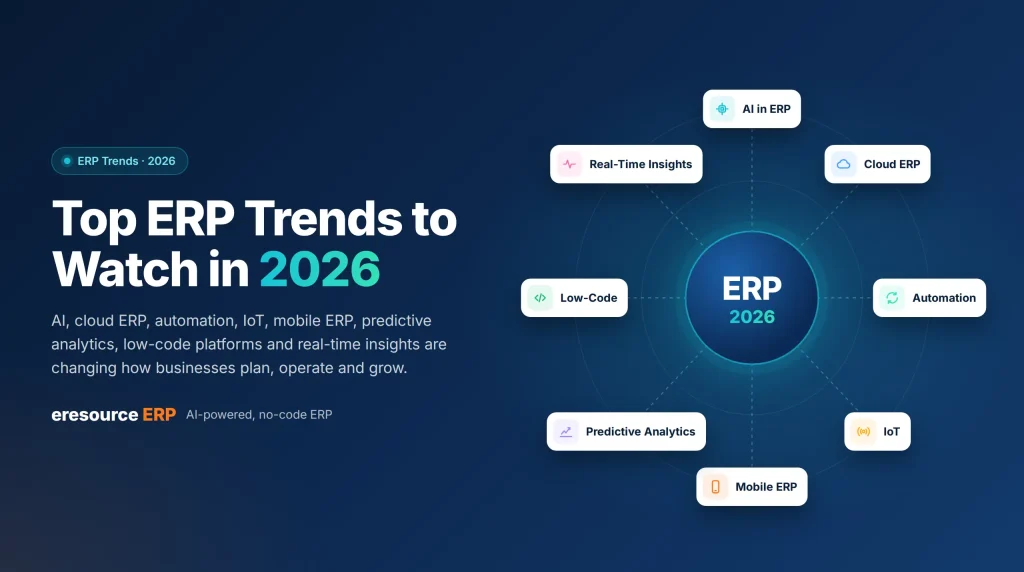
ERP Trends 2026: Emerging Trends in Enterprise Resource Planning
Enterprise Resource Planning (ERP) systems have changed significantly over the years.
Traditional ERP systems mainly helped businesses record transactions and manage core operations. Modern ERP platforms now combine business processes with cloud technology, artificial intelligence, automation, analytics, mobile access and connected devices.
These changes are creating new ERP trends for businesses across manufacturing, construction, trading, logistics and other industries.
Companies now expect ERP software to do more than store business data. They want real-time information, automated workflows, predictive insights and flexible access from different locations.
In this article, we explore the major ERP trends in 2026 and explain how they are changing enterprise business management.
What Is ERP?
Enterprise Resource Planning is business management software that connects different departments through a centralized system.
An ERP system can integrate:
Finance and accounting
Sales and CRM
Purchase
Inventory
Manufacturing
Project management
Human resources
Payroll
Supply chain
Quality management
Reporting and analytics
ERP creates a common data foundation for business operations.
Modern ERP systems are now moving beyond transaction processing. They increasingly combine ERP data with AI, automation, analytics, IoT and mobile technologies.
Why Are ERP Trends Changing?
Business operations are becoming more connected and data-driven.
Companies manage multiple locations, digital sales channels, distributed teams and complex supply chains. They also need faster access to operational information.
Traditional systems may not provide enough flexibility for these requirements.
Modern ERP trends are therefore focused on:
Automation
Real-time data
Artificial intelligence
Predictive analytics
Cloud access
Mobile workflows
Digital integration
Better user experience
Faster customization
Connected operations
These developments are changing how businesses select and use ERP software.
10 Major ERP Trends in 2026
1. AI-Powered ERP
Artificial intelligence is one of the most important ERP trends.
AI can analyze large volumes of business data and identify patterns. It can also support automation, forecasting and decision-making.
AI-enabled ERP systems can support use cases such as:
Demand forecasting
Sales analysis
Inventory prediction
Cost analysis
Anomaly detection
Automated reporting
Intelligent recommendations
Conversational assistance
Current eresource ERP materials describe AI integration across analytics, automation and business processes.
The direction is moving from ERP as a system of record toward ERP as a more intelligent business platform.
2. Generative AI in ERP
Generative AI is adding another layer to ERP software.
Traditional ERP reports require users to select filters and analyze tables. Generative AI can provide a conversational interface for business information.
For example, a manager could ask:
Which customers have overdue payments?
The system could analyze relevant ERP data and present the result.
Generative AI can also support:
Report generation
Business summaries
Data analysis
Scenario planning
Workflow assistance
Natural-language queries
Current ERP developments include generative AI, machine learning, natural language processing and predictive analytics.
3. Cloud ERP Adoption
Cloud ERP continues to change how businesses deploy enterprise software.
Instead of maintaining ERP infrastructure entirely on company premises, businesses can use cloud-based systems.
Cloud ERP can provide:
Remote accessibility
Easier scalability
Centralized updates
Reduced infrastructure requirements
Flexible user access
Faster deployment
Current eresource ERP information describes cloud and hybrid deployment models as part of its approach to scalability and business continuity.
Cloud ERP is particularly useful for businesses with multiple locations and distributed teams.
4. Hybrid ERP
Not every organization wants to move all business systems to the cloud.
Some companies need a combination of cloud and on-premise infrastructure.
This is where hybrid ERP becomes relevant.
A hybrid ERP model can allow organizations to keep selected workloads or data within their own infrastructure while using cloud services for other requirements.
This approach can help businesses balance:
Control
Accessibility
Security requirements
Scalability
Existing infrastructure
The right deployment model depends on business requirements and IT strategy.
5. ERP Automation
Automation is becoming a major part of modern ERP.
ERP systems can automate repetitive processes and reduce manual intervention.
Examples include:
Purchase approvals
Invoice processing
Payment workflows
Stock alerts
Sales order processing
Employee approvals
Notifications
Report generation
Workflow escalation
Automation can reduce repetitive work and improve process consistency.
AI can make these workflows more intelligent by identifying patterns and triggering actions based on business data.
6. Predictive Analytics
Traditional ERP reporting explains what happened.
Predictive analytics can help businesses understand what may happen next.
ERP systems can use historical and current data to support forecasting.
Examples include:
Demand forecasting
Cash-flow forecasting
Inventory forecasting
Sales forecasting
Maintenance prediction
Cost forecasting
Resource planning
AI and machine learning can improve forecasting by analyzing patterns across business data.
Predictive analytics can help managers move from reactive decisions toward more proactive planning.
7. Mobile ERP
Employees no longer work only from office desktops.
Sales teams, site engineers, warehouse employees, managers and service teams often work outside traditional office environments.
Mobile ERP allows users to access business information through smartphones and tablets.
Mobile ERP can support:
Approvals
Sales orders
Expense reporting
Time tracking
Inventory updates
Customer information
Production updates
Project activities
Business dashboards
Current eresource ERP materials describe mobile access for workflows, approvals, reporting and operational activities.
Mobile access can improve response time when employees need business information away from their desks.
8. IoT-Connected ERP
The Internet of Things is connecting physical devices with business software.
IoT-enabled ERP can receive information from connected machines, equipment, vehicles and other devices.
For example, manufacturing equipment can provide operational data to an ERP system.
This can support:
Machine monitoring
Production tracking
Predictive maintenance
Asset utilization
Supply-chain visibility
Real-time alerts
Current eresource ERP information highlights IoT readiness and API-based integration.
IoT becomes especially valuable when businesses need real-time information from physical operations.
9. Low-Code and No-Code ERP
Traditional ERP customization often requires technical development.
Low-code and no-code platforms reduce the amount of programming required for many configuration tasks.
Businesses can use these capabilities to customize:
Forms
Dashboards
Workflows
Reports
Approvals
Business rules
User interfaces
Current eresource ERP information highlights low-code/no-code capabilities for faster configuration and customization.
This trend can help businesses adapt ERP workflows as their processes change.
10. Real-Time Analytics and Intelligent Dashboards
Businesses generate large amounts of operational data every day.
Managers need more than static reports. They need information that helps them understand current business performance.
Modern ERP systems increasingly provide:
Real-time dashboards
KPI monitoring
Drill-down reports
Multi-dimensional analytics
Exception alerts
Operational summaries
Current eresource ERP describes multi-dimensional reporting and Dashboard Studio as part of its platform capabilities.
Real-time analytics can help managers identify problems earlier.
ERP and Business Intelligence
ERP and business intelligence are becoming increasingly connected.
ERP provides structured business data. Analytics tools can use that data to identify trends and performance patterns.
For example, management can analyze:
Sales by region
Customer profitability
Inventory turnover
Project profitability
Production efficiency
Purchase performance
Outstanding receivables
This allows organizations to use ERP data for more informed planning.
ERP Integration With Other Business Systems
Modern businesses rarely operate with ERP alone.
Companies may also use:
CRM platforms
E-commerce systems
Payment gateways
Banking systems
HR platforms
Logistics applications
Manufacturing equipment
Business intelligence tools
API-based integration allows these systems to exchange information.
Current eresource ERP information describes API readiness for connecting third-party applications and IoT devices.
Better integration reduces data silos and improves information flow.
Industry-Specific ERP
Another important ERP trend is industry specialization.
Different industries have different processes and compliance requirements.
For example:
Manufacturing ERP
Manufacturing businesses need:
BOM
MRP
Production planning
Shop-floor management
Quality
Inventory
Manufacturing costing
Construction ERP
Construction companies need:
BOQ
Tender management
Project estimation
Procurement
Subcontractor management
Site operations
Progress billing
Project costing
Trading ERP
Trading companies often need:
Sales
Purchase
Inventory
Warehousing
Pricing
Customer management
Financial management
Industry-specific ERP can provide workflows that better match the organization’s operating model.
ERP for Small and Medium Businesses
ERP is no longer limited to large enterprises.
Cloud deployment, modular architecture and easier configuration have made ERP more accessible to smaller organizations.
Small and medium businesses can use ERP to manage:
Finance
Inventory
Sales
Purchase
Customer relationships
Operations
Reporting
Businesses should still select ERP based on actual requirements rather than company size alone.
ERP and Cybersecurity
As ERP systems become more connected, security becomes increasingly important.
ERP systems contain sensitive business information.
Modern ERP security strategies can include:
User authentication
Role-based access
Data encryption
Activity logs
Approval controls
Backup systems
Access monitoring
Companies should review security capabilities during ERP selection and implementation.
ERP and Sustainability
Sustainability is becoming more relevant to business management.
ERP can help organizations track information related to:
Energy consumption
Material usage
Waste
Transportation
Procurement
Resource utilization
Businesses can use this information to identify areas where resources can be used more efficiently.
The exact sustainability capabilities depend on the ERP platform and business configuration.
ERP Moving Toward Intelligent Business Management
The direction of ERP is changing.
Traditional ERP primarily records transactions.
Modern ERP increasingly combines:
ERP + AI + Automation + Analytics + Cloud + IoT + Mobile
This combination can create a more connected business management environment.
The objective is not simply to collect more data. The objective is to make business data more useful.
AI can analyze data.
Automation can execute repetitive workflows.
Analytics can identify trends.
IoT can provide information from physical operations.
Mobile applications can make information available to employees wherever they work.
Together, these technologies can make ERP more responsive.
Benefits of Following Modern ERP Trends
Businesses that adopt relevant ERP capabilities can gain several operational benefits.
Better Decision-Making
Real-time dashboards and analytics provide better visibility into business performance.
Faster Processes
Automation can reduce repetitive manual work.
Better Forecasting
Predictive analytics can support demand, inventory and financial planning.
Greater Accessibility
Cloud and mobile ERP allow users to access information from different locations.
Improved Integration
APIs can connect ERP with other business applications.
Greater Flexibility
Low-code and no-code tools can simplify business process customization.
Better Operational Visibility
IoT and connected systems can provide information from physical operations.
How to Prepare for the Future of ERP
Businesses should not adopt every new technology simply because it is available.
Instead, companies should identify the processes that need improvement.
A practical approach includes:
Review current business processes.
Identify manual and repetitive activities.
Find data silos.
Identify reporting gaps.
Evaluate integration requirements.
Define automation opportunities.
Review AI use cases.
Evaluate cloud and hybrid deployment options.
Plan mobile access requirements.
Measure results after implementation.
This approach helps businesses connect ERP investment with measurable business requirements.
How eresource ERP Is Evolving With ERP Trends
eresource ERP currently positions its platform around multiple modern ERP capabilities.
The platform describes:
AI-powered ERP
Cloud and hybrid deployment
Low-code/no-code configuration
Mobile ERP
IoT and API integration
Multi-dimensional reporting
Dashboard customization
Industry-specific ERP solutions
The current platform includes products for manufacturing, construction, logistics, trading and other business requirements.
The company also describes Azaalea AI as part of its intelligent ERP direction.
Conclusion
ERP is moving beyond traditional transaction management.
The latest ERP trends in 2026 show a clear movement toward intelligent, connected and automated enterprise systems.
AI, generative AI, cloud ERP, predictive analytics, mobile access, IoT, automation, low-code platforms and real-time dashboards are changing how businesses use ERP software.
The future of ERP is not simply about storing business information. It is about connecting data, processes and people so organizations can respond to business changes more effectively.
Businesses should evaluate these trends based on their own processes, industry requirements, technology environment and growth plans.
A well-planned ERP strategy can provide the foundation for more connected and data-driven business operations.
Frequently Asked Questions
Common questions about ERP trends and the future of ERP
What are the latest ERP trends in 2026?
Major ERP trends include AI-powered ERP, generative AI, cloud ERP, hybrid ERP, automation, predictive analytics, mobile ERP, IoT integration, low-code/no-code platforms and real-time analytics.
What is the future of ERP?
The future of ERP is moving toward more intelligent, connected and automated business management. AI, analytics, automation, IoT and cloud technologies are becoming more closely integrated with ERP platforms.
How is AI changing ERP?
AI can analyze ERP data, support forecasting, automate selected tasks, identify anomalies and provide business insights.
Is cloud ERP still an important trend?
Yes. Cloud ERP remains an important deployment model because it can support remote access, scalability and centralized system management.
What is mobile ERP?
Mobile ERP allows employees to access selected ERP functions through smartphones and tablets. It can support approvals, reporting, data entry and operational workflows.
What is IoT-enabled ERP?
IoT-enabled ERP connects ERP software with connected devices and equipment. This can provide real-time operational information from machines, vehicles and other physical assets.
What is low-code ERP?
Low-code ERP uses visual configuration tools to help businesses customize forms, workflows, dashboards and other functions with less traditional programming.
Will AI replace ERP?
AI is more likely to become integrated with ERP than replace ERP completely. ERP provides structured business data and workflows that AI can use for analysis, automation and decision support.