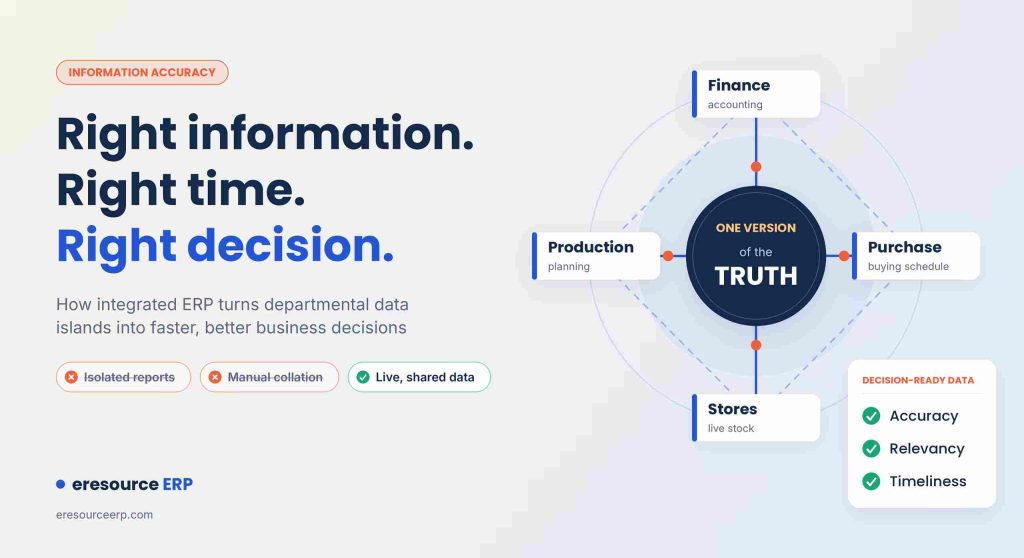
Information Accuracy and Decision-Making: eresource ERP’s Core Strength
In today’s competitive business environment, the key resource of every organization is information. An organization that cannot give its decision-makers the right information at the right time stands a very remote chance of succeeding. This article explains the three characteristics good information must carry, why legacy systems fail to deliver them — and how an integrated ERP turns information accuracy into decision-making capability.
The Three Characteristics of Useful Information
Information earns its value through three fundamental characteristics:
- Accuracy — the numbers must be correct
- Relevancy — the information must matter to the decision-maker’s question
- Timeliness — it must arrive when the decision-maker needs it, not after
An organization that collects, collates, analyzes, and presents high-quality information to its employees enables better decisions at every level. Consequently, it stays one step ahead of the competition. Moreover, the time available to react to market trends keeps shrinking — so any mechanism that automates this gathering and analysis directly improves the odds of beating competitors.
Why Legacy Systems Fail the Test
The major drawback of legacy systems was the lack of an integrated approach. The finance department ran an accounting system. Manufacturing ran a production planning system. Stores ran an inventory management system. Each performed in isolation.
So what happened when someone needed information that spanned two systems? They pulled a report from each, then correlated and combined the data by hand. For any question involving more than one department, this became a difficult, slow task. No executive can take good decisions from such isolated data — and even when the collation succeeds, the valuable time lost in assembling it was time stolen from the decision itself.
What Integration Changes
An organization cannot function as islands of departments, because every department’s data feeds another’s work:
- The purchase department needs production planning details — with them, it builds the purchasing schedule at the right time
- The finance department needs purchase details — the moment a purchase enters the system, finance plans the cash flow it will require
- The purchase section needs stores data — live stock decides what actually needs buying
Integrate these islands into a single system, and the impact is dramatic. Each department works from the others’ live data instead of last week’s reports.
One Entity, One Version of the Truth
With the implementation of the eresource ERP system, the organization functions as a single entity that serves the information needs of the whole business. Every transaction enters once and appears everywhere it matters — accurate, timely, and relevant. Therefore, decision-makers spend their time deciding, not assembling.
This is eresource ERP’s strength: integration and automation. That is exactly why implementing eresource ERP improves information accuracy — and with it, the quality and speed of every business decision.
Also Read – ERP Software in Nigeria
Frequently Asked Questions
Common questions about information accuracy and ERP
How does ERP improve decision-making?
ERP puts every department's data on one database, so decision-makers receive accurate, relevant, and timely information without assembling reports from separate systems — and spend their time deciding, not collating.
What are the three characteristics of useful information?
Accuracy — the numbers are correct; relevancy — the information matters to the question at hand; and timeliness — it reaches the decision-maker when needed, not after the moment has passed.
Why do legacy systems weaken decision-making?
Legacy systems run in department-wise isolation. Any question spanning two departments means pulling separate reports and combining them by hand — slow work that produces stale, error-prone answers.
How does ERP integration help departments work together?
Each department sees the others' live data: purchase reads production plans to schedule buying, finance reads purchases to plan cash flow, and stores data shows what genuinely needs ordering.