Manufacturing ERP Software for SMEs and Growing Businesses
Choosing the right manufacturing ERP software can help manufacturing companies manage their business operations more efficiently. An integrated ERP system connects important departments, improves data visibility, and helps businesses manage key processes from one central platform.
For small and medium-sized enterprises (SMEs), this can be especially useful. Instead of managing different processes through separate systems, businesses can connect production, inventory, purchasing, sales, finance, and other business functions through an integrated ERP system.
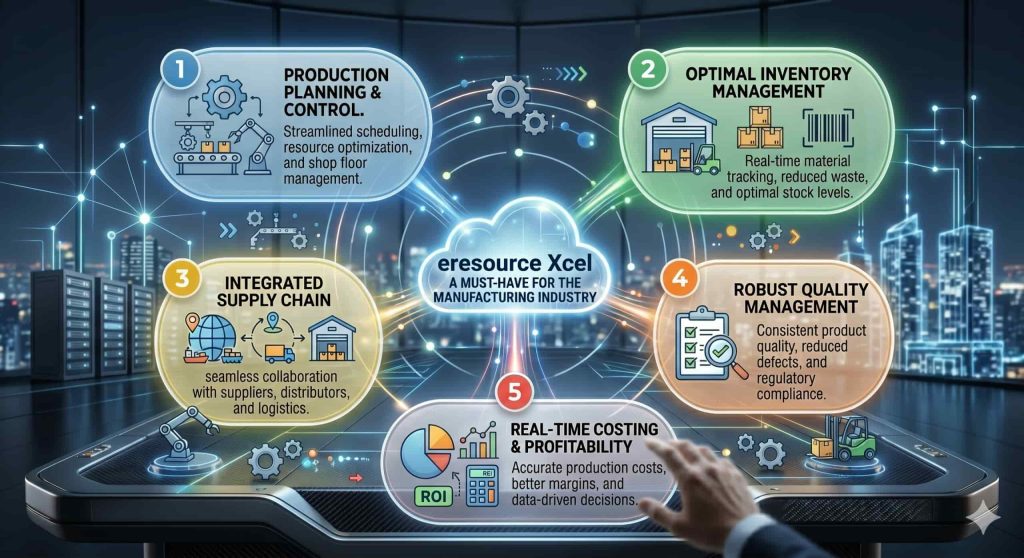
eresource Xcel ERP is designed to support the operational requirements of manufacturing businesses. It brings different business functions together and helps organizations create standardized processes. As a result, businesses can improve communication, access reliable information, and make better business decisions.
An ERP System Designed for Manufacturing Companies
Manufacturing companies manage many activities every day. These activities include purchasing raw materials, managing suppliers, planning production, controlling inventory, processing sales orders, managing finances, and delivering finished products.
However, managing these activities through separate systems can make communication and coordination more difficult. Therefore, an integrated manufacturing ERP system can help connect different business functions within one platform.
eresource Xcel helps connect suppliers, vendors, customers, departments, and branches operating at different locations. As a result, employees and management can access relevant business information more easily and coordinate day-to-day activities.
Moreover, eresource Xcel can be deployed on-premises or on the cloud, depending on the organization’s business requirements, infrastructure, and implementation preferences.
The ERP system integrates important business processes such as:
Sales management
Purchase management
Production management
Inventory management
Customer management
Vendor management
Finance and accounting
Billing
Product management
Financial reporting
By connecting these functions, manufacturing companies can reduce disconnected processes. At the same time, they can improve visibility across different areas of the business.
Manufacturing ERP Software With Essential Business Modules
A manufacturing company needs an ERP system that can support different business activities. For this reason, eresource Xcel provides a range of ERP modules designed to support the requirements of manufacturing businesses.
The system includes:
Purchase Management
Sales and Billing Management
Customer Management
Vendor Management
Product Management
Financial Reporting
Account Management
Statutory Compliance
Inventory Management
Each module supports specific business activities. At the same time, the modules work together as part of an integrated ERP system.
Purchase Management
Purchase management helps businesses organize purchasing activities and manage supplier-related information. In addition, an integrated purchasing process can help organizations coordinate procurement requirements with inventory and other business operations.
As a result, purchasing teams can work with more organized information while coordinating their activities with other departments.
Sales and Billing Management
Sales and billing management helps businesses handle customer orders, sales transactions, and billing activities through a centralized system.
Furthermore, connecting sales and billing information with other ERP functions can help businesses maintain better visibility into customer transactions and related business activities.
Vendor Management
Vendor management helps organizations maintain supplier information and coordinate purchasing-related activities.
Moreover, keeping vendor information within the ERP system can make it easier for businesses to access supplier details when required. This can also support better procurement planning and supplier communication.
Product Management
Product management provides a centralized way to manage product-related information.
In addition, it can support data exchange between different business users and departments that work with products. Therefore, employees can work with more consistent product information across the organization.
Financial Reporting and Accounting
Financial reporting and accounting are important parts of any business management system.
eresource Xcel helps finance teams record, organize, maintain, and analyze financial information generated across different business functions. Consequently, management can access financial information along with other operational data within the ERP environment.
Inventory Management
Inventory management is particularly important for manufacturing businesses. Companies need to monitor raw materials, work-in-progress, and finished goods throughout their operations.
An integrated ERP system can provide better visibility into inventory-related information. As a result, businesses can coordinate inventory activities with purchasing, sales, and other operational requirements.
eresource Xcel provides visibility into important supplier, inventory, and operational information. Therefore, management can use relevant information when making business decisions.
How Manufacturing ERP Software Helps Businesses
There are several reasons why manufacturing companies consider implementing an ERP system. First, a centralized ERP platform can improve operational transparency. Second, it can help connect business processes. Finally, it can provide more consistent access to business information.
Some key benefits include:
Improved Business Transparency
An integrated ERP system provides centralized access to operational information.
For example, management can use available information to monitor business activities and understand the status of different processes. In this way, an ERP system can provide greater visibility across the organization.
Better Data Reliability
When businesses maintain information across disconnected systems and spreadsheets, duplicate or inconsistent data can occur.
However, a centralized ERP system can help businesses maintain more consistent information across departments. Therefore, employees can work with information from a common business system.
Improved Process Integration
Manufacturing companies often manage purchasing, inventory, production, sales, finance, and supplier activities at the same time.
Without integration, these activities can become difficult to coordinate. Therefore, an ERP system connects relevant functions so that information can move between business processes more efficiently.
Reduced Operational Risk
Standardized processes and centralized information can help businesses improve process control.
Furthermore, better visibility can help organizations identify operational issues and take appropriate action. As a result, businesses can manage their processes in a more structured way.
Support for Business Growth
As a manufacturing business grows, the number of transactions, users, suppliers, products, and locations can also increase.
At the same time, managing these activities through separate systems can become more difficult. An integrated ERP platform can therefore provide a technology foundation that supports changing business requirements.
Manufacturing ERP for Small and Medium-Sized Businesses
Small and medium-sized manufacturing companies often manage multiple business functions with limited resources.
However, using separate systems for different departments can make information sharing and process coordination more difficult. For this reason, an integrated manufacturing ERP system for SMEs can bring important business functions together within one platform.
With eresource Xcel, manufacturing organizations can manage areas such as:
Procurement
Sales
Inventory
Finance
Customer relationships
Vendor relationships
Product information
Business reporting
Moreover, connecting these functions can help SMEs improve operational visibility and create more standardized processes across departments.
Improve Inventory Management With Manufacturing ERP
Inventory plays an important role in manufacturing operations. Businesses need to maintain suitable stock levels while ensuring that required materials are available for production and customer orders.
However, inventory information can become difficult to manage when it is spread across multiple systems.
An integrated ERP system can provide centralized visibility into inventory information. In addition, it can help businesses coordinate inventory with purchasing, sales, and other operational activities.
eresource Xcel provides visibility into supplier, inventory, and operational information. Therefore, management can use relevant information to support inventory and business decisions.
Manufacturing ERP for Better Business Decision-Making
Reliable and timely information is important for manufacturing management.
When business data is distributed across different systems, managers may need to collect information from several departments before making decisions. However, an integrated ERP system can provide a centralized source of business information.
As a result, executives and managers can monitor business performance using available operational and financial information. They can also identify operational issues and make decisions based on relevant business data.
Grow Your Manufacturing Business With eresource Xcel
ERP implementation can provide different benefits depending on a company’s processes, implementation approach, objectives, and user adoption.
One eresource ERP case study reports that a manufacturing company replaced its legacy systems with a web-based ERP solution. According to the case study, the company reduced inventory levels by 30%, reduced warehouse space requirements by 38%, improved its month-end closing process by five days, and increased sales by 100% without hiring additional employees.
However, these results are specific to the reported case study. They should not be considered guaranteed results for every manufacturing company. Actual ERP outcomes can vary depending on business processes, implementation quality, data quality, user adoption, and organizational requirements.
Cloud-Based Manufacturing ERP Software
Businesses can choose different ERP deployment approaches based on their requirements.
With cloud-based manufacturing ERP software, authorized users can access the ERP system through an internet-connected environment. This approach can help businesses centralize operational information while supporting access based on user roles and requirements.
On the other hand, some organizations may prefer an on-premises deployment model based on their infrastructure and business needs.
eresource Xcel can be implemented according to the organization’s preferred deployment model and requirements.
Automate Manufacturing Business Processes
Manual processes can take significant employee time. In addition, manual data entry can increase the possibility of errors.
ERP software can help businesses automate and standardize repetitive activities. As a result, employees can spend less time transferring information between different systems.
eresource Xcel supports automation and integration across areas such as:
Purchasing
Sales
Inventory
Finance
Vendor management
Customer management
Product management
Reporting
By connecting these functions, businesses can reduce manual information transfer between departments. Furthermore, they can improve coordination across their business processes.
Manufacturing ERP Software for Integrated Business Operations
A manufacturing ERP system is not limited to financial management or inventory control.
Instead, an integrated ERP platform can connect multiple business functions and provide a broader view of organizational performance.
eresource Xcel can support areas beyond core financial operations, including:
Payroll
Quality control
Resource allocation
Scheduling
Supplier relationship management
Purchasing and procurement
Training management
Time and attendance
Therefore, manufacturing organizations can use an integrated ERP environment to manage both operational and administrative activities.
Why Choose eresource Xcel Manufacturing ERP?
Every manufacturing business has its own processes, products, suppliers, organizational structure, and operational requirements.
Therefore, businesses should evaluate an ERP solution based on how well it aligns with their actual business processes and requirements.
eresource Xcel provides an integrated ERP environment for managing important business functions, including production-related operations, purchasing, sales, inventory, finance, customer management, vendor management, product management, and reporting.
Furthermore, the system can support SMEs that want to improve process integration and business visibility through a centralized ERP platform.
Conclusion
The right manufacturing ERP software can help businesses connect their operations, improve data visibility, streamline business processes, and support better decision-making.
For small and medium-sized manufacturing companies, an integrated ERP system can provide greater control over purchasing, sales, inventory, finance, customer management, vendor management, and other critical business activities.
In addition, a centralized ERP platform can help organizations create more consistent processes across departments. With the right implementation approach, businesses can use ERP technology to support their operational requirements and future growth.
eresource Xcel is designed to support manufacturing organizations with an integrated ERP platform that can be deployed according to their business requirements. By connecting key business functions and providing centralized information, it can help manufacturing companies create more structured and efficient business operations.