Table of Contents
What is ERP Software for Construction Industry?
ERP software for construction industry is a system that helps construction companies manage projects, finances, labor, materials, and timelines in one place. It connects all operations so businesses can track progress, reduce delays, and improve efficiency.
Introduction
Managing construction projects is not easy. There are multiple teams, deadlines, budgets, and materials involved. Without a proper system, things can quickly become messy.
This is where ERP software helps. It acts like a central control system that keeps everything organized and running smoothly.
How Does ERP Software Work in Construction?
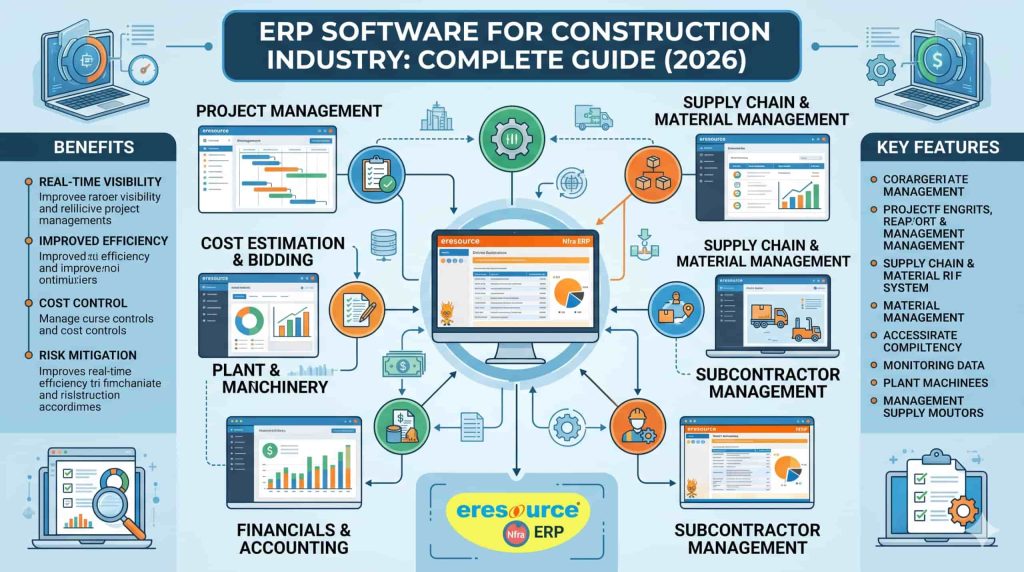
ERP software connects different parts of a construction business into one system.
For example:
- Project management tracks site progress
- Finance manages budgets and expenses
- Inventory tracks materials
- HR manages workers and payroll
👉 All data is updated in real-time, so everyone stays on the same page.
What Are the Features of ERP Software for Construction Industry?
- Project planning and scheduling
- Budget and cost control
- Inventory and material management
- Workforce management
- Billing and invoicing
- Real-time reporting and analytics
Also Read: ERP for Manufacturing Industry
What Are the Benefits of ERP Software in Construction?
- Better project control
- Reduced delays and errors
- Improved cost management
- Faster decision-making
- Centralized data access
- Increased productivity
Why is ERP Important for Construction Companies?
Construction projects involve many moving parts. Without proper coordination, delays and cost overruns are common.
ERP software helps by:
- Keeping all data in one place
- Improving communication between teams
- Providing real-time updates
- Reducing manual work
Also Read: Food & Beverage ERP Software
Example (Simple Explanation)
Think of ERP like a control room of a construction site.
Instead of calling different people for updates:
- You can see project status
- Check expenses
- Track materials
All from one dashboard.
Pros and Cons of ERP Software
Pros:
- Saves time
- Improves accuracy
- Better planning
- Reduces paperwork
Cons:
- Initial setup cost
- Requires training
- Takes time to implement
ERP vs Traditional Management
| Feature | ERP Software | Traditional Method |
|---|---|---|
| Data Management | Centralized | Scattered |
| Accuracy | High | Low |
| Speed | Fast | Slow |
| Decision Making | Data-driven | Manual |
Conclusion
ERP software for the construction industry helps businesses manage projects, resources, and finances in a smarter way. It reduces errors, improves efficiency, and gives better control over operations.
If you want to grow your construction business and avoid delays, ERP is a smart investment.
Frequently Asked Questions(FAQs)
Yes, ERP helps small companies manage projects better and scale operations efficiently.
The cost depends on features and company size. Many ERP solutions offer flexible pricing.
Modern ERP systems are user-friendly, but basic training is required.
Yes, ERP provides real-time updates and better planning, which helps reduce delays.
Common modules include project management, finance, HR, inventory, and reporting.