Skip to content


What Is Enterprise Resource Planning (ERP)?
Enterprise Resource Planning (ERP) is business management software that integrates different business functions into one centralised system. These functions can include finance, human resources, procurement, inventory, and customer relationship management.
An ERP system gives organisations a unified view of their operations. It connects business processes and data across departments. This helps companies improve efficiency, make informed decisions, and streamline daily operations.
In simple terms, ERP connects people, processes, and data across departments in real time.
In simple terms: ERP connects people, processes, and data across departments in real time.
Why Businesses Needed ERP in the First Place
Before ERP systems became common, companies often relied on separate software for each department. Finance used one system. Production used another. Employees often managed inventory through spreadsheets or manual records.
This disconnected approach created several challenges:
- Data duplication
- Inconsistent reporting
- Delayed decision-making
- Limited visibility across departments
During the 1960s and 1970s, manufacturers used Material Requirements Planning (MRP) systems to manage production. MRP later evolved into MRP II (Manufacturing Resource Planning).
ERP vendors eventually expanded these capabilities beyond manufacturing. They added functions such as finance, human resources, procurement, and distribution.
This evolution led to Enterprise Resource Planning (ERP).
Today, ERP software supports businesses across many industries. These include manufacturing, construction, retail, logistics, healthcare, and professional services.
How Does ERP Work?
An ERP system typically uses a centralised database. Different departments can access dedicated modules while sharing the same business data.
This structure allows information to flow across the organisation. Employees do not need to enter the same information into multiple systems.
For example:
- The sales team enters a customer order.
- The inventory module checks available stock.
- The production module schedules manufacturing if required.
- The procurement module triggers raw material purchasing.
- The finance module records the related revenue and costs.
This integrated approach reduces manual data entry. It also improves accuracy and gives teams better visibility.
Also Read: [What Is the Basic Structure of a Good ERP Solution?]
Benefits of Enterprise Resource Planning (ERP)
ERP systems offer several practical benefits. They can improve daily operations while supporting long-term business planning.
1. Real-Time Visibility
Management can access updated business information without waiting for manual data consolidation. Real-time dashboards can provide a clearer view of operations.
2. Better Decision-Making
ERP systems provide structured reports and dashboards. Leaders can use accurate business data instead of relying on assumptions.
3. Process Standardisation
ERP systems support defined workflows and approval processes. This reduces dependency on individual employees and improves consistency.
4. Cost Control
Companies can track expenses more accurately. Integrated procurement and financial information can also improve cost visibility.
5. Compliance and Audit Support
ERP systems maintain transaction records and business data. Auditors can use these records to trace transactions and review financial activity.
6. Scalability
An ERP system can grow with the organisation. Businesses can add users, modules, departments, and locations as their requirements change.
Industries That Use ERP
Enterprise Resource Planning supports businesses across many industries, including:
- Manufacturing
- Construction
- Infrastructure
- Distribution
- Logistics
- Retail
- Healthcare
- Professional services
Manufacturing companies can connect production planning with inventory and procurement. Construction companies can manage projects, billing, subcontractors, and materials.
Logistics companies can use ERP to manage warehouse activities and other operational processes. The system can adapt to different industry workflows and requirements.
Common Myths About ERP
Many businesses have misconceptions about ERP. Let’s address some of the most common ones.
Myth 1: ERP Is Only for Large Enterprises
ERP is not limited to large organisations. Small and medium-sized businesses can also use ERP software to manage their operations.
Cloud-based ERP solutions have made these systems more accessible to growing businesses.
Myth 2: ERP Solves Business Problems Automatically
ERP software can improve business processes, but it cannot fix every management problem automatically.
Companies should define clear workflows before implementation. Employees also need proper training to use the system effectively.
Myth 3: ERP Replaces Employees
ERP software can automate repetitive tasks. However, it does not eliminate the need for strategic roles.
Instead, automation allows employees to spend more time on analysis, planning, customer service, and decision-making.
ERP Implementation: What Really Matters
An ERP project involves more than installing software. Successful implementation requires planning, collaboration, and employee adoption.
Key requirements include:
- Clear business objectives
- Process mapping
- Data cleansing
- User training
- Leadership involvement
- Change management
Technology alone does not guarantee ERP success. Employees need to understand the system and its benefits.
Strong leadership can also encourage user adoption. When employees receive proper training and support, they are more likely to use the ERP system effectively.
Also Read: [How to Make ERP Software Implementation Successful?]
ERP and Business Growth
Businesses often face greater operational complexity as they grow. Manual processes and spreadsheets may work initially, but they can become difficult to manage at scale.
Consider a business managing:
- Multiple locations
- Hundreds of SKUs
- Multi-level approvals
- GST compliance
- Project-based billing
Spreadsheets can become difficult to manage in such environments. An ERP system provides structured processes and centralised information.
ERP can also support:
- Multi-company consolidation
- Multi-currency transactions
- Advanced reporting
- Budget control
- Centralised data management
For these reasons, ERP can become a long-term strategic investment rather than simply another business application.
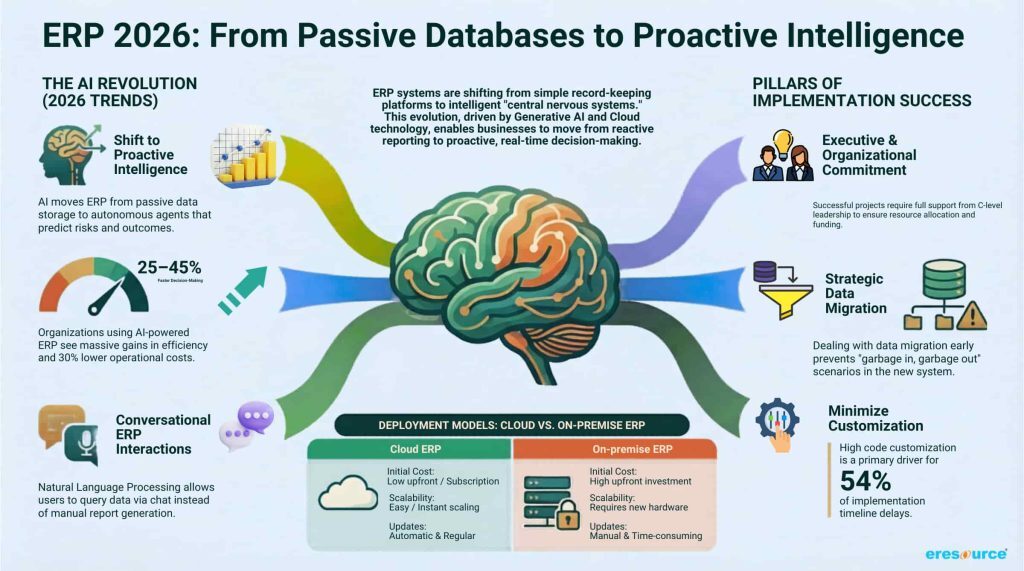
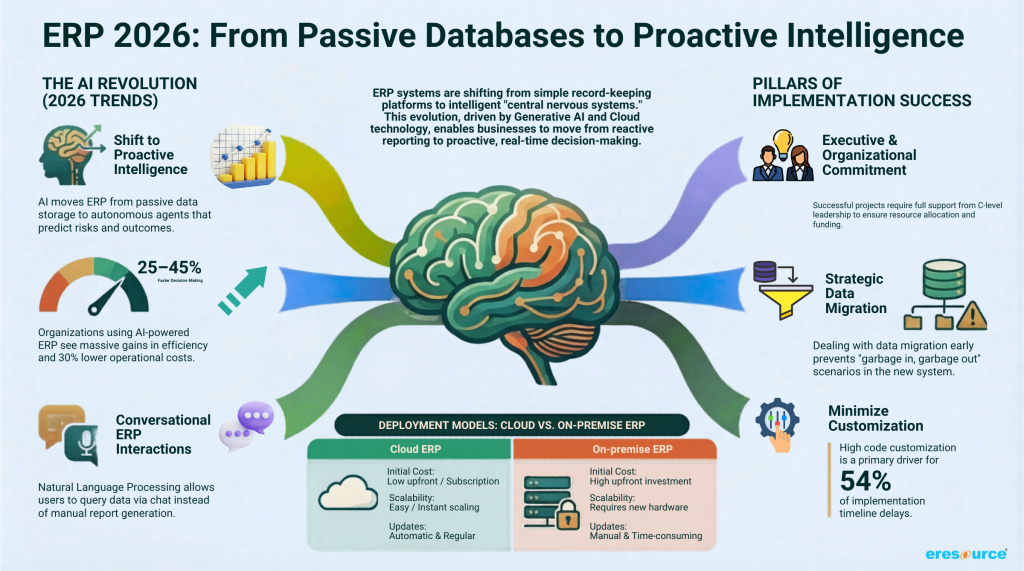
ERP in the Age of AI and Automation
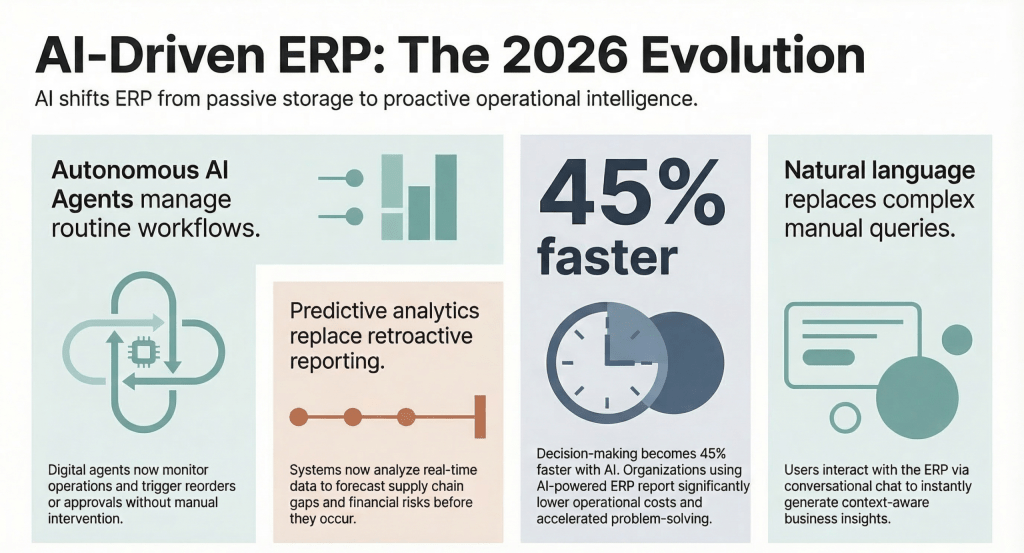
Modern ERP systems increasingly integrate with artificial intelligence, analytics, and automation technologies.
Businesses can use these capabilities for:
- Predictive demand forecasting
- Automated approval workflows
- Real-time dashboards
- Business intelligence
- Automated data analysis
ERP provides the structured data foundation that these technologies need. AI and analytics work more effectively when businesses maintain accurate and organised data.
Without a reliable data foundation, businesses may struggle to generate accurate insights.
However, ERP remains the foundation. AI tools depend on structured, clean data. ERP provides that structure.
No data foundation means no reliable analytics.
Read also – What is the basic structure of a good ERP solution?
Choosing the Right ERP System
Businesses should evaluate several factors before selecting an ERP solution.
Important considerations include:
- Industry fit
- Scalability
- Implementation partner experience
- Integration capabilities
- Reporting flexibility
- Customisation requirements
- Total cost of ownership
ERP selection should support the company’s long-term strategy. Focusing only on the initial price can create limitations later.
Businesses should evaluate both current requirements and future growth before making a decision.
Final Thoughts: What Is Enterprise Resource Planning (ERP)?
Enterprise Resource Planning (ERP) is a unified business management system that connects core business functions through one centralised platform.
It brings together finance, operations, supply chain, human resources, and other business processes. Shared data and structured workflows give organisations better visibility and control.
ERP does not magically solve every business challenge. Instead, it creates a structured environment for managing business information and processes.
Strong leadership, employee adoption, and process discipline turn that structure into business value.
In a competitive market, companies need accurate information, faster decisions, and controlled operations. ERP provides the foundation required to achieve these goals.
When implemented thoughtfully, ERP can become the operational backbone of an organisation.
Also Read
[How BPR Plays a Critical Role in ERP Implementation?]
Frequently Asked Questions About ERP
1. What is Enterprise Resource Planning (ERP)?
Enterprise Resource Planning (ERP) is business management software that integrates core processes such as finance, human resources, inventory, procurement, and customer relationship management into one centralised platform. ERP helps organisations streamline operations, improve data accuracy, and support better decision-making.
2. What are the main benefits of ERP systems?
ERP systems can improve operational efficiency, reduce manual work, support better collaboration, provide real-time business information, and automate repetitive tasks. These capabilities help organisations make faster and more informed decisions.
3. How does ERP improve business operations?
ERP connects multiple departments through one integrated system. It reduces data silos, automates workflows, tracks resources, and gives teams access to consistent and updated business information.
4. What industries use ERP software?
ERP software is used across many industries, including manufacturing, construction, retail, healthcare, logistics, education, professional services, and finance. Organisations can use ERP to manage resources, processes, financial information, and other core operations.
5. What are the challenges of implementing ERP?
Common ERP implementation challenges include initial investment, data migration, employee training, system customisation, integration, and resistance to organisational change. Proper planning, communication, and implementation support can help businesses manage these challenges.
6. Is ERP suitable for small and medium-sized businesses?
Yes. Many ERP solutions support small and medium-sized businesses. Cloud-based ERP systems can provide scalability and easier deployment, making them suitable for growing organisations.