Manufacturing ERP Software for Business Growth
Manufacturing companies need more than basic business software to control production, costs, inventory and customer orders. They need a connected system that brings every important manufacturing activity into one platform.
Manufacturing ERP software helps businesses connect planning, procurement, inventory, production, quality, sales, finance and reporting. With better visibility across these processes, manufacturers can reduce data duplication, improve production planning and make faster business decisions.
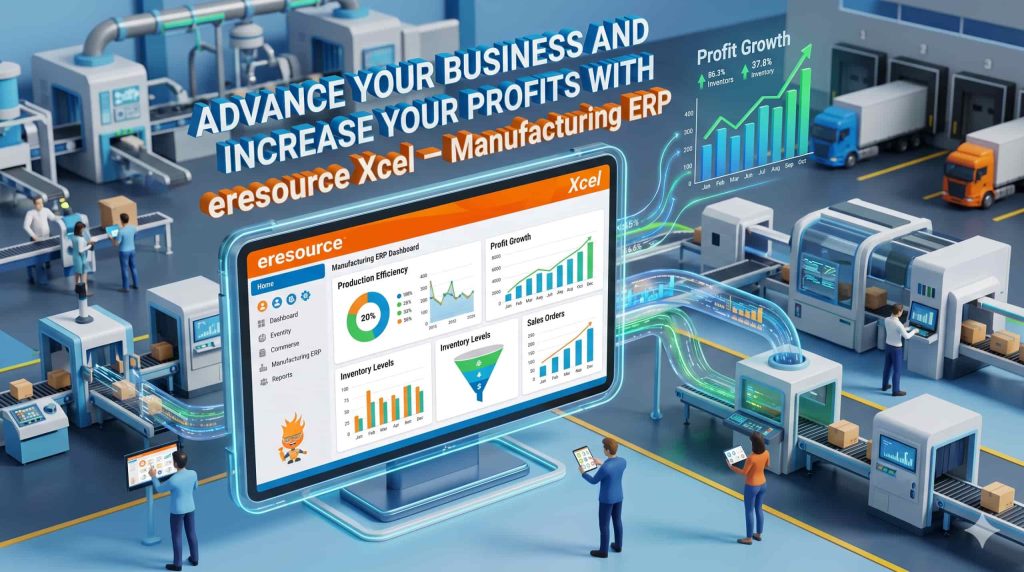
eresource Xcel is a manufacturing-focused ERP solution designed to support manufacturing operations from planning and material requirements to production, quality control, inventory and financial management.
What Is Manufacturing ERP Software?
Manufacturing ERP software is an integrated business management system built for manufacturing companies.
It connects different departments through a central database. Teams can access relevant information without maintaining separate spreadsheets or disconnected systems.
A manufacturing ERP system can help manage:
Product and material information
Bill of Materials (BOM)
Material Requirements Planning (MRP)
Production planning
Production scheduling
Work orders
Shop-floor activities
Inventory management
Procurement
Quality control
Job work and subcontracting
Maintenance
Costing
Sales and customer management
Finance and accounting
Management reporting
The result is better coordination between business functions and improved visibility across the manufacturing process.
Why Do Manufacturing Companies Need ERP?
Manufacturing operations involve many connected activities. A delay in purchasing can affect production. A material shortage can affect delivery. A production variance can affect product cost.
When teams use separate systems, information can become difficult to track.
A manufacturing ERP system creates a connected workflow.
It helps businesses monitor:
What needs to be produced
How much needs to be produced
Which materials are required
What materials are available
Which purchase orders are pending
What is currently in production
Which jobs are completed
What has passed quality inspection
What inventory is available
What each product or job costs
This visibility can help management identify issues earlier and take corrective action.
How eresource Xcel Helps Manufacturers
eresource Xcel is positioned as a dedicated manufacturing ERP platform. Its current manufacturing offering covers production planning, MRP, shop-floor operations, quality, inventory, maintenance and manufacturing cost tracking.
1. Manage Bill of Materials
A Bill of Materials defines the materials and components required to manufacture a product.
ERP software can help manufacturers maintain BOM structures and connect them with production planning and material requirements.
This makes it easier to understand:
Required raw materials
Components
Quantities
Product structures
Production requirements
Material consumption
Accurate BOM information also supports better costing and procurement planning.
2. Improve Production Planning
Production planning helps manufacturers decide what to produce, when to produce it and what resources are required.
An ERP system can connect customer demand with production requirements.
Manufacturers can use production planning to:
Plan production quantities
Schedule manufacturing activities
Allocate resources
Identify material requirements
Track production progress
Reduce production delays
Better planning can help production teams work with clearer priorities.
3. Use MRP for Material Planning
Material Requirements Planning helps manufacturers determine which materials are required for upcoming production.
MRP can connect:
Demand → BOM → Material Requirements → Inventory → Purchase Planning → Production
This helps teams identify shortages before they affect production.
It can also reduce unnecessary inventory purchases and improve material availability.
4. Control Inventory
Inventory has a direct impact on manufacturing costs.
Excess inventory can increase carrying costs. Insufficient inventory can interrupt production.
Manufacturing ERP software provides a centralized view of inventory across relevant processes.
Manufacturers can monitor:
Raw materials
Components
Work-in-progress
Finished goods
Stock movements
Material consumption
Inventory availability
Better inventory visibility supports more informed purchasing and production decisions.
5. Improve Shop-Floor Visibility
Shop-floor operations generate important information throughout the production cycle.
An ERP system can connect production planning with actual shop-floor activities.
Managers can monitor production progress and identify bottlenecks more quickly.
Current eresource Xcel positioning also includes shop-floor visibility and real-time manufacturing information.
6. Strengthen Quality Control
Quality problems can increase rework, scrap, returns and production costs.
Manufacturing ERP software can connect quality activities with production and inventory processes.
Quality teams can manage inspection-related information and track product quality throughout manufacturing.
This helps manufacturers identify quality issues before products move further through the supply chain.
7. Manage Manufacturing Costs
Manufacturing profitability depends on controlling product and production costs.
ERP software can bring cost-related information together across materials, production and other business activities.
Manufacturers can use this information to understand:
Material costs
Production costs
Job costs
Operational expenses
Product margins
Cost variances
Better cost visibility helps management make more informed pricing and production decisions.
8. Simplify Procurement
Procurement teams need accurate information about material requirements and inventory availability.
A manufacturing ERP system can connect purchase planning with production and inventory.
This helps procurement teams:
Identify material requirements
Create purchase requirements
Track suppliers
Monitor purchase orders
Follow material receipts
Coordinate purchasing with production
This connected process can reduce communication gaps between procurement and production teams.
9. Manage Job Work and Subcontracting
Many manufacturers outsource specific production activities.
Examples include machining, fabrication, finishing, heat treatment and other specialized operations.
Manufacturing ERP software can help track outsourced activities, material movement and job-work transactions.
This gives management better visibility into subcontracting activities and related costs.
10. Connect Finance With Operations
Manufacturing decisions directly affect financial performance.
Production costs, inventory, purchases, sales and expenses all contribute to the financial picture.
An integrated ERP system connects operational data with financial processes.
This helps management understand business performance without depending on disconnected spreadsheets.
Key Benefits of Manufacturing ERP Software
A properly implemented manufacturing ERP system can support several business improvements.
Better Production Control
Production teams gain access to centralized information about plans, orders, materials and production progress.
Improved Inventory Management
Real-time inventory visibility can help companies avoid unnecessary stock and reduce material shortages.
Lower Operational Costs
Better planning, material control and process visibility can help identify avoidable costs.
Faster Decision-Making
Management can use centralized business information instead of waiting for manually prepared reports.
Better Quality Management
Connected quality processes help manufacturers monitor inspection activities and production quality.
Improved Customer Service
Sales teams can access better information about orders, production status and delivery commitments.
Better Resource Utilization
Production planning can help businesses use machines, materials and people more effectively.
Greater Business Visibility
ERP connects departments and gives management a broader view of business performance.
Manufacturing ERP Modules
A complete manufacturing ERP solution can include multiple modules.
| ERP Module | Purpose |
|---|---|
| CRM | Customer and sales relationship management |
| BOM | Product structure and component management |
| MRP | Material requirements planning |
| Production | Manufacturing and work-order management |
| Shop Floor | Production activity and execution visibility |
| Inventory | Stock and material movement management |
| Purchase | Procurement and supplier management |
| Quality | Inspection and quality control |
| Job Work | Outsourced manufacturing activity |
| Maintenance | Equipment and maintenance management |
| Costing | Product and production cost analysis |
| Finance | Accounting and financial management |
| HR | Employee and workforce management |
| Reporting | Business and management reporting |
The exact modules and configuration should match the manufacturer’s production model and operational requirements.
Manufacturing ERP for Different Industries
Manufacturing companies operate with different production models. Their ERP requirements can therefore vary.
Manufacturing ERP can support businesses such as:
Automotive component manufacturers
Engineering goods manufacturers
Machinery manufacturers
Electronics manufacturers
Electrical manufacturers
Metal fabrication companies
Industrial product manufacturers
Valve manufacturers
Rubber product manufacturers
Medical device manufacturers
Textile manufacturers
Plastics manufacturers
Current eresource Xcel positioning specifically targets discrete manufacturing segments and lists areas such as automotive components, engineering goods, machinery, electronics, metal fabrication, valves and rubber products.
Manufacturing ERP for Make-to-Stock and Make-to-Order
Manufacturing companies may follow different production models.
Make-to-Stock
Products are manufactured based on expected demand and inventory requirements.
ERP helps manufacturers plan production and maintain appropriate stock levels.
Make-to-Order
Production starts after receiving a customer order.
ERP helps connect customer requirements with BOM, material planning, production and delivery.
Engineer-to-Order
Products require customer-specific engineering and production planning.
ERP can help connect engineering information with BOMs, production requirements, procurement and costing.
Job-Based Manufacturing
Each customer order or manufacturing job may require separate costing and production tracking.
ERP can provide better visibility into individual job performance.
How ERP Can Help Increase Manufacturing Profitability
Profitability depends on revenue as well as cost control.
Manufacturing ERP software can support profitability by improving visibility across the areas that influence costs.
For example:
Accurate BOM → Better Material Planning → Better Inventory Control → Better Production Planning → Better Cost Visibility → Better Business Decisions
ERP does not automatically guarantee higher profits. However, better information and process control can help management identify operational inefficiencies and respond faster.
Manufacturing ERP and Digital Transformation
Manufacturers are increasingly moving from manual processes to connected digital systems.
Modern manufacturing ERP platforms can combine traditional ERP functionality with technologies such as:
Cloud-based access
Real-time dashboards
Mobile applications
IoT integration
Artificial intelligence
Low-code/no-code customization
Automated reporting
Current eresource Xcel materials describe capabilities including IoT and shop-floor integration, AI through AzaaleaGPT and low-code/no-code customization.
Why Choose eresource Xcel for Manufacturing?
eresource Xcel is designed specifically around manufacturing workflows rather than treating manufacturing as a small part of a generic ERP.
Its current manufacturing platform covers areas such as:
Multi-level BOM
MRP
Production planning
Shop-floor management
Quality control
Inventory
Maintenance
Manufacturing costing
Procurement
Engineering changes
Manufacturing analytics
The company currently states that Xcel has more than 20 years of manufacturing ERP experience and is used across 400+ factories. These are company-reported figures.
How to Select Manufacturing ERP Software
Before implementing an ERP system, manufacturers should evaluate the solution against their actual business processes.
Consider these factors:
Manufacturing Functionality
Check whether the system supports your production model and manufacturing processes.
Scalability
The ERP should support business growth, additional users, products, plants and processes.
Integration
Check whether the ERP can connect relevant departments and existing business systems.
Reporting
Management should have access to useful operational and financial reports.
User Experience
The system should be practical for office teams as well as production users.
Implementation
Review implementation methodology, training, data migration and post-implementation support.
Customization
Check whether the platform can adapt to business requirements without creating unnecessary complexity.
Manufacturing ERP Implementation Workflow
A typical implementation can follow these steps:
Understand current manufacturing processes.
Identify operational gaps.
Define ERP requirements.
Configure the required modules.
Prepare and migrate master data.
Train users.
Test business processes.
Go live.
Monitor performance.
Improve processes continuously.
A structured implementation helps employees adopt the new system and reduces disruption during the transition.
Conclusion
Manufacturing ERP software can help companies connect production, procurement, inventory, quality, costing, sales and finance through one integrated system.
Instead of managing information across disconnected spreadsheets and applications, manufacturers can create a centralized flow of operational data.
eresource Xcel provides a manufacturing-focused ERP platform with capabilities across BOM, MRP, production, shop-floor management, inventory, quality, maintenance and costing.
For manufacturers looking to improve operational visibility, control production processes and manage costs more effectively, a dedicated manufacturing ERP system can provide a structured foundation for digital transformation.
Frequently Asked Questions
Common questions about manufacturing ERP
What is manufacturing ERP software?
Manufacturing ERP software is an integrated system that helps manufacturers manage production, inventory, procurement, quality, costing, sales, finance and other business processes from a centralized platform.
How does ERP help manufacturing companies?
ERP helps connect manufacturing processes and provides better visibility into production, materials, inventory, costs and business performance.
Can manufacturing ERP manage BOM and MRP?
Yes. Manufacturing-focused ERP systems can manage Bill of Materials and Material Requirements Planning as part of the production planning process.
Can ERP help control manufacturing costs?
ERP can provide centralized information about materials, production, inventory and other operational costs. This helps management identify cost variances and improve cost control.
Is eresource Xcel suitable for discrete manufacturing?
Yes. Current eresource Xcel positioning focuses on discrete manufacturing and includes sectors such as automotive components, engineering goods, machinery, electronics and metal fabrication.