Table of Contents
Introduction
Top ERP software in India refers to the most widely used enterprise resource planning systems that help businesses manage operations like accounting, inventory, sales, manufacturing, and compliance in a single integrated platform.
In simple terms, ERP software allows Indian businesses to automate processes, improve efficiency, ensure GST compliance, and make better decisions using real-time data.
With rapid digital transformation across industries, choosing the right ERP software is essential for businesses aiming to scale efficiently.
What is ERP Software?
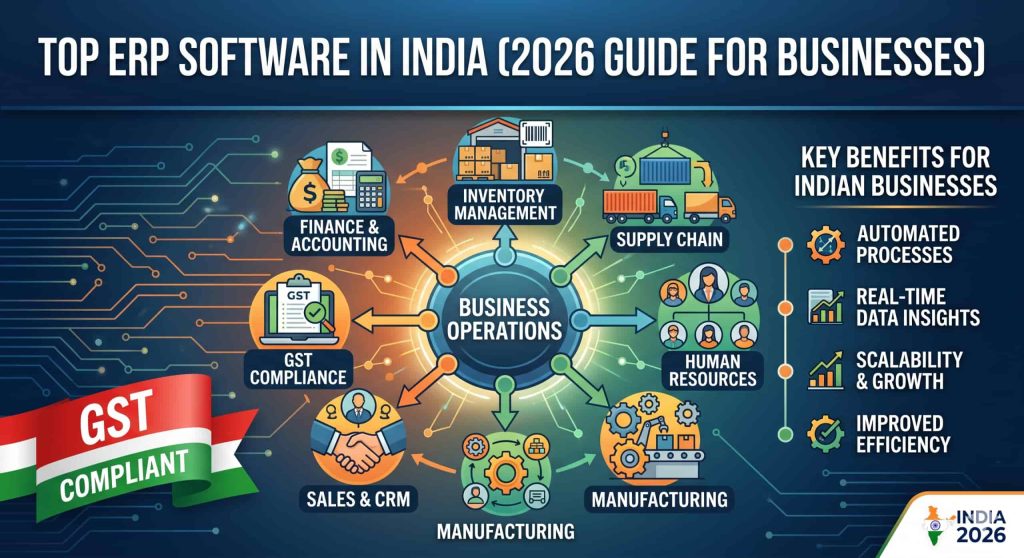
ERP (Enterprise Resource Planning) software is a centralized system that integrates all business functions, including:
- Finance and accounting
- Inventory and warehouse management
- Sales and CRM
- Procurement and supply chain
- Human resources
- Manufacturing and operations
Instead of using multiple tools, ERP brings everything into one unified platform.
Why Businesses in India Need ERP Software
Indian businesses face unique challenges that require advanced solutions.
Key Challenges:
- GST compliance and taxation
- Manual processes and data errors
- Multi-location operations
- Inventory mismanagement
- Growing competition
The top ERP software in India helps overcome these challenges by offering automation and real-time insights.
Also Read: AI Powered ERP
Top ERP Software in India
Here’s a balanced and practical comparison of widely used ERP solutions in India:
1. eresource ERP
eresource ERP is designed for SMEs and growing enterprises looking for flexibility and scalability.
Key Features:
- Integrated modules for finance, inventory, sales, and manufacturing
- GST-compliant system
- Cloud and on-premise deployment
- Customizable workflows
- Multi-location and multi-currency support
Drawbacks:
- May require implementation support
- Initial learning curve for new users
2. Tally
Tally is one of the most widely used accounting software in India.
Key Features:
- Strong accounting and GST compliance
- Easy invoicing and tax filing
- Simple interface
Drawbacks:
- Limited ERP capabilities
- Not suitable for complex operations
3. Zoho (Zoho One)
Zoho offers a suite of cloud-based applications that function like an ERP.
Key Features:
- Cloud-based and affordable
- Strong CRM and finance tools
- Integration across apps
Drawbacks:
- Requires multiple apps
- Limited manufacturing depth
4. SAP Business One
SAP Business One is used by mid-sized businesses needing structured ERP systems.
Key Features:
- Comprehensive business management
- Strong analytics
- Scalable system
Drawbacks:
- High cost
- Complex implementation
5. Oracle NetSuite
NetSuite is a global cloud ERP solution.
Key Features:
- Cloud-native platform
- Real-time dashboards
- Multi-country support
Drawbacks:
- Expensive
- Complex setup
6. Microsoft Dynamics 365
Microsoft Dynamics offers ERP integrated with Microsoft tools.
Key Features:
- Integration with Microsoft ecosystem
- Flexible and scalable
- Strong reporting
Drawbacks:
- Licensing costs
- Requires configuration
7. Odoo
Odoo is an open-source ERP with modular flexibility.
Key Features:
- Modular system
- Open-source customization
- Wide range of applications
Drawbacks:
- Requires technical expertise
- Implementation varies by partner
8. Busy Accounting Software
Busy is popular among small businesses.
Key Features:
- GST compliance
- Inventory management
- Affordable
Drawbacks:
- Limited ERP functionality
- Not suitable for large businesses
9. Marg ERP
Marg ERP is widely used in retail and distribution.
Key Features:
- Billing and inventory management
- Industry-specific features
- GST-ready
Drawbacks:
- Limited scalability
- Less suitable for complex operations
10. Epicor ERP
Epicor is focused on manufacturing and distribution.
Key Features:
- Industry-specific modules
- Strong manufacturing capabilities
- Scalable system
Drawbacks:
- Higher cost
- Longer implementation time
How to Choose the Best ERP Software in India
1. Identify Your Needs
Understand your business processes and challenges.
2. Industry-Specific Features
Choose ERP tailored to your industry.
3. Budget
Evaluate cost vs value.
4. Scalability
Ensure it grows with your business.
5. Vendor Support
Reliable support ensures smooth implementation.
Why eresource ERP is a Strong Choice in India
For businesses searching for the top ERP software in India, eresource ERP offers a balanced solution.
Key Strengths:
- GST-ready system
- Industry-specific modules
- Flexible deployment options
- Cost-effective for SMEs
- Scalable for long-term growth
It focuses on delivering practical, adaptable solutions aligned with real business needs.
ERP Trends in India (2026)
1. Cloud ERP Adoption
More businesses are moving to cloud systems.
2. AI & Automation
Improving efficiency and decision-making.
3. Mobile ERP
Accessing business data on the go.
4. Integration with Digital Platforms
Connecting ERP with CRM, e-commerce, and analytics tools.
Also Read: Best ERP Software in India
Frequently Asked Questions(FAQs)
The top ERP software depends on business needs. eresource ERP, SAP, Zoho, and Tally are commonly used options.
Small businesses can use eresource ERP, Zoho, or Tally depending on their requirements.
Costs vary based on features and deployment type. Cloud ERP is generally more affordable.
Yes, most ERP systems in India include GST compliance features.
Yes, modern ERP systems offer customization based on business needs.
Cloud ERP offers flexibility and lower costs, while on-premise provides more control.