Table of Contents
Introduction
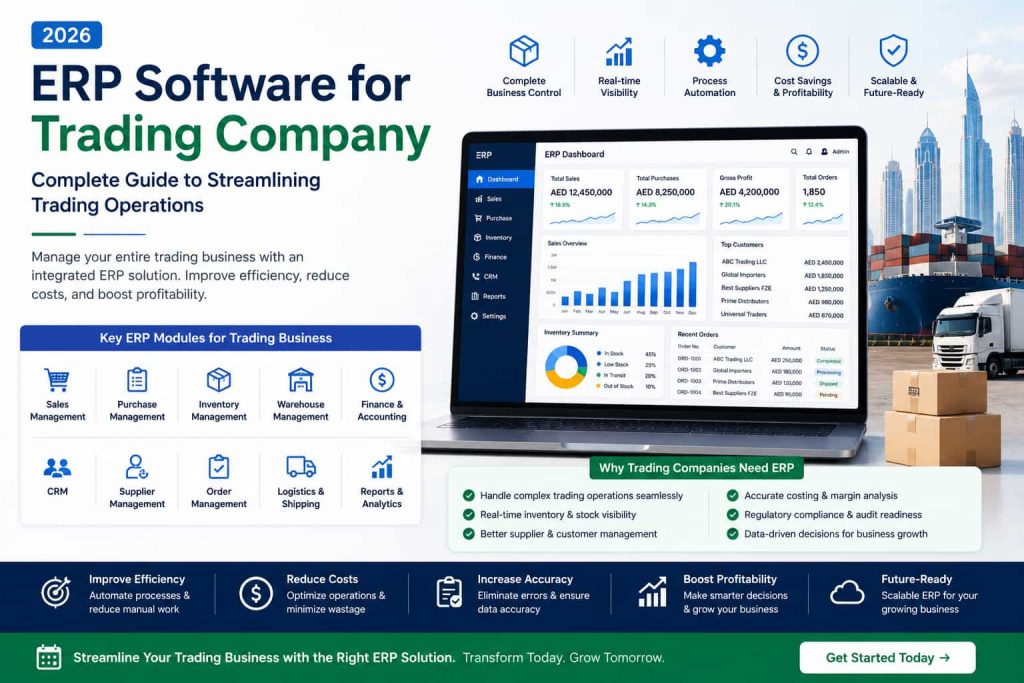
ERP software for trading company is a centralized business management system designed to handle inventory, procurement, sales, finance, and supply chain operations in one integrated platform.
In simple terms, it helps trading businesses manage stock, track orders, handle multi-location warehouses, automate billing, and monitor financial performance in real time.
For trading companies dealing with high transaction volumes, multiple suppliers, and fluctuating demand, ERP software is essential to ensure efficiency, accuracy, and profitability.
What is ERP Software for Trading Company?
ERP software for trading companies is specifically designed to manage buying and selling operations efficiently.
It integrates:
- Inventory and warehouse management
- Purchase and supplier management
- Sales and order processing
- Financial accounting
- Logistics and distribution
- Reporting and analytics
Unlike generic software, trading ERP focuses on fast-moving inventory, multi-location operations, and real-time stock tracking, which are critical for trading businesses.
Why Trading Companies Need ERP Software
Trading businesses operate in a fast-paced environment where delays or inaccuracies can lead to losses.
Key Challenges:
1. Inventory Mismanagement
Overstocking ties up capital, while stockouts lead to lost sales.
2. Multi-Warehouse Operations
Managing stock across locations is complex.
3. Order Processing Errors
Manual processes lead to delays and mistakes.
4. Supplier Coordination
Handling multiple vendors requires proper tracking.
5. Financial Visibility
Difficult to track profit margins in real time.
ERP software for trading company helps solve these challenges by integrating operations and automating workflows.
How ERP Works in Trading Companies
Example Scenario:
- Purchase order is created for stock
- Inventory is updated upon receipt
- Sales order is generated
- Stock is allocated and dispatched
- Invoice is created automatically
- Payment is tracked
- Financial reports are updated in real time
👉 This ensures seamless operations and accurate data.
Core Features of ERP Software for Trading Company
1. Inventory & Warehouse Management
Tracks stock across multiple warehouses. Includes:- Real-time stock updates
- Batch and serial tracking
- Stock transfers
- Accurate inventory control
- Reduced stockouts
2. Purchase & Supplier Management
Manages procurement and vendor relationships. Benefits:- Better supplier coordination
- Cost optimization
3. Sales & Order Management
Handles customer orders and billing. Benefits:- Faster order processing
- Improved customer satisfaction
4. Multi-Location Management
Supports operations across multiple warehouses or branches. Benefits:- Centralized control
- Better coordination
5. Financial Management
Tracks revenue, expenses, and profitability. Benefits:- Real-time financial insights
- Better decision-making
6. Logistics & Dispatch Management
Manages shipping and delivery. Benefits:- Faster dispatch
- Reduced delays
7. Reporting & Analytics
Provides business insights. Benefits:- Data-driven decisions
- Performance tracking
8. Multi-Currency Support
Essential for international trading. Benefits:- Simplifies global transactions
- Accurate financial reporting
Benefits of ERP Software for Trading Company
1. Improved Inventory Accuracy
Real-time tracking reduces errors.
2. Faster Order Processing
Automation speeds up operations.
3. Better Financial Control
Tracks profit margins and expenses.
4. Reduced Operational Costs
Optimizes procurement and logistics.
5. Real-Time Visibility
Monitor business performance instantly.
6. Scalability
Supports business growth.
7. Improved Customer Experience
Faster delivery and accurate orders.
Types of Trading Businesses That Use ERP
- Wholesale distributors
- Import/export businesses
- Retail trading companies
- FMCG trading companies
- Industrial goods traders
Real-Life Use Cases
1. Wholesale Distributor
Manages bulk inventory and supplier coordination.
2. Import-Export Business
Handles multi-currency transactions and logistics.
3. FMCG Trader
Tracks fast-moving inventory and demand.
4. Industrial Supplier
Manages large product catalogs and orders.
Common Mistakes Trading Companies Make
- Using manual inventory systems
- Poor stock tracking
- Lack of real-time data
- Delayed invoicing
- Choosing generic ERP without trading features
How to Choose the Best ERP Software for Trading Company
1. Inventory Management Capability
Must support real-time tracking.
2. Multi-Warehouse Support
Essential for growing businesses.
3. Integration Capability
Should integrate with existing systems.
4. Scalability
Must support future growth.
5. Ease of Use
User-friendly interface improves adoption.
Why eresource ERP is a Strong Choice
For businesses searching for reliable ERP software for trading company, eresource ERP offers:
Key Strengths:
- Advanced inventory and warehouse management
- Real-time financial tracking
- Multi-location and multi-currency support
- Flexible deployment (cloud and on-premise)
- Customizable workflows
- Scalable for SMEs and enterprises
It focuses on delivering practical ERP solutions tailored to trading business needs.
ERP Trends in Trading Industry (2026)
1. Cloud ERP Adoption
Increasing flexibility and accessibility.
2. AI-Based Demand Forecasting
Improves inventory planning.
3. Mobile ERP
Manage operations on the go.
4. Integration with E-commerce
ERP connected with online sales platforms.
Frequently Asked Questions(FAQs)
ERP software for trading company helps manage inventory, sales, and financial operations in one system.
ERP improves efficiency, reduces errors, and provides real-time data.
It should include inventory management, order processing, and financial tracking.
Yes, ERP systems support multi-location inventory management.
Yes, ERP systems are scalable and suitable for SMEs.
Yes, ERP provides real-time tracking.
Yes, ERP systems support global transactions.
Wholesale, retail, import-export, and distribution businesses.