ERP for Payroll Management: Why Integrated Payroll Beats Standalone Software
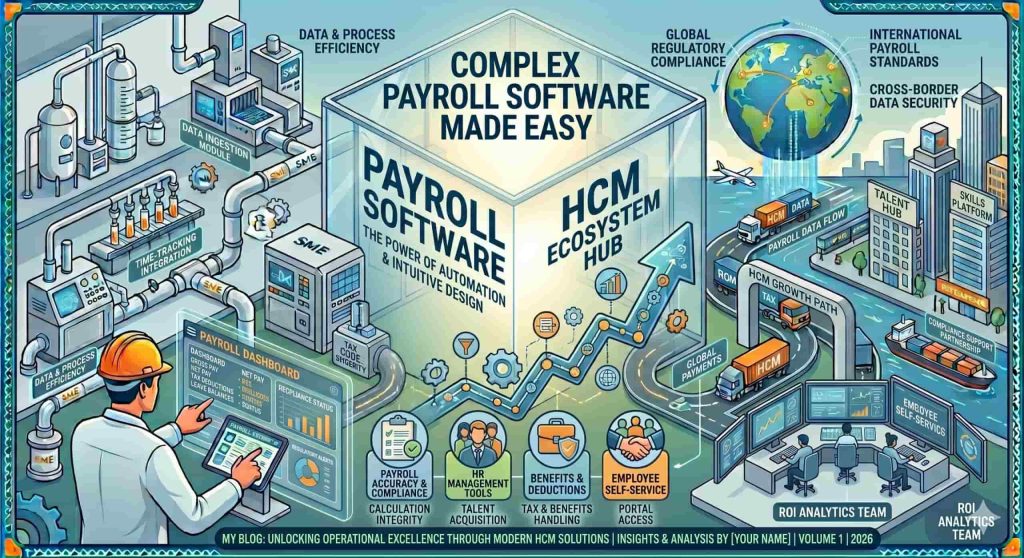
Payroll touches every employee, every month, without fail. Yet most companies still run it on standalone payroll software or spreadsheets — disconnected from attendance, finance, and project costs. ERP for payroll management solves this by running payroll inside the same system that already manages your operations. As a result, attendance flows into salaries, salaries flow into accounts, and labour costs flow into your product or project costing — automatically, with no re-entry.
This article explains what payroll management in ERP covers, and why integration changes the economics of the payroll function.
The Problem with Standalone Payroll Software
Standalone payroll tools calculate salaries well. However, they live in a silo. Attendance comes from one system, salary data sits in another, and accounting entries go into a third. Every handover means exports, imports, and manual checks. Consequently, three problems keep repeating:
- Duplicate data entry — the same employee, attendance, and salary data maintained in multiple places
- Reconciliation delays — finance spends days matching payroll output to ledger entries
- Blind costing — management never sees what labour actually costs per project, site, or product
An integrated ERP removes all three, because payroll shares one database with HR, finance, and operations.
What Payroll Management in ERP Covers
A complete ERP payroll and HRMS function handles the full employee lifecycle:
- Attendance and shifts — biometric or mobile attendance feeds payroll directly, including overtime and shift allowances
- Salary structures — earnings, deductions, and grade-wise structures defined once and applied automatically
- Statutory compliance — PF, ESI, professional tax, and TDS calculated and reported as part of the payroll run
- Payslips and employee self-service — employees access payslips and records without chasing HR
- Loans, advances, and reimbursements — recovered automatically through the salary cycle
- Full and final settlement — exits processed with every pending component accounted for
The Integration Advantage: Payroll That Feeds Costing
This is where ERP payroll leaves standalone software behind. Because payroll runs inside the ERP:
- Finance posting is automatic. The salary journal posts to the ledger the moment payroll is processed. Month-end reconciliation disappears.
- Contractors see site-wise labour cost. For construction and contracting companies, wages flow into each project’s cost sheet. Therefore, project profitability includes real labour cost, not an estimate. (Construction ERP users track this per site, per month.)
- Manufacturers see labour cost per product. Operator hours recorded on the shop floor feed both payroll and product costing in manufacturing ERP. Management finally knows the true labour component of every item made.
In short: standalone payroll tells you what you paid. Integrated payroll tells you what that pay produced.
Compliance Without the Month-End Scramble
Indian payroll compliance is unforgiving — PF and ESI deposits, TDS, professional tax, and labour-law registers all run on deadlines. An ERP generates these as part of the payroll run itself. Moreover, every figure traces back to attendance and salary records in the same system, so audits become a review instead of a reconstruction.
How eresource Handles Payroll
eresource ERP includes HRMS and payroll as an integrated module across its industry editions — from attendance to payroll to financial posting on one platform. Because the licence is flat with unlimited users, adding employees never adds software cost; the payroll function scales with your headcount for free. Implementation follows eresource’s fixed-cost, on-time model with structured user training.
Want to see what integrated payroll saves in rupee terms? Read: How to Calculate ERP ROI
Also Read – Why Businesses Choose eresource ERP
Frequently Asked Questions
Common questions about payroll management in ERP
What is ERP for payroll management?
It is payroll run inside an integrated ERP system, where attendance, salary structures, statutory deductions, payslips, and financial posting all work on one shared database instead of separate tools.
How is ERP payroll different from standalone payroll software?
Standalone payroll calculates salaries in a silo. ERP payroll connects attendance to salaries, posts entries to finance automatically, and feeds labour costs into project or product costing.
Does ERP payroll handle Indian statutory compliance?
Yes. An ERP payroll module can calculate and report PF, ESI, professional tax, and TDS as part of the payroll run, with every figure traceable to attendance and salary records.
Can ERP track labour cost per project or product?
Yes. Because payroll shares the ERP database, wages flow into site-wise project costing for contractors and into product-level labour costing for manufacturers.