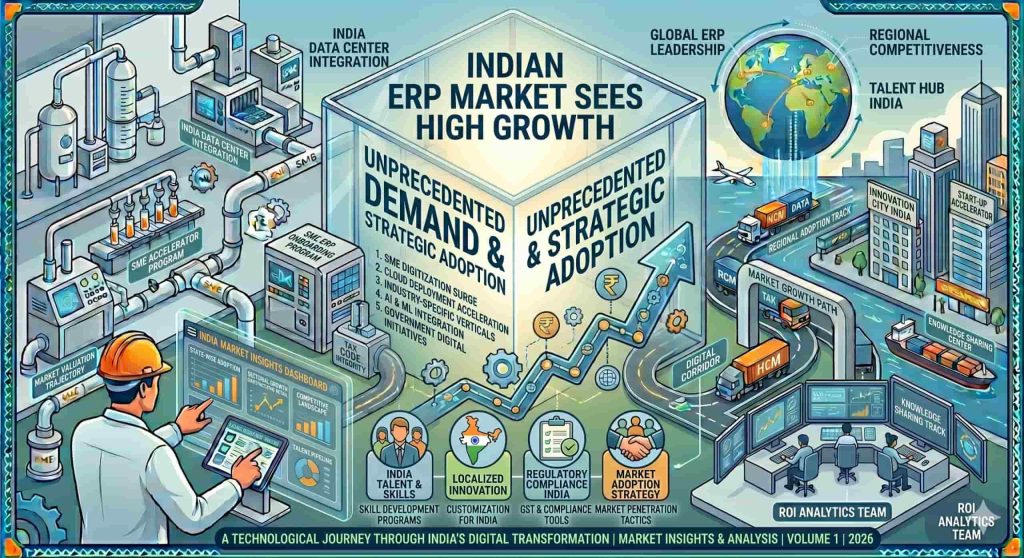
Indian ERP Market Sees High Growth: What Is Driving It
The Indian ERP market has changed the way businesses run in this country. Every year, more organizations implement ERP solutions — and the pace keeps rising. An integrated ERP optimizes resource utilization and provides up-to-the-minute information on demand, so managers make decisions quickly. This article looks at what is driving the growth, which industries lead it, and what it means for a business that has not adopted ERP yet.
Why ERP Adoption Is Rising in India
Companies that implement ERP successfully report the same pattern of gains:
- Overall cost reduction across the business
- An increase in per-capita productivity
- Quicker response times to customers and suppliers
- Lower inventory levels, which release working capital
- Better customer orientation — and therefore higher customer satisfaction
Moreover, ERP implementation has helped many Indian organizations achieve far better management and operational control. ERP is much more than computer software. It has changed how the business environment in India functions, and today it is becoming indispensable.
India’s economic growth adds pressure of its own. Because Indian companies now face intense global competition, they need the discipline and visibility that ERP brings — along with the operational, financial, and people resources to adopt it well.
From Large Enterprises to SMEs
Earlier, ERP systems focused mainly on larger establishments. The reason was simple: implementation cost too much for anyone else. However, that barrier has fallen. With the introduction of low-cost, web-based ERP systems such as eresource ERP, smaller organizations now benefit from the same business solution — without servers, heavy licences, or long projects. As a result, SMEs have become the fastest-growing segment of the Indian ERP market.
Which Industries Lead ERP Adoption
Automotive, steel, consumer durables, engineering, and manufacturing industries show the highest ERP penetration in India. These sectors handle complex materials, production, and compliance — exactly the problems ERP solves best. Consequently, they represent the strongest ERP market in the coming years, and other industries are following the same path. Many large companies are still to implement an ERP system; as they do, the Indian ERP market growth rate will climb further.
Implementation Speed Decides Who Wins
The Indian market is encouraging for ERP adoption. However, organizations must pay close attention to the deployment time-frame. A structured implementation programme speeds up both system deployment and return on investment. In contrast, a delayed go-live quietly eats the returns the system was bought for. This is why eresource follows a fixed-cost, guaranteed on-time implementation model. (Read more: ERP Implementation and ROI)
What This Means for Your Business
The growth of the Indian ERP market carries a simple message: your competitors are integrating their operations. Companies that adopt early gain the cost, productivity, and customer-service advantages first. Meanwhile, waiting does not reduce the eventual cost of adoption — it only extends the years spent running on spreadsheets and disconnected tools.
Also Read – ERP Software in Nigeria
Frequently Asked Questions
Common questions about the Indian ERP market
Why is the Indian ERP market growing?
Global competition, economic growth, and the arrival of low-cost web-based ERP systems have made integrated business management both necessary and affordable for Indian companies of all sizes.
Which industries in India use ERP the most?
Automotive, steel, consumer durables, engineering, and manufacturing industries show the highest ERP penetration, because they manage complex materials, production, and compliance requirements.
Is ERP affordable for small businesses in India?
Yes. Web-based ERP systems such as eresource removed the heavy server and licence costs that once limited ERP to large enterprises, so SMEs now adopt ERP within practical budgets.
What should a company check before joining the ERP adoption wave?
Check the deployment time-frame. A structured, fixed-cost, on-time implementation programme speeds up both the go-live and the return on investment.