Table of Contents
Introduction
ERP accounting software is an advanced financial management system that integrates accounting functions with core business processes such as inventory, sales, procurement, payroll, and reporting into one unified platform.
In simple terms, it allows businesses to manage their entire financial ecosystem in real time, eliminating the need for multiple disconnected tools.
Unlike traditional accounting software, ERP accounting systems provide automation, accuracy, compliance, and complete financial visibility, making them essential for businesses aiming to scale efficiently.
What is ERP Accounting Software?
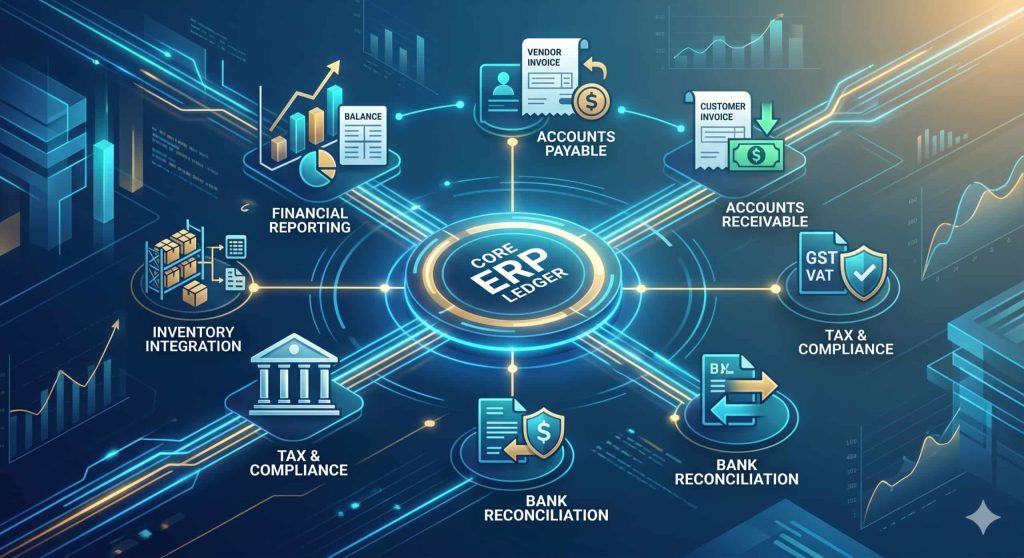
ERP accounting software is a centralized system where every financial transaction is automatically recorded, processed, and reflected across all relevant business functions.
It combines:
Traditional Accounting Capabilities:
- General ledger
- Accounts payable
- Accounts receivable
- Taxation (GST, VAT, etc.)
- Financial reporting
With ERP Capabilities:
- Inventory-linked accounting
- Sales and purchase integration
- Automated workflows
- Real-time dashboards
- Cross-department data synchronization
This means your accounting is no longer isolated. It becomes a core part of your business operations.
Why Traditional Accounting Software is No Longer Enough
Most businesses start with basic accounting tools. But as they grow, limitations become obvious.
Problems with Traditional Systems:
- Data is stored in silos
- Manual entry leads to errors
- No real-time financial visibility
- Difficult reconciliation
- Poor integration with inventory and sales
- Limited scalability
For example, if your inventory system is separate from accounting, every sale must be entered twice. This increases errors and wastes time.
Also Read: Best ERP Software in India
How ERP Accounting Software Works (Detailed Flow)
Let’s break down a real-world workflow to understand its impact.
Scenario: A Product Sale
- Sales order is created
- Inventory is automatically reduced
- Invoice is generated instantly
- Revenue is recorded in accounts
- GST/VAT is calculated
- Financial reports update in real time
Core Modules of ERP Accounting Software (In Depth)
Let’s go deeper into each module and its real business value.
1. General Ledger (GL)
The general ledger is the backbone of accounting.
ERP systems automatically post entries into GL from all transactions.
Why it matters:
- No manual journal entries
- Real-time financial accuracy
- Easy audit trails
2. Accounts Payable (AP)
Manages all outgoing payments.
Includes:
- Vendor invoices
- Payment schedules
- Expense tracking
Business Impact:
- Avoid late payments
- Maintain vendor relationships
- Improve cash flow control
3. Accounts Receivable (AR)
Handles incoming payments.
Includes:
- Customer invoices
- Payment tracking
- Credit management
Business Impact:
- Faster collections
- Better customer management
- Reduced bad debts
4. Taxation & Compliance (GST / VAT)
ERP systems automate tax calculations and compliance.
Includes:
- GST filing (India)
- VAT reporting (UAE)
- Automated tax entries
Business Impact:
- Reduced compliance risk
- Accurate tax reporting
- Easier audits
5. Bank Reconciliation
Automatically matches transactions with bank statements.
Business Impact:
- Saves hours of manual work
- Eliminates discrepancies
- Improves financial accuracy
6. Financial Reporting & Dashboards
ERP provides real-time reports such as:
- Profit & Loss
- Balance Sheet
- Cash Flow
- Expense analysis
Business Impact:
- Faster decision-making
- Clear financial visibility
- Strategic planning support
7. Budgeting & Forecasting
ERP systems allow businesses to plan finances.
Includes:
- Expense forecasting
- Revenue projections
- Budget tracking
Business Impact:
- Better financial planning
- Cost control
- Risk reduction
8. Multi-Currency & Multi-Company Management
Essential for global businesses.
Business Impact:
- Seamless international operations
- Consolidated financial reports
- Simplified global expansion
Key Benefits of ERP Accounting Software
1. Real-Time Financial Visibility
You don’t have to wait for month-end reports.
👉 You get instant insights into revenue, expenses, and profitability.
2. Automation of Financial Processes
Manual accounting tasks are reduced significantly.
👉 Saves time and reduces human errors.
3. Improved Accuracy & Reduced Errors
Since data is entered once and used across the system, errors are minimized.
4. Better Compliance & Audit Readiness
ERP maintains proper records and audit trails.
👉 Makes audits easier and faster.
5. Scalability for Growing Businesses
ERP systems grow with your business.
👉 You don’t need to change systems as you scale.
6. Improved Decision-Making
With accurate data, business decisions become more strategic and data-driven.
Also Read: ERP Software for Food Industry
ERP Accounting vs Traditional Accounting Software
Feature | Traditional Software | ERP Accounting Software |
Integration | Limited | Fully integrated |
Reporting | Manual | Automated |
Accuracy | Moderate | High |
Scalability | Low | High |
Industries That Benefit the Most
ERP accounting software is useful across industries, but especially powerful for:
Manufacturing
Tracks production costs and material usage.
Trading & Distribution
Manages inventory and financial transactions together.
Retail & E-commerce
Integrates POS, inventory, and accounting.
Construction
Tracks project costs and budgets.
Service-Based Businesses
Monitors profitability per project or client.
Real-Life Business Use Cases
1. Manufacturing Company
ERP calculates cost per unit based on raw materials, labor, and overhead.
2. Trading Business
Inventory and accounting are synced, eliminating stock mismatches.
3. Retail Store
Sales automatically update financial reports.
4. Service Company
Tracks revenue and expenses per project.
Common Mistakes Businesses Make
Let’s be practical. Many ERP failures happen due to poor decisions.
Mistakes to Avoid:
- Choosing based only on price
- Ignoring integration capabilities
- Not considering scalability
- Lack of employee training
- Poor implementation planning
How to Choose the Best ERP Accounting Software
1. Understand Your Financial Needs
Identify your accounting complexity.
2. Check Compliance Features
Ensure GST, VAT, or local tax support.
3. Evaluate Integration
Must connect with inventory, sales, and HR.
4. Scalability
Choose a system that grows with your business.
5. Ease of Use
User-friendly interface improves adoption.
Why eresource ERP is a Strong Choice
For businesses looking for reliable ERP accounting software, eresource ERP offers a practical and scalable solution.
Key Strengths:
- Fully integrated accounting with operations
- GST and VAT-ready system
- Real-time financial dashboards
- Customizable workflows
- Scalable for SMEs and enterprises
Instead of isolated accounting tools, it provides complete financial control across business processes.
ERP Accounting Trends in 2026
1. Cloud-Based Financial Systems
Businesses are moving to cloud ERP.
2. AI-Powered Accounting
Automated forecasting and anomaly detection.
3. Real-Time Reporting
No more delayed financial insights.
4. Automation of Compliance
Tax filing and reporting becoming fully automated.
Frequently Asked Questions(FAQs)
ERP accounting software integrates accounting with business operations like inventory, sales, and HR.
ERP accounting is fully integrated and automated, while traditional systems are standalone.
Yes, it supports GST, VAT, and other compliance requirements.
Yes, ERP systems are scalable and suitable for growing businesses.
Yes, it offers real-time financial insights.
Yes, ERP connects accounting with inventory and other modules.