Table of Contents
Introduction
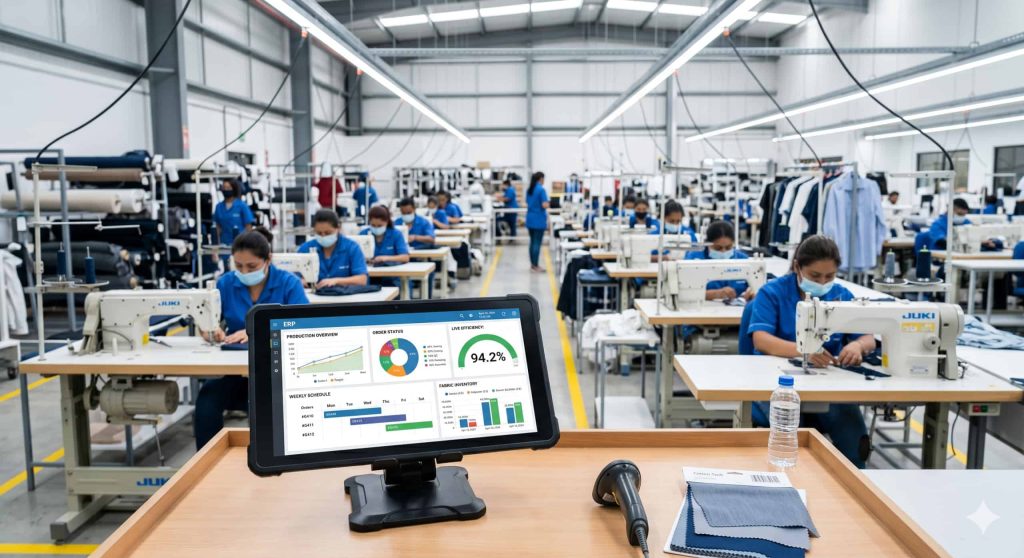
ERP for garment manufacturing industry is a specialized software system that helps apparel businesses manage production, inventory, orders, supply chain, and finances in one integrated platform.
In simple terms, it enables garment manufacturers to track raw materials, manage styles and sizes, control production processes, reduce wastage, and improve efficiency, all while maintaining real-time visibility across operations.
With fast-changing fashion trends, seasonal demand, and complex supply chains, ERP systems have become essential for garment manufacturers looking to scale and stay competitive.
What is ERP for Garment Manufacturing Industry?
ERP for garment manufacturing is designed specifically for the textile and apparel sector, where production involves multiple stages such as design, cutting, stitching, finishing, and distribution.
It integrates:
- Fabric and raw material management
- Style, size, and color (SKU) management
- Production planning and tracking
- Inventory and warehouse management
- Order and sales management
- Financial accounting
Unlike generic ERP systems, garment ERP focuses on multi-variant products, seasonal demand, and fast production cycles, which are critical in the apparel industry.
Why Garment Manufacturers Need ERP Software
Garment manufacturing involves high complexity due to variations in designs, sizes, and colors.
Key Challenges:
1. Managing Multiple SKUs
Different styles, sizes, and colors increase complexity.
2. Production Delays
Lack of planning leads to missed deadlines.
3. Inventory Issues
Overstocking or shortage of fabrics and accessories.
4. Cost Control Problems
Difficult to track production costs accurately.
5. Supply Chain Complexity
Managing vendors, fabrics, and logistics.
An ERP for garment manufacturing industry helps solve these challenges by centralizing operations.
Also Read: Batch manufacturing software
How ERP Works in Garment Manufacturing (Real Workflow)
Example:
- Buyer places order with style, size, and quantity
- ERP generates production plan
- Fabric and materials are allocated
- Cutting, stitching, and finishing are tracked
- Inventory updates in real time
- Finished goods are recorded
- Shipment and invoicing are processed
- Financial records are updated
Core Features of ERP for Garment Manufacturing (In Depth)
1. Style, Size & Color (SKU) Management
ERP manages multiple variations efficiently.
Benefits:
- Accurate tracking of variants
- Simplified order processing
- Better inventory control
2. Bill of Materials (BOM) for Garments
Defines fabric, trims, and accessories required.
Benefits:
- Precise material planning
- Reduced wastage
- Cost optimization
3. Production Planning & Scheduling
Plans cutting, stitching, and finishing processes.
Benefits:
- On-time delivery
- Improved efficiency
- Reduced bottlenecks
4. Inventory & Warehouse Management
Tracks raw materials, WIP, and finished goods.
Benefits:
- Real-time stock visibility
- Reduced stockouts
- Better warehouse control
5. Order & Sales Management
Handles bulk orders and customer requirements.
Benefits:
- Faster order processing
- Improved customer satisfaction
6. Quality Control
Ensures product quality at every stage.
Benefits:
- Reduced defects
- Better brand reputation
7. Costing & Profitability Analysis
Tracks production costs per garment.
Benefits:
- Accurate pricing
- Improved profit margins
8. Financial Management
Handles accounting, invoicing, and reporting.
Benefits:
- Real-time financial insights
- Better decision-making
Benefits of ERP for Garment Manufacturing Industry
1. Improved Production Efficiency
Automation reduces delays and improves workflow.
2. Better Inventory Management
Tracks fabrics, trims, and finished goods.
3. Reduced Wastage
Accurate BOM and planning minimize material loss.
4. Real-Time Visibility
Track orders, production, and inventory instantly.
5. Faster Order Fulfillment
Improves delivery timelines.
6. Better Cost Control
Tracks every expense in production.
7. Scalability
Supports business growth and expansion.
Real-Life Use Cases
1. Apparel Export Company
ERP manages bulk orders, production, and exports.
2. Textile Manufacturer
Tracks raw materials and production processes.
3. Fashion Brand
Manages seasonal collections and inventory.
4. Garment Factory
Monitors production lines and worker efficiency.
Common Mistakes Garment Businesses Make
- Managing operations manually
- Poor inventory tracking
- Lack of production planning
- Ignoring cost analysis
- Choosing generic ERP instead of industry-specific
How to Choose the Best ERP for Garment Manufacturing
1. Industry-Specific Features
Must support SKU and garment workflows.
2. Scalability
Choose ERP that grows with your business.
3. Integration Capability
Should integrate with existing tools.
4. Ease of Use
User-friendly interface is critical.
5. Vendor Support
Strong support ensures success.
Why eresource ERP is a Strong Choice
For businesses searching for reliable ERP for garment manufacturing industry, eresource ERP offers:
Key Strengths:
- Garment-specific production modules
- Integrated inventory and financial management
- Flexible deployment (cloud and on-premise)
- Customizable workflows
- Scalable for SMEs and large enterprises
It focuses on delivering practical and efficient solutions tailored to apparel businesses.
Also Read: Best cloud Manufacturing ERP for MSME
ERP Trends in Garment Industry (2026)
1. Fast Fashion Integration
ERP supports quick production cycles.
2. AI-Based Demand Forecasting
Improves inventory planning.
3. Cloud ERP Adoption
Enhances flexibility and scalability.
4. Real-Time Production Tracking
Improves efficiency and control.
Frequently Asked Questions(FAQs)
ERP for garment manufacturing industry is a system that manages production, inventory, and operations for apparel businesses
ERP improves efficiency, reduces wastage, and helps manage complex production processes
It should include SKU management, production planning, inventory tracking, and financial management.
Yes, ERP systems manage multiple variants efficiently.
Yes, ERP systems are scalable and suitable for SMEs.
ERP automates scheduling and resource allocation.
Yes, ERP optimizes material usage and reduces wastage.
Textile, apparel, fashion, and export industries use garment ERP systems