Table of Contents
Introduction
Implementing an ERP system is one of the most important decisions for any construction business. Whether you are managing multiple project sites, handling procurement, or tracking budgets, a well-planned ERP implementation can transform your entire operation.
However, many companies fail to achieve expected results due to poor planning, lack of training, or choosing the wrong system.
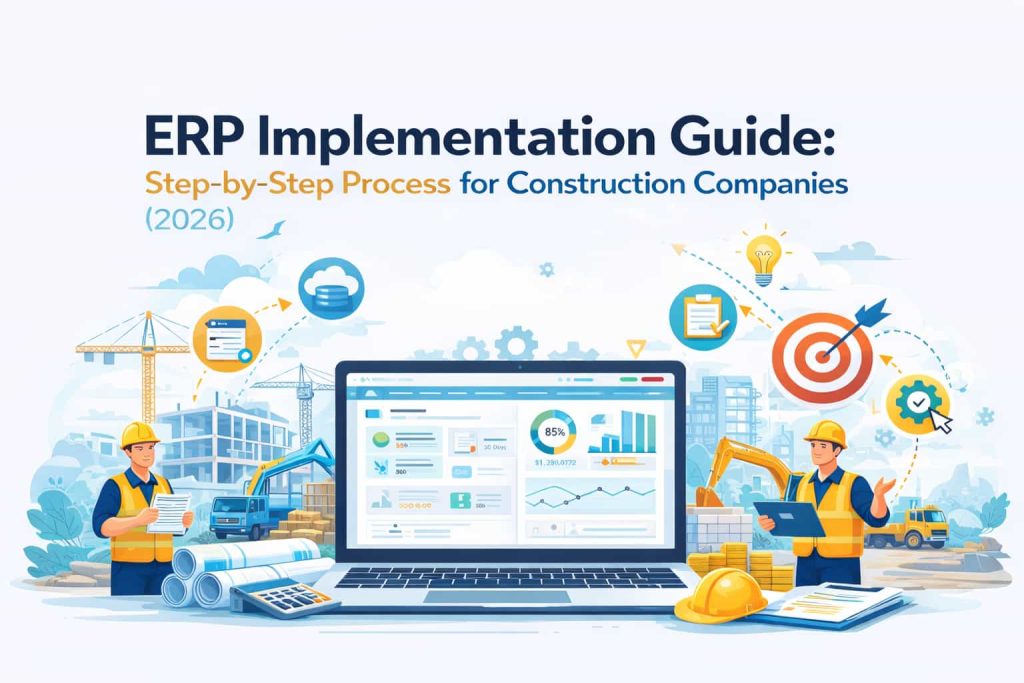
This ERP implementation guide will help you understand the complete process, best practices, challenges, and how to successfully deploy ERP in your construction business.
What is ERP Implementation?
ERP implementation is the process of deploying an Enterprise Resource Planning system within an organization to integrate and manage core business functions such as finance, procurement, inventory, and project management.
In the construction industry, ERP implementation connects all project activities into a single platform, ensuring real-time visibility and better decision-making.
Why ERP Implementation is Important for Construction Companies
- Enables centralized control of multiple construction projects
- Improves cost estimation and budget tracking
- Enhances coordination between site and office teams
- Reduces delays and resource mismanagement
- Ensures compliance with industry regulations
Key Phases of ERP Implementation
1. Requirement Analysis
This is the foundation of your ERP implementation.
- Identify business goals
- Analyze current workflows
- Define project requirements
- Involve key stakeholders
2. ERP Vendor Selection
Choosing the right ERP is critical.
For construction businesses, solutions like eresource ERP provide industry-specific modules for project management, procurement, and finance.
Things to consider:
- Industry experience
- Customization capability
- Scalability
- Support and training
3. Planning and Strategy
Create a detailed roadmap for implementation.
- Define timeline
- Assign responsibilities
- Set milestones
- Allocate budget
4. Data Migration
Transfer data from existing systems into the ERP.
- Clean outdated data
- Standardize formats
- Validate accuracy
5. System Configuration & Customization
Adapt ERP to your business needs.
- Configure modules
- Customize workflows
- Integrate with existing tools
6. Training and User Adoption
One of the most critical steps.
- Train employees
- Conduct workshops
- Provide documentation
7. Testing and Go-Live
Before full deployment:
- Perform system testing
- Fix errors
- Launch ERP system
8. Post-Implementation Support
After going live:
- Monitor performance
- Resolve issues
- Optimize processes
ERP Implementation Process Flow
- Requirement gathering
- Vendor selection
- Planning
- Data migration
- Customization
- Training
- Deployment
- Optimization
Benefits of ERP Implementation in Construction
- Real-time project tracking
- Improved cost control
- Better resource utilization
- Enhanced decision-making
- Reduced operational risks
Common Challenges in ERP Implementation
- Resistance to change
- High initial investment
- Data migration complexity
- Lack of proper training
- Poor project planning
ERP Implementation Best Practices
- Start with clear goals
- Choose industry-specific ERP like eresource ERP
- Involve stakeholders early
- Focus on user training
- Monitor KPIs regularly
ERP Implementation Cost
The cost of ERP implementation depends on:
- Number of users
- Customization requirements
- Deployment type (cloud or on-premise)
- Training and support
Use Case: ERP Implementation in Construction
A construction company managing multiple projects struggled with cost overruns and delays.
After implementing ERP:
- Project tracking improved
- Costs reduced by 20%
- Productivity increased
Frequently Asked Questions(FAQs)
ERP implementation is the process of integrating ERP software into a business to manage operations efficiently.
It can take a few weeks to several months depending on the complexity and size of the organization.
The biggest challenge is user adoption and change management.
Costs vary based on customization, users, and deployment type.
Industry-specific solutions like eresource ERP are highly effective for construction businesses.
Conclusion
A successful ERP implementation can transform your construction business by improving efficiency, reducing costs, and enhancing project management.
By following this ERP implementation guide, choosing the right solution like eresource ERP, and focusing on proper planning and training, you can ensure long-term success.
In 2026, ERP is not just a tool, it is a strategic investment for growth and competitiveness.