Table of Contents
Introduction
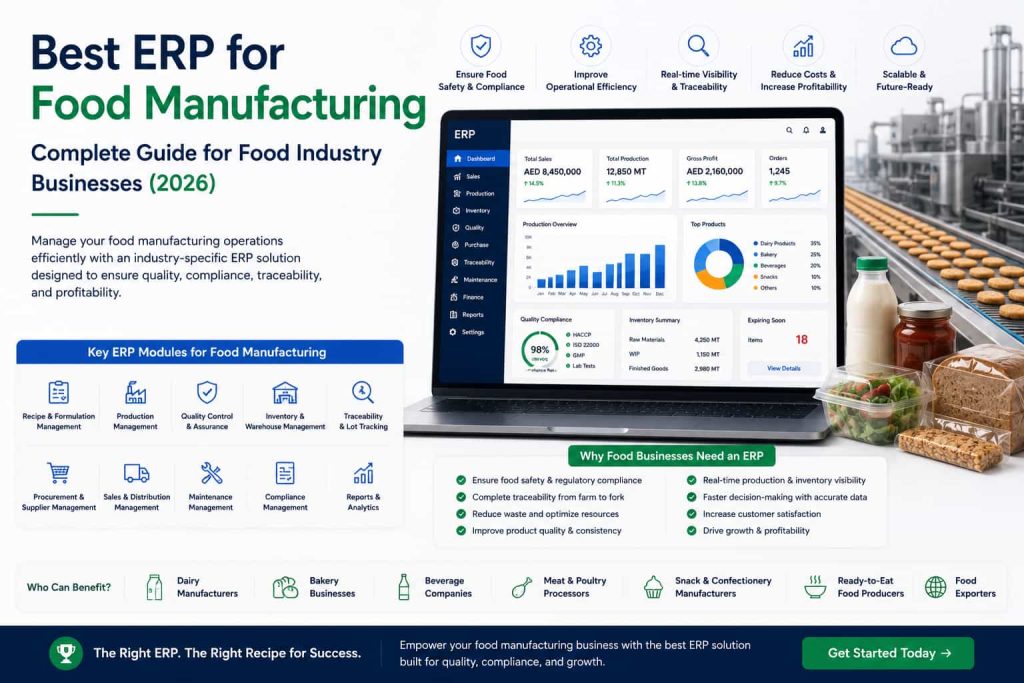
The best ERP for food manufacturing is a specialized software solution designed to manage production, inventory, quality control, compliance, and supply chain operations within food processing businesses.
In simple terms, it helps food manufacturers track raw materials, manage batch production, ensure food safety compliance, reduce wastage, and maintain product quality, all within one integrated system.
With increasing regulatory requirements, demand for traceability, and pressure to reduce costs, ERP systems have become essential for food manufacturing companies aiming to scale efficiently.
What is ERP for Food Manufacturing?
ERP for food manufacturing is an industry-specific system tailored to handle the complexities of food production.
It integrates:
- Batch and process manufacturing
- Inventory and warehouse management
- Procurement and supplier management
- Quality control and compliance
- Production planning
- Financial accounting
- Supply chain management
Unlike generic ERP systems, food ERP focuses on traceability, shelf-life management, and regulatory compliance, which are critical in the food industry.
Why Food Manufacturers Need ERP Software
Food manufacturing involves strict compliance and complex operations.
Key Challenges:
1. Batch Production Complexity
Managing recipes, ingredients, and batch processes.
2. Expiry & Shelf-Life Management
Tracking product freshness is critical.
3. Regulatory Compliance
Following food safety standards and regulations.
4. Traceability Requirements
Tracking products from raw material to final delivery.
5. Inventory & Wastage
Managing perishable goods efficiently.
The best ERP for food manufacturing helps solve these challenges through automation and real-time tracking.
How ERP Works in Food Manufacturing
Example Scenario:
- Raw materials are purchased and recorded
- Inventory is updated with batch and expiry details
- Production is planned based on demand
- Recipes and formulations are followed
- Batch production is tracked
- Quality checks are performed
- Finished goods are stored and distributed
- Financial records are updated
👉 This ensures traceability, compliance, and efficiency.
Core Features of the Best ERP for Food Manufacturing
1. Batch & Process Manufacturing
Handles recipe-based production.
Benefits:
- Accurate production planning
- Consistent product quality
2. Lot Traceability
Tracks products from raw materials to finished goods.
Benefits:
- Easy recall management
- Improved transparency
3. Shelf-Life & Expiry Management
Tracks product freshness.
Benefits:
- Reduced wastage
- Better inventory control
4. Quality Control & Compliance
Ensures adherence to food safety standards.
Benefits:
- Regulatory compliance
- Improved product quality
5. Inventory Management
Tracks raw materials and finished goods.
Benefits:
- Real-time visibility
- Reduced stock issues
6. Production Planning & Scheduling
Optimizes manufacturing processes.
Benefits:
- Increased efficiency
- Reduced downtime
7. Financial Management
Tracks costs and profitability.
Benefits:
- Accurate cost analysis
- Better financial decisions
8. Supply Chain Management
Manages procurement and distribution.
Benefits:
- Efficient logistics
- Improved supplier coordination
Benefits of Using the Best ERP for Food Manufacturing
1. Improved Product Quality
Ensures consistency across batches.
2. Enhanced Traceability
Tracks products throughout the supply chain.
3. Reduced Wastage
Optimizes inventory and shelf-life.
4. Better Compliance
Meets food safety regulations.
5. Increased Efficiency
Automates production and operations.
6. Real-Time Visibility
Provides instant insights into operations.
7. Scalability
Supports business growth.
Top ERP Options for Food Manufacturing (Balanced Overview)
1. eresource ERP
A flexible ERP solution designed for food manufacturers.
Key Features:
Batch and process manufacturing support
Inventory and expiry tracking
Compliance-ready system
Customizable workflows
Scalable solution
Drawbacks:
Requires proper implementation planning
Advanced features may need training
2. SAP Business One
Widely used ERP for mid-sized food businesses.
Strengths:
Strong reporting
Scalable
Limitations:
High cost
Complex setup
3. Oracle NetSuite
Cloud ERP for large enterprises.
Strengths:
Global capabilities
Real-time insights
Limitations:
Expensive
Requires customization
4. Microsoft Dynamics 365
ERP integrated with Microsoft ecosystem.
Strengths:
Flexible system
Strong integration
Limitations:
Licensing costs
Customization needed
5. Odoo ERP
Modular ERP for SMEs.
Strengths:
Cost-effective
Flexible
Limitations:
Requires customization
Depends on partner
Real-Life Use Cases
1. Food Processing Company
Tracks batch production and expiry dates.
2. Dairy Manufacturer
Manages perishable inventory and compliance.
3. Beverage Company
Handles large-scale production and distribution.
4. Packaged Food Brand
Tracks supply chain and product quality.
Common Mistakes Food Manufacturers Make
- Using generic ERP instead of industry-specific
- Poor inventory tracking
- Ignoring compliance requirements
- Lack of traceability
- Not tracking production costs
How to Choose the Best ERP for Food Manufacturing
1. Industry-Specific Features
Must support batch processing and traceability.
2. Compliance Support
Ensure food safety standards are met.
3. Scalability
Choose ERP that grows with your business.
4. Integration Capability
Must connect with existing systems.
5. Ease of Use
User-friendly interface is essential.
Why eresource ERP is a Strong Choice
For businesses searching for the best ERP for food manufacturing, eresource ERP offers:
Key Strengths:
- Food industry-specific modules
- Batch and expiry management
- Real-time inventory tracking
- Compliance-ready system
- Flexible deployment options
- Scalable for SMEs and enterprises
It focuses on delivering practical ERP solutions tailored to real food manufacturing challenges.
ERP Trends in Food Manufacturing (2026)
1. Smart Manufacturing
Integration with IoT and automation.
2. AI-Based Demand Forecasting
Improves planning accuracy.
3. Cloud ERP Adoption
Enhances flexibility.
4. Real-Time Analytics
Improves decision-making.
Frequently Asked Questions(FAQs)
ERP for food manufacturing is a system that manages production, inventory, and compliance in food businesses.
ERP improves efficiency, ensures compliance, and provides traceability.
It should include batch tracking, expiry management, and quality control.
Yes, ERP systems support regulatory requirements.
Yes, ERP systems are scalable.
Yes, ERP optimizes inventory and shelf-life management.
Yes, it tracks products from raw materials to delivery.
Dairy, beverages, packaged food, and processing industries.