ERP Software for the Plastic Manufacturing Industry: Solving the Challenges That Generic Systems Miss
Plastic manufacturing is one of the most competitive segments in Indian manufacturing — and one of the hardest to manage with generic software. Resin prices swing weekly, machines run around the clock, scrap and regrind must be tracked gram by gram, and customers demand batch-level traceability. Consequently, plastic manufacturers need ERP software built for how their factories actually work. This guide covers the specific challenges of the industry and how an integrated system like eresource Xcel addresses each one.
The Challenges Unique to Plastic Manufacturing
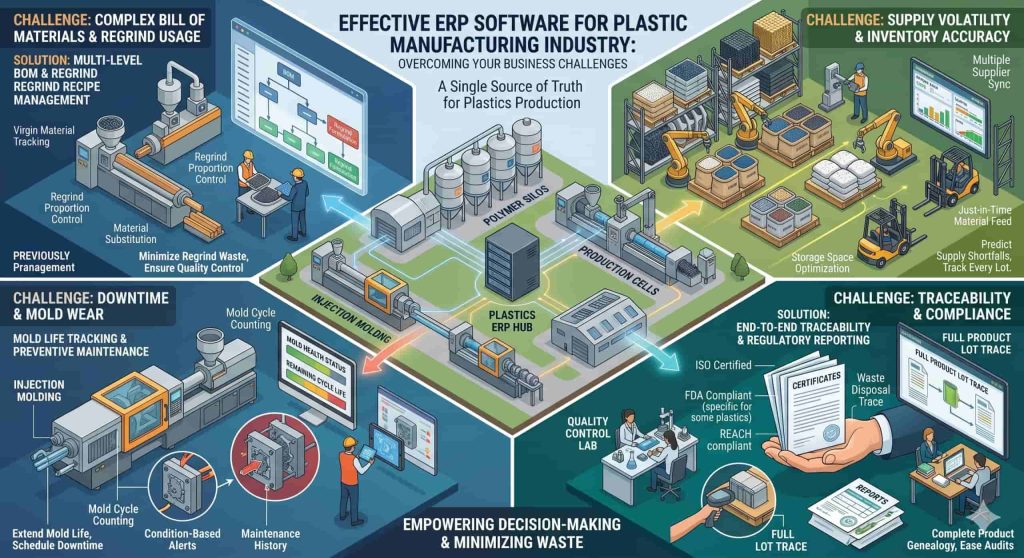
Plastic processors — whether running injection molding, extrusion, blow molding, or thermoforming — face a set of problems that ordinary business software was never designed for:
- Volatile raw material costs. Resin, polymers, colorants, and additives move with global markets. A quotation priced on last month’s rates can turn a profitable order into a loss.
- Machine-driven production. Output depends on press and line scheduling; an idle machine or a slow mold changeover burns margin directly.
- Scrap and regrind. Runners, sprues, flash, and rejected parts are not waste — they are recoverable material. But without systematic tracking, nobody knows how much regrind exists, where it went, or what it saved.
- Mold and tooling health. Molds are among the costliest assets in the plant. Missed maintenance means defects, downtime, and shortened tool life.
- Batch traceability. Customers in packaging, automotive, and FMCG supply chains increasingly demand traceability from resin lot to finished part.
How ERP Software Solves Each Challenge
1. Raw Material Planning and Cost Control
The system tracks resin and additive stocks by lot, calculates requirements against confirmed orders through MRP, and raises purchase orders at the right time. Moreover, live material rates flow into costing, so every quotation reflects today’s resin price — not an outdated assumption.
2. Production Planning Across Machines and Molds
Work orders are scheduled machine-wise and mold-wise against real capacity. Supervisors record production, downtime, and rejection at each press or line, so planners see utilization daily and management sees output against plan without waiting for month-end.
3. Scrap and Regrind Tracking
Every kilogram of scrap generated, reground, and reused is recorded against its job and material lot. As a result, manufacturers finally see their true material yield — and the genuine savings regrind delivers — instead of estimates.
4. Mold and Tooling Maintenance
Preventive maintenance schedules by shot count or calendar, breakdown logging, and full history per mold keep tooling healthy. The system flags a mold due for service before it starts producing defects.
5. Batch Traceability and Quality Control
Inspection checkpoints at material inward, in-process, and final stages tie every result to its batch. Therefore, when a customer raises a complaint, you trace the affected parts to their resin lot, machine, operator, and shift in minutes.
6. Costing, GST, and Finance
Material, machine-hour, and overhead costs post to each job in real time, revealing the true margin per product and per customer. Meanwhile, GST, e-invoicing, and e-way bills generate directly from dispatch data.
Why Plastic Manufacturers Choose eresource Xcel
eresource Xcel is a web-based [manufacturing ERP software](→ /erp-for-manufacturing/) developed exclusively for manufacturing industries, with every module a plastic processor needs — planning, production, stores, purchase, quality, maintenance, sales, and finance — integrated on one platform. Because it is web-based, supervisors update production from the shop floor on a mobile device, and management reviews live dashboards from anywhere. Implementation follows eresource’s guaranteed on-time model, with structured user training so the system is used to its full capability from day one.