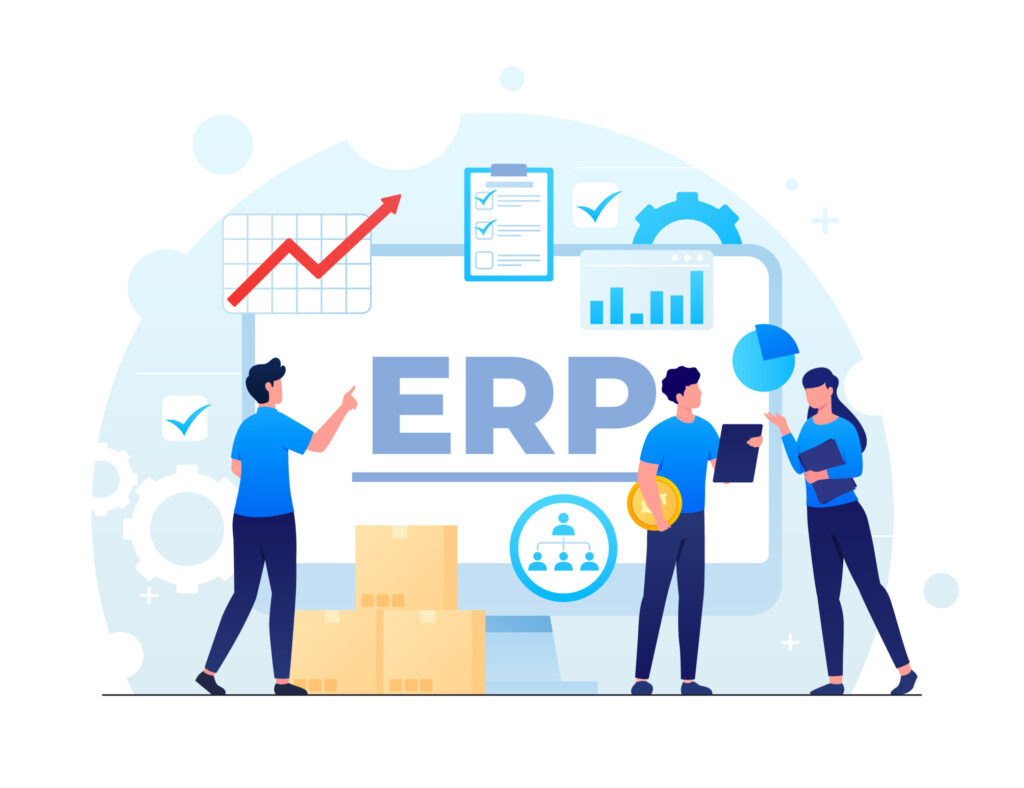
Common Myths of ERP (Enterprise Resource Planning): There are a lot of ERP myths that surround the concept, infrastructure, implementation and practice of Enterprise Resource Planning. Very often people are not willing to adopt ERP because of these wrong notions. In this section we will see some of the most common myths about ERP and will try to demystify them. ERP MEANS MORE WORK AND PROCEDURES Properly implementing and managing an ERP system is not an easy task. The transition period from the traditional system or manual processing to ERP is difficult as new skills have to be learned; new procedures and processes have to be followed, and so on. Many employees think that ERP will add more work, make the work more difficult and will force unnecessary procedures. Transformation from the old system to the ERP system is a difficult process. However, if the management and the implementation team do their job properly, ensuring that the employees are told what to expect and given proper training, then the transition can be smooth. Once the employees get used to the new system, they will understand the potential benefits and the effort saved through automation of talks and jobs. Today’s ERP tools automate many of the repetitive, monotonous and tedious procedures, tasks and processes thus making the life of the employees a lot easier. ERP WILL MAKE MANY EMPLOYEES REDUNDANT AND JOBLESS Another popular misconception about ERP system is that its implementation will make many jobs redundant (because of the automation) and hence, many employees will lose their jobs. A properly implemented ERP system will automate many tasks in the organization. This does not mean that the ERP system will make people redundant. Yes, there will be changes in job descriptions and in the activities people used to do. Many tasks will be automated and this will make the people who were doing those jobs unnecessary. But ERP system also create new job opportunities and they very same people whose jobs were automated could be used to fill the new positions after giving them proper training on the new tasks. Hence, the amount of planning that goes into re-location and re-training of the employees by the management and the implementation team can go a long way in reducing the anxieties of the employees. ERP is a people system made possible by computer software and hardware. ERP IS THE SOLE RESPONSIBILITY OF THE MANAGEMENT Making an ERP system work is the responsibility of all the employees. It involves virtually every department and every person within the company. The company management is not responsible for the day-to-day operation of the ERP system. Their main job is to create an organizational environment in which ERP can thrive – give ERP the full backing of the management. They should also be involved in the development of ERP policies, usage guidelines, allocation of budget, package selection and appointment of competent professionals to implement and manage the ERP system. Only when the ERP team has the full backing and support of the management, they will be able to implement the system smoothly. The management should monitor the implementation and operation of the system, review the progress and status periodically and should take necessary corrective action, if required. The management should also ensure that the ERP implementation team gets the support and co-operation of all the departments, But, thinking that the ERP system will succeed just because the management is fully committed to its implementation and operation is one of the biggest mistakes that an organization can make. In fact, it is the employees – the day-to-day users of the system – who will decide the fate of the ERP system. If the employees are not fully appraised, trained, satisfied and are not happy with the system and are not using it properly, then the ERP system will be a failure. ERP IS JUST FOR MANAGERS OR DECISION-MAKERS The managers and decision-makers are the major users of the ERP system. They are the people who benefit the most from the properly implemented ERP system. They will have all the information they need at their fingertips for making informed decisions. The quality of the decisions and the speed with which the decisions are made are dramatically improved as the ERP systems provide high-quality, timely and relevant information. But every employee in an organization benefits from the ERP system. An ERP system gives the store clerk access to the inventory record and enables him to find out the exact quality of an item. It allows the production supervisor to plan his activities. It allows all employees to apply for leave, get loads approved, gets the travel expenses reimbursed and so on. But for making the best use of the information processing power of an ERP system the users should be trained on how to make the best use of the various features available. If people are ignorant about these, they will find it useless and if they are not properly trained, they will find the experience frustrating and tedious. These people will not use the ERP system or if forced will use it but not to its fullest potential. They will see ERP as a waste of time and do it just because they are forced to do it. This hostility towards ERP can be eliminated if the users are properly educated and make aware of the benefits of the ERP system. ERP IS JUST FOR MANUFACTURING ORGANIZATIONS This assumption is basically due to the way in which ERP was historically developed from the methods of Material Requirement Planning (MRP) and Manufacturing Resource Planning (MRP II), which are relevant to manufacturing organizations. In the manufacturing industry, MRP became the fundamental concept of production management and control in mid 1970s. At this stage BoM (Bill of Materials), which is purchase order management that utilizes parts list management and parts development, was the prevailing trend. And this concept unfolded from order inventory management of materials to plant and personnel planning and distribution planning, which in turn became MRP II. This incorporated
eresource Life Science ERP software is helping drive the change a way to benchmark compliance, improve processes and keep up with the pace of business. How do we avoid Quality and Compliance Oversights? How do we stay in line with Good manufacturing practices (GMP)? Budgets have decreased for R&D due to pricing norms leading to low profitability in a highly volatile market? How do we bring in cutting edge ideas, convert them into implementable business processes, encouraging continuous innovation extending far beyond Intellectual Property Rights (IPR) for a product? All such questions above are generally faced by most pharmaceutical companies. At a corporate level, quality and compliance management in heavily regulated pharmaceutical environments is a tricky endeavor. After all, success in the areas of quality and compliance can only be achieved when a multitude of variables are controlled and continually maintained. From document control to CAPA control, and from audit to CRO management, quality and compliance, to avoid oversights, requires full attention and/or automation over all pertinent details. Also Read – Construction Management ERP Key Benefits : Holistic approach, consolidating, integrating and streamlining all the business processes, helping to keep track of sensitive functions, such as: Compliance with legal regulation. Formulation and Recipe management. Real-time bi-directional material traceability. Batch tracking in WIP, and Yield reconciliation. Lot Management. Effective management of BMR/BPR as per GMP. Wastage elimination through expiry management. In Process Quality Control (IPQC) system, Inspection and certificate analysis. Shorten production cycles, maintaining high quality standards across processes and optimize the use if resources. Single source of centralized data, effective and clear analytical reporting, leading to quick decision making. Also Read – ERP for electronics
ERP for Construction and Infrastructure Industry: Infrastructure and construction companies are known for having a large site network. Today’s rapid business environment demands these companies to have on-line information on daily work progress. It is required for better planning and effective payment system. eresource Nfra ERP for Construction and Infrastructure industry is integrated with suitable modules that helps the management to get data from the sites on a daily basis. There is no need of expensive hardware installations. What you need at the site is only a PC and Internet connection and your work is done. eresource Nfra ERP has a number of implementations in the construction and infrastructure field in its credit. It makes us happy when he hears our customers say they were able to recover the investment that they have made in our ERP solution within a year. The first and most important benefit of eresource Nfra ERP solution is that information has now become completely transparent and seamless. There is no scope for malpractices or hoarding information. With a smooth information flow, decision-making has also become much quicker. Processes like purchasing materials have been automated and have been immense benefit from the solution. Here are some of the key benefits of eresource Nfra ERP for construction and infrastructure Industry. All offices, branches with its department and site offices are now connected on a single platform Free flow of Information between departments Effective fund management Overview of the projects and instant availability of data and reports With the implementation of eresource Nfra web-based ERP you also take your business online. Your company will link all the modules together to the central system and make the information flow in real-time. The construction and infrastructure companies are witnessing the results of enterprise management and consolidation of information. One of the many benefits of implementing eresource ERP solution has been a tight integration between all projects and site offices with the company headquarters. As a result of this improved coordination there is greater efficiency across the various business processes and function. The company will able to get a complete breakdown of its project costs in terms of material. With eresource Nfra ERP you have nothing to look beyond. Take the right decision. Implement eresource Nfra ERP and be happy with a business solution with guaranteed success. Also Read – ERP for packaging industry
eresource: A scalable, flexible and affordable ERP solution for SMEs FOR any organization, success depends on having the ability to keep pace with rapidly changing customer and industry demands and execute in a short amount of time, the ability to quickly seize new opportunities and the ERP flexibility to achieve sustainable business growth. Today small and mid-size enterprises (SMEs) are facing greater competition than ever across diverse industries. With the increasing power of large rivals in some segments and the pricing pressure and they have a critical need to optimize business processes, cut operational costs and improve customer acquisition and retention rates. With the complexity and global reach of today’s business environment, SMEs are also under increased pressure to monitor business processes and financial operations more closely. Stricter accounting and corporate governance requirements intensify this challenge thus, placing growing pressure on businesses of all sizes for greater transparency, timeliness and accuracy in reporting and managerial control. Small and mid-size enterprises are recognizing integrated business management solutions as essential for growth, scalability and keeping up with competitors as the solutions become more affordable, easy-to-implement and adept at addressing industry-specific business processes. While choosing their software solutions, SMEs must balance their long-term needs for innovative solutions to drive the next level of growth with their existing resources and short-term trends for quick return on investment, low-cost of ownership and minimum disruption to current operations. Many SEMs must also ensure integration into their corporate and partner/supplier ecosystems, often requiring the complete replacement of legacy systems. eresource ERP solution for SMEs providing vertical and micro-vertical solutions has nearly half of its software implemented in the SME sector. Monitored through a highly qualified implementation team, eresource ERP solution is affordable, easy-to-deploy and proven business solutions to better meet the needs of customers across diverse industries. The integrated and cost-effective eresource ERP solution allows small and mid-size companies to maintain, a low total cost of ownership and the scalability and the flexibility to support current and future business needs. Also Read – ERP for electronics
Workshop on ERP to guide how to run a successful Business We have, time and again emphasized the importance of having ERP system to run businesses in successful way in today’s competitive economic market. As there are number of big and small vendors in the Indian ERP market, selection of a proper system that suits your business needs are very important. To place the matter straight forward, what the decision makers must understand is having an ERP system just can’t help your business process. What is important is which system you have implemented. A rightfully conducted ERP workshop could provide you the guidelines of what your requirements and expectations should be, including hands-on experience with the most successful ERP software in India available today. ERP workshop can also empower CEOs, COOs, CFOs, accountants, controllers, business owners and key decision-makers with ERP technology concepts. CRM or Customer Relationship Management, the backbone of any business has been integrated as an important module in the ERP system. Sales and marketing teams from companies can benefit from attending the workshop that will help them gain knowledge in marketing plans. The knowledge gained through from workshop can put into practice by the sales or marketing team with the approach to the customers that could help improve your revenue and market share growth and minimize expenses – all of which leads to higher profitability. The workshop will also debate on all areas of an ERP system, its advantages and disadvantages. When it comes to benefits of ERP there are many arenas which are unknown to many. ERP expects boundary-less flat organization structure where every employee is a decision maker and not a mere follower. Secondly, the decision-making must be scientific than based on ‘gut feel’. Thirdly, ERP assumes that the user has an in-depth knowledge of the process he is associated with. He has to work in a team as a key resource element. The objective of the user is to pass maximum value to the customer than to create his own convenience. The user must be analytical in his thinking and be able to use information generated through data iterations for more effective and informed decisions. ERP system will work successfully if the users are training to handle the system to the optimum usage. Proper training makes the users fully equipped with handling of the system independently and this will contribute the success of all the business operations. The solution provider must pay attention while providing training to the user in the right manner. To become a good user, one has to get trained and trained well, and later self trained. But what is the disappointing factor is most of the ERP training in India is more of software training rather than going deeply into the functionality and technicality of the ERP system. Normally the user is shown various screens of the ERP system and taught how to enter what he was doing previously. The trainer must explain to the user why he should enter there, what are the repercussions of his entries in other modules, how to use the best out of multiple settings, why a particular setting is made like that, etc. In fact, the reality that every entry is the financial entry and ultimately gets posted into General Ledger and posted in turn into Profit & Loss Account or Balance Sheet is never realized by the user during training or even after implementation. This feel of responsibility is extremely essential for the user to become a mature ERP user. To enhance the interest of users Indian ERP companies must make a point of user training, focusing on ERP functionalities and not merely on tools for ERP. Ideally, the training session should be designed to cater to individual needs and hence carefully planned. ERP workshop will have a separate session to discuss and elaborate the training method of ERP extensively. Also Read – Construction erp in uae
It is common for all vendors and consultants to say that their products are the best. But when eresource makes such a claim it holds a concrete evidence to support that claim. The commendable feature of web-based ERP is that employees enter information only once and that information is then available to all systems company-wide. Business activities across the organization is tracked or triggered by the eresource ERP are also automatically captured in the enterprise’s general ledger, without the risk of re-entry errors. This means everyone in the company can make decisions based on accurate, real-time information. eresource ERP system manages everything from order capture to accounting and procurement to warehousing. eresource makes timely changes in their modules with the requirement and its functionality has grown in both breadth and depth to suit small to large scale industries. As companies integrate business units through consolidation, shared services, or global operations, their IT ability also to be stretched to support these changes. With eresource ERP’s broad functionality, any organization can replace much of their legacy systems. eresource ERP is capable of providing better support for these new business structures and strategies. An efficient and completely integrated web-based ERP system like eresource ERP could capture and create accurate, consistent and timely relevant data, and assist in intelligent business decision-making. The effect of ERP/e-Business integration is will be clearly visible. The result will be reflected in every level of operations, ranging from reduced inventory and personnel level to improved order and cash management. It can also result in improved customer responsiveness, reduced IT costs and the availability for value-added activities. Also read – ERP for Plastic industry Benefits of eresource ERP With eresource ERP customer orders can be handled easily and efficiently on a time-bound basis. Like when a customer service agent receives a phone call from an existing customer the agent can quickly locates the customer’s account, records the order details, prices the order, and checks the availability date. The customer confirms the order details and the agent books the order. That single entry triggers everything from allocation of the finished product against the order to delivery and billing. That is, based on existing demand and allocation rules, eresource ERP system will determine whether the product should come from current finished goods in a warehouse, in-process goods, scheduled production, or new production. It will set the order up for shipment based on information from either the customer or the customer master record, and, once the order is shipped, prepare an invoice and an accounts receivable entry. However, along with efficient customer handling method, organizations must also have operational efficiency to succeed in business process. Because just keeping customers happy and offering personalized service will not have any effect if the operating efficiency of the company is poor. In order to improve efficiency and to have better information integration, companies should have an effective Web-enabled ERP system in place. There is no doubt that an efficient and well-implemented ERP system like eresource ERP can raise the productivity to unprecedented levels. Also read – construction erp software in uae
How ERP can improve productivity in Manufacturing sector? Productivity improvement Enterprise Resource Planning (ERP) solution can significantly improve the productivity of the Manufacturing ERP sector. Use of ERP should not be looked at as a tool for automation of the transaction system. The major objective of ERP application should be improvement of business process. ERP systems are designed to address the problem of fragmentation of information in manufacturing organizations. ERP systems promise to integrate an entire business with a suite of software modules covering activities in all areas of the business. Furthermore, ERP is now being prompted as a desirable and critical link for enhancing integration between all functional areas within the manufacturing enterprise. ERP system has been defined as a packaged business software system that allows a company, to automate and integrate the majority of its business processes, and share common data and practices across the enterprise. Through integration of various functions in the organization, managers and staff alike can use timely information to make better decisions and to perform activities, which add value to the company. Also read – ERP for Plastic industry Here are some of generic ERP capabilities that can be used in the Manufacturing sector: ERP can transform unstructured processes into routine transactions such as electronic approval of purchase orders based on predefined company policies. ERP can replace or reduce the human labour involved in processes, like matching of supplier invoices based on accepted purchase receipts. ERP can transfer information rapidly and with ease over large distances. It is now possible for various offices and factories of an organization to perform transactions and analysis on the same server, reducing geographical distances. ERP can help manufacturing companies in carrying out analysis such as: Forecasting of market demand based on statistical models; Capturing of hidden market trends through multi-dimensional analysis; Identification of potential improvement areas. ERP can bring a vast amount of detailed information into the process. ERP can enable changes in the sequence of task in the process, often allowing multiple tasks to be performed concurrently. ERP allows the capture and dissemination of knowledge and expertise to improve the process. ERP allows detailed tracking of task status, inputs and outputs. Also read – construction erp software in uae
ERP for Industrial Manufacturing sector: eresource ERP Complex equipment manufacturing organization comes under Industrial Manufacturing sector, which is very technology and price sensitive market. Needless to say the challenges faced by this sector for the steady business process are numerous. As it is known that manufacturing is based on customer specification in Make to Order situation and translating customer specification into bill of material and bill of routing is a big challenge. There are even separate departments have been set up in some organizations to handle this activity. The ERP system have configured to order (CTO) functionalities where the design rules can be configured. It will be geared to handle any amount of complexity in design rule. Once the customer specifications are put into the system, the same should be automatically transformed into bill of material and routing. ERP Manufacturing industries have a strong requirement for analyzing at the quotation stage. Normally the customer specifications are complex and lead time for manufacturing is high. It is a big challenge to quickly quote the right price and promise the delivery date based on material and capacity availability. The ERP system will greatly help in this regard. Since design rules can be configured through the ERP system, it will be possible to quickly translate customer demands into manufacturing requirements and hence, reduce the cost of making the product. Also it will help in keeping the due dates to the customers based on organization capabilities. Since technologies are changing at a fast pace, the customers demand short delivery times from the Original Equipment Manufacturer (OEM). It is a real challenge to provide customer specific products at a short notices. The ERP system should be able to handle hybrid manufacturing scenarios (mix of make to stock and make to order) where they will take advantage of making the final product using Make to Order Scenarios (MTO) and reduce total time for delivery using the strong planning features of Make to Stock (MTS). The technology sensitive market requires close collaborations between vendors, contractors and subcontractors at the design level. Design level collaboration between different parties using the B2B interface of the business application will be of special help. Without use of sophisticated ERP systems, such collaboration cannot be effective. The management of spare parts is also important. Spare parts are characterized by both Independent and Dependent demand. While the former coming directly from the market and the later from the manufacturing of the final product. These scenarios are normally characterized by strong after sales service. ERP systems can really help in devising the service schedules, collating the service information from the market and providing the same as feedback to the design and manufacturing department, quick diagnosis and rectification of faults through knowledge management and managing after sales contracts with customers. The whole process of manufacturing has to be taken up as a project with demand pegging throughout the manufacturing structure. This indicates there is a strong need of information exchange across the manufacturing project and at all levels. Also Read – ERP Software in Mumbai
Indian ERP Market eresource ERP helping many small and medium business enterprises in India gain maximum benefits from its ERP implementation and also edge over their competitors by successfully integrating its key business operations. eresource ERP system links the sales, purchase, manufacturing, order, inventory, supply chain and warehouse management modules in an enterprise for fast and accurate information access to every single person. This is because every single operation and action taken at any place by any person depends on consistent and updated information. Whatever a person required can be immediately accessed by him provided he has the legitimate access to the system. ERP Modules at a glance The integration of the business processes improves coordination between bodies, streamlines workflows and processes and benefits them in terms of retaining and satisfying customers by delivering their orders ‘on dot’. eresource ERP also helps keeping the customer informed about their orders’ current status rather than keeping them waiting for information. eresource ERP makes an organization more time-sensitive. The manufacturing enterprises can also benefit of better marketing opportunities through eresource ERP. It also penetrates section-wise to addresses solutions to many shortcomings existing in an organization. eresource ERP also further enhance the decision making by highlighting future projections about sales during a certain period of a certain product. It helps the management take appropriate decision on the production plan and also helps the executives to introduce new value added features to the existing product. This way the product quality could be checked on time which will enhance the sales process. Listing of benefits from eresource ERP also includes reduced inventory costs by better planning and forecasting of requirements. Ultimately eresource ERP system helps getting higher return on investments (ROI) quickly. Finally, there are no two opinions that ERP system has a great importance and it has become the need of the hour for the survival of organizations especially in the manufacturing sector. Irrespective of their strength, whether they are the big players in the field or the SMEs, their success will depend on the way they are dealing with the current business process environment. With this note we would like to remind them that an ERP system is part and parcel of that successful formula. eresource ERP for Manufacturing industry consists of following modules. Sales and Distribution Management This Module comprises of Contact Management and Sales Order Processing Management. It is an integrated solution comprising of marketing and sales activities. Organization can act immediately to improve sales, service and marketing effectiveness by using this Module. eresource Sales Management module is all about retaining customers, improving customer loyalty and gaining customer insight Purchase Management Module Purchase Management module in eresource ERP streamlines procurement of required raw materials, packaging material, sub assembly and other non-inventory materials. It automates the processes of identifying potential suppliers, Supplier Evaluation, Supplier Quote Evaluation, awarding purchase order to the supplier, and billing processes. Purchase module is tightly integrated with the inventory control and production planning modules. Manufacturing, Planning and Control Manufacturing, Planning and Control Module in eresource ERP optimizes the utilization of manufacturing capacity, parts, components and material resources using historical production data and sales forecasting. Total Quality Management Module eresource ERP Quality Control Module not only monitors quality by control plans in purchasing and manufacturing but also provides real-time process capability index for quick review. Quality Control in eresource facilities are versatile and offer support for every phase of your operations, from receipt and acceptance of raw materials, through production of intermediates, to inspections of finished goods before shipment to customers. Inventory and Material Management Inventory Management Module in eresource ERP provides a powerful and flexible set of features to help you manage and report your inventory information. eresource Inventory Management facilitates processes of maintaining the appropriate level of stock in a warehouse. The activities of inventory control involves in identifying inventory requirements, setting targets, providing replenishment techniques and options, monitoring item usages, reconciling the inventory balances, and reporting inventory status. Plant and Machine Maintenance The time has changed, machine breakdown and idle repair is no more accepted practice. The plant maintenance module in eresource ERP provides an integrated solution for supporting the operational efficiency. The plant maintenance module covers all equipment / machines of the plant. Excise Management The Excise module in eresource ERP will enable the organization to ensure Excise compliance to manage all transactions of Sales, Purchase, Production, Warehouse Transfer etc., This module will help the organization fulfill its statutory requirements according to latest government regulations. Human Resource Management Human Resource module in eresource ERP streamlines the management of human resources and human capitals. It comprises of four broad sections, mainly Training, Recruitment, Payroll and Attendance. HR module in eresource routinely maintains a complete employee database including contact information, salary details, attendance, performance evaluation and promotion of all employees. Finance Resource Management Finance Resource Management in eresource ERP gathers financial data from various functional departments and generates valuable financial reports such as Balance Sheet, Trial balance, General Ledgers, Quarterly Financial Reports, Account Statements, Gross Profit Analysis, Cost Center wise Analysis, Branch wise Profit Analysis, profitability report, Asset and Depreciation Management, Tax Management, ABC Analysis and many more. Also read – erp for trading company
Web-based ERP Software for Manufacturers : Many of the Indian manufacturers, who have implemented eresource ERP recently, has started showing a steady growth in their business which in turn has helped to bring a considerable return on investment (ROI) in a short period. eresource ERP, India’s leading and exclusive web-based ERP solution aims to bring a software revolution in India’s small and medium scale industry. ERP for India’s SMEs who are limping behind the leaders in their respective fields required a strong foundation for their functional process. Till recently an ERP solution was a distant dream for many of them. But with the introduction of eresource ERP the situation has been changed and many of these manufacturing organizations have implemented our low cost ERP which falls within their budget. As far as the Indian SMEs are concerned the customer is demanding fast turnarounds, which force the planning modules to be much smarter. A small mistake can be very costly. Therefore the ERP solution has to be flexible to accommodate changes and manage the process. With eresource ERP your business process to be more transparent, which ultimately helps add more customers to your client list. The best lesson to be learned by the small and medium scale enterprises in India is you can’t just compete on price and quality alone anymore. To keep pace with the competition you required a system. You need to have the ERP system on place. It will be too late if you don’t realize it at the right time. Also read – ERP for Packaging industry
Pharmaceutical ERP (Enterprise Resource Planning) software system is the most effective way to identify and track every single raw material from receipt through processing, packaging and shipping, to the exact customer location. If that is the case then what prevents from many small and medium Indian enterprises keeping away from implementing this effective tool. The ground reality points to cost factor. ERP is costly, that’s what some of the feedback we have received. eresource Infotech thought of an alternative. An affordable for ERP from eresource ERP for Indian market has been found its way through many of our customers who have started taking advantage of this effective tool in a very successful manner. The advantage of eresource ERP for pharmaceutical manufacturers are that it can effortlessly track lot properties while optimizing and improving other business processes like batch production, sales functions, inventory control, purchasing, quality assurance, accounting and finance, regulatory reporting etc. Best ERP for Pharmaceutical Industry It has been proved beyond doubt that implementation of eresource ERP systems not only gives more transparency to your business process but also it allows your business to operate more efficiently, predictably and more profitably. Implementing an industry-compatible eresource ERP system will not only meet the traceability requirements, but also seamlessly link all departments, resulting in streamlined operations, maximized productivity, and increased profitability. While choosing an ERP system you should consider both its ability to track every raw material from receipt through finished product delivery, and its adaptability to your unique manufacturing process. eresource ERP helps you to oversee every area of your business without the necessity for separate software packages or expensive customization. Also read – Manufacturing erp software in uae
ERP Software for SMEs The first and foremost reason being that it has been designed by an Indian software solution company exclusively for the Indian manufacturing industry, especially the Small and Medium scale Enterprises. Needless to say that the contribution made by the SME’s in the Indian manufacturing industry incomparable. What is more appreciable is that all these years they were contributing largely into the growth of Indian industry with their limited resources and infrastructure facilities. Growth of any industry depends on what basic environment they work with. An advanced work environment will not only boost morale of their employees but also the outcome will be reflected in the quality of their product. Also Read – ERP for Electronics Industry eresource ERP Software for SMEs (Small and Mid-size Enterprises) There was a time when implementation of ERP solution was a long lost dream for many of the SME’s in India. They never imaged implementation of ERP could be within their reach in near future. But introduction of an affordable low-cost ERP by eresource Infotech was a dream comes true for the Indian SME’s. The reason why we have come out with this kind of a solution is that if Indian SME’s could perform tremendously with the limited resources they have, they can also bring miracles in the industry if they are armed with right working environment. We were sure that the implementation eresource ERP will definitely change the way they work and also it can make the impact on their production sector, in both quality and quantity wise. Another matter of success with eresource ERP is its quick implementation. The ERP system should be implemented quickly, efficiently, on time and on budget and with no interruption to the business. As far as Indian SME’s are concerned time factor is very important and fully understanding this scenario eresource ERP gives maximum priority in implementation process. Over and above, eresource Infotech serves all our ERP customers directly, unlike some ERP vendors who have a strategy to serve the large client directly whilst, directing SME’s to their re-sellers or consultants. Though our client list too include many large enterprises, when it comes to business we are impartial. That’s our policy practice, indeed. Also Read – Best ERP for Automotive industry
ERP Software Training it was discussed earlier how an ERP implementation could turn success or failure depend upon the user. There are different views expressed by Indian users towards ERP, but mostly it is based on organizational culture. The word ‘culture’ is used here to connote the average IT acquaintance of the overall users. In India, normally four different cultural transformations prevailed during ERP implementation. From no system to ERP system From manual system to ERP system From computerized system to ERP system From ERP system to ERP system In the normal circumstances at least two scenarios do exist in most of the Indian companies and sometimes all the four types exist in one organization itself. As the characteristics of the users differ in all the four cases the situation must be managed accordingly. An assessment of ERP by the users is that ERP is a ‘job killer’; hence attempts are made to kill ERP first. Most of the users of this school of thought found successful in their mission but unsuccessful in retaining their job. ERP has nothing to do with the downsizing of employment, but it may possibility recommend redeployment of people in appropriate areas. We have to agree on certain issues like so many years the organization had built a mentality of not owning responsibility in the employees, which immediately cannot be changed within a year or so. ERP expects boundary-less flat organization structure where every employee is a decision maker and not a mere follower. Secondly, the decision-making must be scientific than based on ‘gut feel’. Thirdly, ERP assumes that the user has an in-depth knowledge of the process he is associated with. He has to work in a team as a key resource element. The objective of the user is to pass maximum value to the customer than to create his own convenience. The user must be analytical in his thinking and be able to use information generated through data iterations for more effective and informed decisions. eresource ERP plays successfully when it comes to the training part and our hardcore training session makes the user fully equipped with handling of the system independently. The solution provider must pay attention while providing training to the user in the right manner. To become a good user, one has to get trained and trained well, and later self trained. But what is the disappointing factor is, unlike eresource ERP, most of the ERP training in India is more of software training rather than going deeply into the functionality and technicality of the ERP system. Normally the user is shown various screens of the ERP system and taught how to enter what he was doing previously. Actually the trainer must explain to the user why he should enter there, what are the repercussions of his entries in other modules, how to use the best out of multiple settings, why a particular setting is made like that, etc. In fact, the reality that every entry is the financial entry and ultimately gets posted into General Ledger and posted in turn into Profit & Loss Account or Balance Sheet is never realized by the user during training or even after ERP implementation. This feel of responsibility is extremely essential for the user to become a mature ERP user. To enhance the interest of users Indian companies must make a point of user training, focusing on ERP software functionalities and not merely on tools for ERP. Ideally, the training program should be designed to cater to individual needs and hence carefully planned. Secondly, the empowerment has to be planned slowly but positively over a period. This should include removing ridiculous and conflicting targets, thus helping the users to participate in making ERP a success. Also Read – Benefits of ERP in Construction Industry
Ways to ensure ERP success: In our last article we have discussed what makes a business grow. It was explained in details the basic qualities, applications and dedicated efforts are necessary to succeed in a business field. What we would like emphasis in coming series of articles are that just implementing ERP solution won’t make your business grow. To make ERP implementation sensible, we have to consider some other elements along with its focusing styles and then formulate the overall plan of actions. There are five important elements that have been identified and these are analyzed in details in the following articles. The Client: The first and foremost element The client is, who suggests focusing on the organization’s main line of business. As ERP implementation is more of business strategy than IT strategy, one has to analyze the key business driver’s specific to the industry and also for the company. It is customary to redefine the business processes with proper synchronization of these drivers along with improved customer interactions. The term ‘customer ‘ includes internal as well as external. The organization must plan for leaving traditional functional set-ups and re-configuring its resources across pull type process set-ups where every transaction has specified supplier, customer, and the activities known in all aspects. What is happening in most of the Indian companies is that even after adopting ERP, the organization continues with traditional functional style of departmentalization. This is mainly because of the absence of customer driven strategic plan or its incomplete ERP implementation. In such set-ups or typically in make-to-stock environment, we find the traditional atmosphere of rivalry between various functional departments. For example, Marketing is the main ‘culprit’ for the production planning inefficiencies because of the dynamic, non-standard requirements which do not make sense. Also Read – Eresource plays big role in global ERP market Similarly, production planning department is regarded as the ‘worst’ ever planner by the purchase department. The accounts department is the common enemy of all. Such culture is the outgrowth of the multi-hierarchy organization structure in which cohesive and common language for business performance is missing. The organization is operating with fragmented departmental optimum results and no orientation is observed for the integrated business strategies. ERP completely fails to address such environment the underlying reason being misunderstanding and lack of coordination between different departments. ERP cannot ‘fulfill’ the requirements of these users. For example, a sudden change in released marketing plan without consent of planning and purchase will create complete nervousness in the organization. Also, the targets given to purchase will conflict with production and maintenance targets. Such local optimum objectives lead to overall fragmentation and under utilization of organizational resources. ERP never supports these practices and the corresponding deviation between the Sucessfull ERP software concept and the organization practice will make ERP a costlier affair for the organization. If the client is not able to switch over to lean products and still wishes to eliminate these problems, then S&OP (Sales and Operations Planning) must be followed sincerely. It is the only way out for the Indian companies to improve their existing ERP performance. A few organizations already started this, but it should become a general feature across all sectors. The main idea of SOP is to collaborate internally and find out workable and naturally optimistic plans for particular planning horizons. Participating regularly in such meetings will boost the morale of participants for driving ERP towards success. An important point to be noted here is that this recommendation is applicable to each and every industrial sector including manufacturing and service. Also Read – Major benefits of ERP in production planning
Indian currency this is the one question many businessmen ask themselves. What makes the business grow? We have the answer. It is the Planning. Planning makes a business grow and yield good profit. You may think it is simple. But is it? No. Do you want to find out why it is not simple? For a good planning in business you need to get proper guidance. Are you getting proper guidance or you being misguided? Let us begin from the beginning. It is said that, well begun is half done. This punch line best suited as far as a business enterprise is concerned. In today’s hyper competitive markets, small and midsize companies are faced with ever-growing challenges and they could overcome these challenges if only they are fully prepared. Business enterprises must be occupied with the infrastructure, whether it is in the form of man power strength or the software system, which could streamline and handle the workload successfully and help deliver the result in a desired manner. Success of a business lies in the faith their customers keep with them. To gain the customers’ faith, organizations must fulfill their commitment. Is your organization able to keep the commitment? If not, why? You must have searched for the reasons many a time without getting an answer. Also Read – Manufacturing ERP Software In spite of having dedicated personnel who are ready to carry out orders successfully and enough man power strength to bring out required product from the factory, most of the time you have failed to achieve the desired result. You have failed to deliver goods to your customers as per the commitment made. What went wrong when everything seems going right? We can say nothing went wrong. But you failed in your planning or things weren’t turned out as you and your personnel anticipated. Production department need the raw material to produce the product. You need to provide the raw material. Have you made sure your production department had enough stock in their hand? Have you made arrangement of these materials with your delivery sources? No. Isn’t? And because of the some human error you failed to deliver the goods and you could not keep the promise made to your customers. Will these customers approach you again for their requirements? Can your business survive if the customers don’t come back? But you could have avoided this entire scenario if you had implemented eresource ERP in your organization. eresource ERP identifies the requirement of production in advance, from the raw material requirement, stock available, stock to be ordered, delivery time, production details, man power required, time required for production and all that need to bring out the product on time on a required manner and also it intimates the concerned departments though email alerts. It is just a small example of how eresource ERP could contribute to your business function. eresource ERP, a reliable and affordable ERP solution from eresource Infotech, identifies and supports every function of an organization including its branches, departments and its sub-sections. What is more exciting about eresource ERP is, it not only addresses all your day to day business challenges, you will also get a healthy return on your investment quickly and faster than you probably thought. Also Read – ERP Software for Project Industry
Deliver Return On Investment with ERP software of eresource: A flexible ERP, a reliable ERP, a user-friendly ERP, an affordable ERP, these are some of the features that make eresource ERP stands out from the rest. It is a known fact that due to the economic slowdown it has become a question of survival for majority of the small and medium scale industries in India. The rapid functionality changes in the business environment forces them to be more aggressive, competitive and intelligent. To keep pace with the rivals in the field every organization need to make some smart moves to take their business ahead and help yield a pre-conceived profit. A good resource planning system required to support any smart move to make the desired results. This is the juncture where eresource ERP plays a major role by conceiving and implementing a most reliable and suitable ERP system in place, which obviously results in good ROI (Return on Investment). It is not surprising that eresource ERP has bagged the prestigious UDYOG RATTAN AWARD for Excellence for its services. We are very proud to be the number one in our field in the country. Being the only exclusive home-grown WEB-BASED ERP, our customers are bound to yield a good return on their investment and tremendous growth in their business without any worrying factors. What is more exciting about eresource ERP is, it not only addresses all your day to day business challenges, you will also get a healthy return on your investment quickly and faster than you probably think. eresource ERP can yield higher net profits by: 1. Streamlining your supply chain 2. Improving customer relationship 3. Reducing operational cost 4.Allowing real-time access to information 5. Providing foundation to growth Also Read – ERP Software for Infrastructure Industry