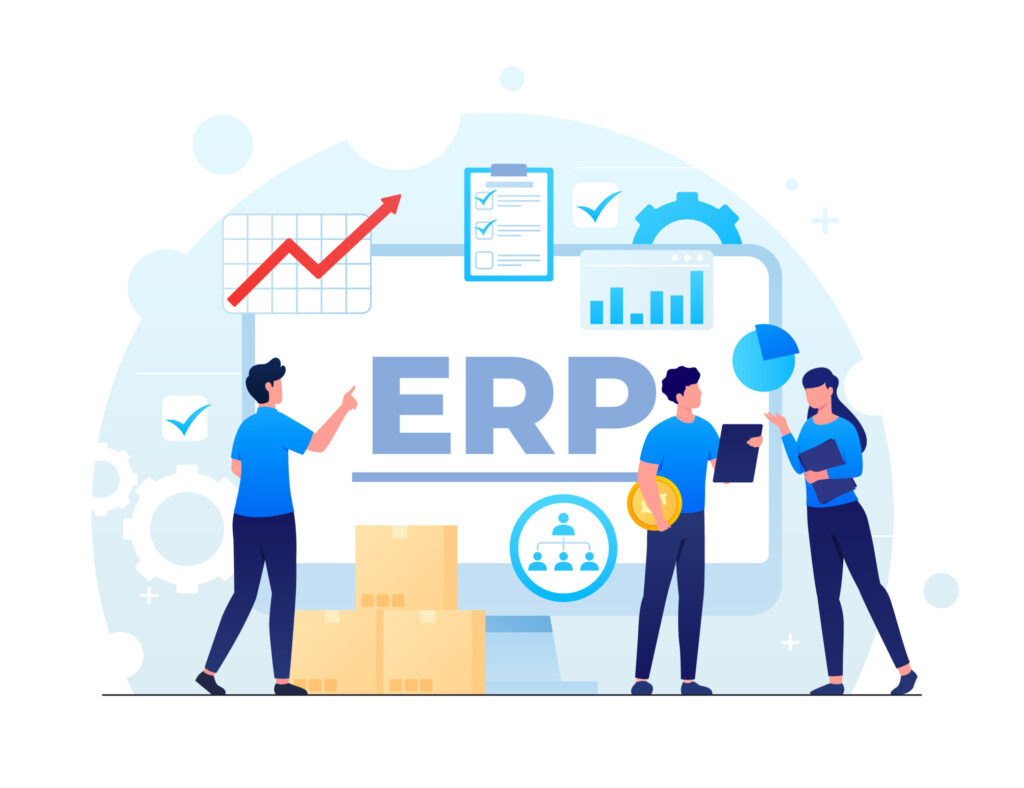
It is common for all vendors and consultants to say that their products are the best. But when eresource makes such a claim it holds a concrete evidence to support that claim. The commendable feature of web-based ERP is that employees enter information only once and that information is then available to all systems company-wide. Business activities across the organization is tracked or triggered by the eresource ERP are also automatically captured in the enterprise’s general ledger, without the risk of re-entry errors. This means everyone in the company can make decisions based on accurate, real-time information. eresource ERP system manages everything from order capture to accounting and procurement to warehousing. eresource makes timely changes in their modules with the requirement and its functionality has grown in both breadth and depth to suit small to large scale industries. As companies integrate business units through consolidation, shared services, or global operations, their IT ability also to be stretched to support these changes. With eresource ERP’s broad functionality, any organization can replace much of their legacy systems. eresource ERP is capable of providing better support for these new business structures and strategies. An efficient and completely integrated web-based ERP system like eresource ERP could capture and create accurate, consistent and timely relevant data, and assist in intelligent business decision-making. The effect of ERP/e-Business integration is will be clearly visible. The result will be reflected in every level of operations, ranging from reduced inventory and personnel level to improved order and cash management. It can also result in improved customer responsiveness, reduced IT costs and the availability for value-added activities. Also read – ERP for Plastic industry Benefits of eresource ERP With eresource ERP customer orders can be handled easily and efficiently on a time-bound basis. Like when a customer service agent receives a phone call from an existing customer the agent can quickly locates the customer’s account, records the order details, prices the order, and checks the availability date. The customer confirms the order details and the agent books the order. That single entry triggers everything from allocation of the finished product against the order to delivery and billing. That is, based on existing demand and allocation rules, eresource ERP system will determine whether the product should come from current finished goods in a warehouse, in-process goods, scheduled production, or new production. It will set the order up for shipment based on information from either the customer or the customer master record, and, once the order is shipped, prepare an invoice and an accounts receivable entry. However, along with efficient customer handling method, organizations must also have operational efficiency to succeed in business process. Because just keeping customers happy and offering personalized service will not have any effect if the operating efficiency of the company is poor. In order to improve efficiency and to have better information integration, companies should have an effective Web-enabled ERP system in place. There is no doubt that an efficient and well-implemented ERP system like eresource ERP can raise the productivity to unprecedented levels. Also read – construction erp software in uae
ERP Software Training it was discussed earlier how an ERP implementation could turn success or failure depend upon the user. There are different views expressed by Indian users towards ERP, but mostly it is based on organizational culture. The word ‘culture’ is used here to connote the average IT acquaintance of the overall users. In India, normally four different cultural transformations prevailed during ERP implementation. From no system to ERP system From manual system to ERP system From computerized system to ERP system From ERP system to ERP system In the normal circumstances at least two scenarios do exist in most of the Indian companies and sometimes all the four types exist in one organization itself. As the characteristics of the users differ in all the four cases the situation must be managed accordingly. An assessment of ERP by the users is that ERP is a ‘job killer’; hence attempts are made to kill ERP first. Most of the users of this school of thought found successful in their mission but unsuccessful in retaining their job. ERP has nothing to do with the downsizing of employment, but it may possibility recommend redeployment of people in appropriate areas. We have to agree on certain issues like so many years the organization had built a mentality of not owning responsibility in the employees, which immediately cannot be changed within a year or so. ERP expects boundary-less flat organization structure where every employee is a decision maker and not a mere follower. Secondly, the decision-making must be scientific than based on ‘gut feel’. Thirdly, ERP assumes that the user has an in-depth knowledge of the process he is associated with. He has to work in a team as a key resource element. The objective of the user is to pass maximum value to the customer than to create his own convenience. The user must be analytical in his thinking and be able to use information generated through data iterations for more effective and informed decisions. eresource ERP plays successfully when it comes to the training part and our hardcore training session makes the user fully equipped with handling of the system independently. The solution provider must pay attention while providing training to the user in the right manner. To become a good user, one has to get trained and trained well, and later self trained. But what is the disappointing factor is, unlike eresource ERP, most of the ERP training in India is more of software training rather than going deeply into the functionality and technicality of the ERP system. Normally the user is shown various screens of the ERP system and taught how to enter what he was doing previously. Actually the trainer must explain to the user why he should enter there, what are the repercussions of his entries in other modules, how to use the best out of multiple settings, why a particular setting is made like that, etc. In fact, the reality that every entry is the financial entry and ultimately gets posted into General Ledger and posted in turn into Profit & Loss Account or Balance Sheet is never realized by the user during training or even after ERP implementation. This feel of responsibility is extremely essential for the user to become a mature ERP user. To enhance the interest of users Indian companies must make a point of user training, focusing on ERP software functionalities and not merely on tools for ERP. Ideally, the training program should be designed to cater to individual needs and hence carefully planned. Secondly, the empowerment has to be planned slowly but positively over a period. This should include removing ridiculous and conflicting targets, thus helping the users to participate in making ERP a success. Also Read – Benefits of ERP in Construction Industry
Ways to ensure ERP success: In our last article we have discussed what makes a business grow. It was explained in details the basic qualities, applications and dedicated efforts are necessary to succeed in a business field. What we would like emphasis in coming series of articles are that just implementing ERP solution won’t make your business grow. To make ERP implementation sensible, we have to consider some other elements along with its focusing styles and then formulate the overall plan of actions. There are five important elements that have been identified and these are analyzed in details in the following articles. The Client: The first and foremost element The client is, who suggests focusing on the organization’s main line of business. As ERP implementation is more of business strategy than IT strategy, one has to analyze the key business driver’s specific to the industry and also for the company. It is customary to redefine the business processes with proper synchronization of these drivers along with improved customer interactions. The term ‘customer ‘ includes internal as well as external. The organization must plan for leaving traditional functional set-ups and re-configuring its resources across pull type process set-ups where every transaction has specified supplier, customer, and the activities known in all aspects. What is happening in most of the Indian companies is that even after adopting ERP, the organization continues with traditional functional style of departmentalization. This is mainly because of the absence of customer driven strategic plan or its incomplete ERP implementation. In such set-ups or typically in make-to-stock environment, we find the traditional atmosphere of rivalry between various functional departments. For example, Marketing is the main ‘culprit’ for the production planning inefficiencies because of the dynamic, non-standard requirements which do not make sense. Also Read – Eresource plays big role in global ERP market Similarly, production planning department is regarded as the ‘worst’ ever planner by the purchase department. The accounts department is the common enemy of all. Such culture is the outgrowth of the multi-hierarchy organization structure in which cohesive and common language for business performance is missing. The organization is operating with fragmented departmental optimum results and no orientation is observed for the integrated business strategies. ERP completely fails to address such environment the underlying reason being misunderstanding and lack of coordination between different departments. ERP cannot ‘fulfill’ the requirements of these users. For example, a sudden change in released marketing plan without consent of planning and purchase will create complete nervousness in the organization. Also, the targets given to purchase will conflict with production and maintenance targets. Such local optimum objectives lead to overall fragmentation and under utilization of organizational resources. ERP never supports these practices and the corresponding deviation between the Sucessfull ERP software concept and the organization practice will make ERP a costlier affair for the organization. If the client is not able to switch over to lean products and still wishes to eliminate these problems, then S&OP (Sales and Operations Planning) must be followed sincerely. It is the only way out for the Indian companies to improve their existing ERP performance. A few organizations already started this, but it should become a general feature across all sectors. The main idea of SOP is to collaborate internally and find out workable and naturally optimistic plans for particular planning horizons. Participating regularly in such meetings will boost the morale of participants for driving ERP towards success. An important point to be noted here is that this recommendation is applicable to each and every industrial sector including manufacturing and service. Also Read – Major benefits of ERP in production planning
Indian currency this is the one question many businessmen ask themselves. What makes the business grow? We have the answer. It is the Planning. Planning makes a business grow and yield good profit. You may think it is simple. But is it? No. Do you want to find out why it is not simple? For a good planning in business you need to get proper guidance. Are you getting proper guidance or you being misguided? Let us begin from the beginning. It is said that, well begun is half done. This punch line best suited as far as a business enterprise is concerned. In today’s hyper competitive markets, small and midsize companies are faced with ever-growing challenges and they could overcome these challenges if only they are fully prepared. Business enterprises must be occupied with the infrastructure, whether it is in the form of man power strength or the software system, which could streamline and handle the workload successfully and help deliver the result in a desired manner. Success of a business lies in the faith their customers keep with them. To gain the customers’ faith, organizations must fulfill their commitment. Is your organization able to keep the commitment? If not, why? You must have searched for the reasons many a time without getting an answer. Also Read – Manufacturing ERP Software In spite of having dedicated personnel who are ready to carry out orders successfully and enough man power strength to bring out required product from the factory, most of the time you have failed to achieve the desired result. You have failed to deliver goods to your customers as per the commitment made. What went wrong when everything seems going right? We can say nothing went wrong. But you failed in your planning or things weren’t turned out as you and your personnel anticipated. Production department need the raw material to produce the product. You need to provide the raw material. Have you made sure your production department had enough stock in their hand? Have you made arrangement of these materials with your delivery sources? No. Isn’t? And because of the some human error you failed to deliver the goods and you could not keep the promise made to your customers. Will these customers approach you again for their requirements? Can your business survive if the customers don’t come back? But you could have avoided this entire scenario if you had implemented eresource ERP in your organization. eresource ERP identifies the requirement of production in advance, from the raw material requirement, stock available, stock to be ordered, delivery time, production details, man power required, time required for production and all that need to bring out the product on time on a required manner and also it intimates the concerned departments though email alerts. It is just a small example of how eresource ERP could contribute to your business function. eresource ERP, a reliable and affordable ERP solution from eresource Infotech, identifies and supports every function of an organization including its branches, departments and its sub-sections. What is more exciting about eresource ERP is, it not only addresses all your day to day business challenges, you will also get a healthy return on your investment quickly and faster than you probably thought. Also Read – ERP Software for Project Industry
Deliver Return On Investment with ERP software of eresource: A flexible ERP, a reliable ERP, a user-friendly ERP, an affordable ERP, these are some of the features that make eresource ERP stands out from the rest. It is a known fact that due to the economic slowdown it has become a question of survival for majority of the small and medium scale industries in India. The rapid functionality changes in the business environment forces them to be more aggressive, competitive and intelligent. To keep pace with the rivals in the field every organization need to make some smart moves to take their business ahead and help yield a pre-conceived profit. A good resource planning system required to support any smart move to make the desired results. This is the juncture where eresource ERP plays a major role by conceiving and implementing a most reliable and suitable ERP system in place, which obviously results in good ROI (Return on Investment). It is not surprising that eresource ERP has bagged the prestigious UDYOG RATTAN AWARD for Excellence for its services. We are very proud to be the number one in our field in the country. Being the only exclusive home-grown WEB-BASED ERP, our customers are bound to yield a good return on their investment and tremendous growth in their business without any worrying factors. What is more exciting about eresource ERP is, it not only addresses all your day to day business challenges, you will also get a healthy return on your investment quickly and faster than you probably think. eresource ERP can yield higher net profits by: 1. Streamlining your supply chain 2. Improving customer relationship 3. Reducing operational cost 4.Allowing real-time access to information 5. Providing foundation to growth Also Read – ERP Software for Infrastructure Industry
ERP for Midsize Companies Sales and Distribution Module in this age of mergers and acquisitions, many organizations which were once small companies, and now, as midmarket organizations, need to consolidate various software systems and standardize business processes. Currently, most of the ERP action is happening in the midmarket. More and more midsize companies – which are rather broadly defined as organizations are looking to replace outdated ERP systems or jump into the technology for the first time. Most companies in this space are coping with increasingly complex operating environments, aging technology – including outmoded ERP systems – proliferating business-management software and, of course, the need to grow revenue. Midsize companies also face challenges specific to their industries. Businesses that make consumer product goods are concerned about regulations and reporting requirements, while public-sector organizations are worried about maintaining customer loyalty. Also, manufacturers are concerned about the commoditization of their products. A robust ERP package can help address these issues, as well. As per a survey conducted last year, which surveyed more than 500 organizations from a variety of industries, it was found that very few midsize companies – just 6 percent – don’t already have an ERP’s MRP (Material Requirements Planning, the precursor to ERP) implementation. For those businesses, the reasons to take a leap into ERP, which is largely considered necessary infrastructure for midsize companies, are many and compelling. It was found that many ERP implementations in the midmarket are quite mature and ripe for replacement. Most of today’s midmarket organizations had ERP systems older than 10 years old. ERP technology has evolved significantly in the years since these systems were deployed, so many of these organizations have developed their own applications to make up for inadequacies. Many midmarket companies must now also choose an ERP system on which to standardize after multiple systems were installed, perhaps through mergers, across the enterprise. It has been noticed that many midsize companies had two or more ERP packages, and some have implemented three or more ERP systems. Although it’s not necessary, midsize companies seem to prefer consolidating their business-management applications in one ERP package, at least in part to cut down on integration headaches. With the advent of Eresource ERP for midsize Companies in India were able to find a suitable ERP solution to match their needs. eresource ERP’s major strength lies in the manufacturing modules that provide multiple benefits for small and midsize organizations. eresource ERP helps the organizations control their day-to-day business. Needless to say, once implemented, eresource ERP will be the heart of your business, wheels of your distribution channel and the brain of your planning activities. Other added feature about eresource ERP system is its on-time guaranteed implementation programme. eresource offers a full refund for any implementation fees where the agreed-upon ERP go live date is delayed, provided the customer meets all defined milestone deliverables on time. Also Read – ERP Software Company in India
MPS Module in ERP Software Master Production Scheduling (MPS) is defined as an anticipated build schedule for manufacturing end items or product options by quantity per planning period. It represents what the company plans to product, expressed in specific configurations, quantities and dates. Sales Operations Planning (S&OP) process authorizes MPS module various products that should be translated into the MPS. Thus, MPS is a listing of the end items (products) or major sub-assemblies (standard modules) which are to be produced in known quantity and when they should be ready for ship meant or further value addition. MPS is a logical representation of information for decision-making. It is what the firm or plant expects to product in the short run. Each individual MPS has a supporting BOM or Formula defining the components needed to product the planned quantities of the end item. Thus, MPS becomes the inputs to MRP. MPS module in ERP provides the intelligence to interpret the signals it gets from sales and forecast to think of alternative means of satisfying customer demands, and to make adjustments in capacity, inventories and so forth, and allow the company to serve the customer without imbalance between supply and demand. Also Read – ERP Software for Manufacturing Here are the objectives of eresource ERP MPS module: Development data (MPS) to give detailed planning (MRP II) Provide devices to reconcile customer’s desires with plant, material and vendor capabilities. Furnish means to make reliable delivery promises and to evaluate the effects of schedule changes. Coordinate plans and actions of all organization functions and measure their performance. Provide management with means to authorize and control all resources needed to support integrated plans. Schedule production orders and purchase orders for MPS items. Also Read – ERP Software for Construction MPS also have other two principal functions. These are: To serve as bases for planning material requirements, production of components, order priorities, and short-term capacity requirements. The function relates to the ‘firm’ period of the MPS, which is usually equal to the sum of production lead-times from release of purchase requisition to completion of MPS level items. To serve as bases for estimating long-term demands on company resources such as people, plant and equipment, warehousing and capital. Mail Us at sales@eresourceinfotech.com for Live ERP Software Demo
MPS Module in ERP MPS Module in ERP Software Master Production Scheduling (MPS) is defined as an anticipated build schedule for manufacturing end items or product options by quantity per planning period. It represents what the company plans to product, expressed in specific configurations, quantities and dates. Sales Operations Planning (S&OP) process authorizes MPS module various products that should be translated into the MPS. Thus, MPS is a listing of the end items (products) or major sub-assemblies (standard modules) which are to be produced in known quantity and when they should be ready for ship meant or further value addition. MPS is a logical representation of information for decision-making. It is what the firm or plant expects to product in the short run. Each individual MPS has a supporting BOM or Formula defining the components needed to product the planned quantities of the end item. Thus, MPS becomes the inputs to MRP. MPS module in ERP provides the intelligence to interpret the signals it gets from sales and forecast to think of alternative means of satisfying customer demands, and to make adjustments in capacity, inventories and so forth, and allow the company to serve the customer without imbalance between supply and demand. Also Read – ERP Software for Manufacturing Here are the objectives of eresource ERP MPS module: Development data (MPS) to give detailed planning (MRP II) Provide devices to reconcile customer’s desires with plant, material and vendor capabilities. Furnish means to make reliable delivery promises and to evaluate the effects of schedule changes. Coordinate plans and actions of all organization functions and measure their performance. Provide management with means to authorize and control all resources needed to support integrated plans. Schedule production orders and purchase orders for MPS items. Also Read – ERP Software for Construction MPS also have other two principal functions. These are: To serve as bases for planning material requirements, production of components, order priorities, and short-term capacity requirements. The function relates to the ‘firm’ period of the MPS, which is usually equal to the sum of production lead-times from release of purchase requisition to completion of MPS level items. To serve as bases for estimating long-term demands on company resources such as people, plant and equipment, warehousing and capital. Mail Us at sales@eresourceinfotech.com for Live ERP Software Demo
eresource ERP’s strength: Information accuracy and decision-making capability MPS Module in ERP Software in TODAY’s competitive business environment the key resource of every organization is information. If the organization does not have an efficient and effective mechanism that enables it to give the decision-makers the right information at the right time, then the chances of that organization succeeding to the future are very remote. The three fundamental characteristics of information are accuracy, relevancy and timeliness. The information has to be accurate, it must be relevant for the decision-maker and it must be available to the decision-maker when he needs it. Any organization that has the mechanism to collect, collate, analyze and present high-quality information to its employees, thus enabling them to make better decisions will always be one-step ahead in the competition. In the changing business environment, the time available for an organization to react to the market trend is very short. To survive, the organization must act quickly, gathering and analyzing the data – both internal and external. Any mechanism that will automate this information gathering and analysis process will enhance the chances of the organization to beat the competition. Major drawback of the legacy systems was that they did not have an integrated approach. There will be an accounting system for the finance department, a production planning system for the manufacturing department, an inventory management system for the stores department and so on. All these systems will perform in isolated. So if a person wanted some information, which has to be derived from any of these two systems, he has to get the necessary report from both systems and then correlate and combine the data. An organization cannot function as islands of different departments. The production planning data is required for the purchasing department. The purchasing details are required for the finance department and so on. So if all the information islands, which were function in isolation, were integrated into a single system, then the impact of that would be dramatic. If the purchase department can see the production planning details, then it can make the purchasing schedule. If the finance department can see the purchase details as soon as it is entered the system, they can plan for the cash flow that will be necessary for the purchase. In legacy system getting information about some aspect that is dependent on more than one department is a difficult task. And no business executive or decision-maker can take good decisions with this isolated data that he will be collected from the various reports produced by each department. Even if he collates the data and produces the information that he requires, he will have lost valuable time that could have been better spent in decision-making. With the implementation of eresource ERP system the organization will able to function as a single entity and caters to the information needs of the whole organization. When the information that is generated is accurate, timely and relevant, it will go a long way in helping the organization to realize its goals. This is eresource ERP’s strength – integration and automation – and that is why implementation of eresource ERP system will help in improving the information accuracy and in better decision-making. Also Read – ERP Software in Nigeria
eresource ERP – A perfect solution for 24×7 access to business information The changing business scenario has made many organizations realize the need and importance of the integration of ERP and other business technologies to deliver the productivity improvements and remain competitive. eresource’s efforts to make awareness among the business communities about the need of integration of ERP with the Internet and World Wide Web in order to take advantage of that powerful medium, has brought back a desired result through a substantial ROI (return on investment) for many of these organizations. With the advancements in encryption technologies and Internet security, conducting businesses over the Internet is becoming safer. This has enabled extending the ERP dissemination and data transfer across the Internet cheaper compared to expensive private networks and dedicated transmission lines. So taking hints from the growing popularity of the Internet and World Wide Web, eresource has transformed its ERP software into a Web-enabled system which is bound to boost functionality of any business industry. Earlier ERP systems are used to integrate and optimize an organization’s internal manufacturing, financial, distribution and human resource functions. Web-enabled eresource ERP system addresses the integration of business process that extends across the enterprise and its trading partners. eresource ERP forms the basis of Internet enabled eBusiness and collaborative commerce. Web-enabled ERP was introduced to give customers and partner’s access to scheduling, delivery, inventory, manufacturing, invoicing and planning information. Over the last few years, solutions like CRM and SCM have leveraged the Internet to support these processes. eresource ERP incorporates them all in a single package. To be globally competent, an organization needs to open and reach out to its collaborative partners. eresource ERP enables businesses to compete by providing information on-line and adding real value to businesses of all types and sizes. Today’s business leaders need information to be more readily accessible. They want real-time views into their business so that decisions can be made when they need to be, irrespective of where they are located. They also need this information without the added time of tracking data and generating reports. Managers want to monitor key metrics in real-time to actively track the health of their business. Though ERP was a good start, the market is currently demanding more. The one dominant conclusion is that ERP must now involve the entire enterprise, delivering consistent, measurable processes and up-to-the-second information that supports profitable decision-making, irrespective of the location of the user. It is here that eresource ERP comes into picture and boost the power of ERP by offering 24×7 accesses to business information and business intelligence irrespective of the geographical location of the user, enabling him or her to make timely decisions. Also Read – ERP Software in Nigeria
ERP and Reduction of Lead-time The non-availability of an item that is required for production can result in several problems like missing delivery schedule, losing customer goodwill due to the delayed delivery or even losing the customer to competition. One can avoid the situation by requesting for the materials well in advance of when they are actually needed or by keeping a large buffer stock or maintaining a very high re-order level. But all this means that large inventories must be kept, which is money blocked. Also the practical consequences of allowing longer times for delivery seems to be that the present lead-times just grow to take up whatever slack is allowed. So, the company should find out the minimum lead-time and should attempt to context supplier’s delivery delays instead of automatically increasing allowed lead-time. The elapsed time between placing an order and receiving it is known as the lead-time. It plays a significant role in purchasing and inventory control. So, in order to reduce the lead-timers the organization should have an efficient inventory management system, which is integrated with the purchasing production planning and production departments. In this era of just-in-time manufacturing the knowledge of the exact lead-timers for each and every item is of paramount important for uninterrupted production. For a company dealing with hundreds and thousands of raw materials and components, keeping track of the lead-times for each and every individual item manually is a practically impossible task. eresource ERP system helps in automating this task and thus makes inventory management more efficient and effective. Since eresource ERP software solution is integrated and the materials management module is integrated with other modules like sales, marketing, purchasing, manufacturing and production planning, the demand for a particular item can be known as early as an order is received. Since all the records are kept in the system’s database and since everything is up-to-date, finding out the items that are to be ordered takes no time. So once the items that are to be manufactured are identified and once the production planning system prepares a production plan, the materials management module will prepare purchase orders for each and every item making into account the led-timers and when the items are required for production. If the purchasing process has to go through the invitation of quotations, vendor selection etc. the system does that also. Since most suppliers are also connected to the organization’s system, as soon as a purchase order or requisition is issued, the supplier’s system is updated with that information. Thus, the supplier knows what items are to be supplied, and when. Since activities like preparation of contracts, issuing of purchasing orders and payments, etc. happen through the system electronically, the savings in time are phenomenal. So eresource ERP system by virtue of their integrated nature and use of latest technologies reduce the lead times and make it possible for companies to have the items at the time they are needed. Also Read – ERP Software Company in India
When a company decides to implement an ERP system, what they are primarily looking for is the improvement in the management of their financial section. But a hurriedly taken decision about ERP implementation can bring the negative impact. Therefore selection of a suitable ERP system is most important as it must not only suite your business process but also your finance management. By now everyone knows that the continuous changes in the global business environment, efficiency and effective in the management of companies cannot be compromised. For efficiency and effectiveness in the business operation the management must create path for bi-directional relationship of the different areas and processes of the company. Nowadays team work becomes an essential part for a successful business, which includes the planning and administrative functions of all the corporate areas. The use of eresource ERP in the Financial Department is a best way to manage the account records updated in a reliable and effective way. The General Accounting, the centre of the financial activities of the system, helps to capture and integrate the transactions made inside the module, allowing you to see the influence in financial terms over the enterprise as a joint system. Whatever the financial goals of your organization may be, the financial application components of eresource ERP software solution work hand-in-hand to improve the bottom-line. This is true because the financial functionality is tightly integrated across all business areas and all geographic areas. This tight integration includes all the other different modules, from materials management to human resource to logistics. Because eresource ERP system automatically links related areas, it eliminates the need to repeat procedures. You enter your data only once. Within the eresource ERP system all areas work in coordination, creating a new level of efficiency in handling your financial data. All the audits include information details such as who made an entry and when, as well as who created and modified the last time, is recorded in our ERP system in order to maintain a proper order in an organized manner. The display can also be made simpler by opting for filtering the details by date entry. One of the most advantages of finance management module eresource ERP is that the accounting information of several years can be maintained online without affecting the performance; and it also has specific features to leave tracks of audits to determine the origin of the transactions. Also Read – ERP Software for Manufacturing Industry