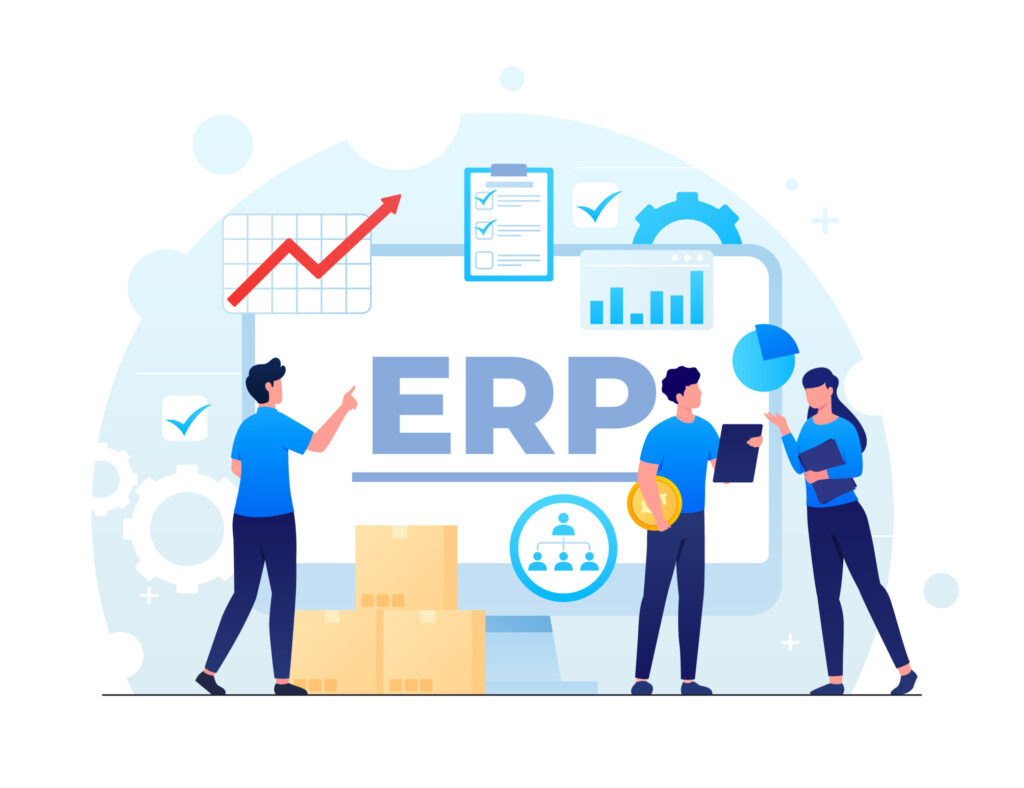
Slip-ups toward the start of an enterprise are famously hard to settle. This is particularly valid for complex procedures like executing an ERP framework. Mistakes toward the start of the usage can fate the enterprise regardless of how well it is executed. Tragically such early mix-ups are very regular in ERP executions with frequently heartbreaking outcomes for the venture. Following can be the errors seen while setting up ERP : Not selecting the right team By its inclination, an ERP execution is a collaboration. It’s essential to gather a solid gathering to take a shot at usage. Pick your group precisely, both for their specialized aptitudes and the capacity to cooperate easily. Not Picking the Right ERP Specialist While you can complete an ERP venture without getting a specialist, it isn’t a smart thought to attempt. You will require somebody with involvement in ERP usage to help control you and to get you over the harsh spots. Since an advisor is vital to the procedure. It’s essential to invest time and pick the correct one. For this, assess potential competitors precisely, both for their involvement with ERP and for their fit with your group. Not Budgeting Enough Time and Resources An ERP execution is a time and resource process. It’s critical you spend enough of both to give the procedure a chance to succeed. You can hold back on the financial plan, yet the hard truth is that the ERP usage will take as long and cost as much as it does not make a difference in what your financial plan says. Belittling both just prompts going over the spending plan and beyond the schedule. Not Getting Support from the Top Management Last but not least, it’s important that you have top management, proceeding with help for your venture from the start itself. The absence of continuous help will be the fate of an ERP venture. Some portion of the activity of the group chief is to ensure that help is there through the whole ERP exertion. Also Read – ERP for trading industry
Security ought to be the main need for any product engineer. Regularly, in any case, engineers of programming, for example, Enterprise Resource Planning (ERP) disregard to incorporate certain security highlights. ERP frameworks give the foundation of numerous organizations, so it’s important that the information be secure and ensured against assault. Associations confront different assault vectors, including close day by day ransom-ware assaults that debilitate their security foundation. What practices can be adopted to raise security? Bring issues to light Absence of attention to the significance of ERP security is the consequence of organizations’ dependence on ERP sellers to join that security. Numerous ERP arrangements accompany some security, yet associations must form a safe system for the ERP framework to dwell in. Construct Parameters Security highlights, for example, firewalls and host-based security frameworks help solidify the system and ensure ERP programming against assault. ERP Structure At the very least, a safe ERP framework should: Have a compartmental structure, with various business capacities outlined as contrasting parts; Be incorporated, with parts of the ERP framework coordinated with a consistent information stream between segments; Be adaptable, with the ERP programming expandable and good with inheritance frameworks; Be adjustable and effortlessly configurable in light of the association’s needs; Be secure, with the security of the ERP programming upheld to ensure arrange assets. Ways to deal with it: ERP security can be coordinated into the system, introduction, and application layer of each system to incorporate outside interfaces, the database, and inward business forms. At the point when an ERP user speaks with other customers or clients, the security of the framework is grouped into the system space. An ERP master doesn’t deal with these individual cases; rather, this capacity is accessible from arrange security sellers. Also Read – ERP for Steel Industry Key Parts of Security includes: Security arrangement : Express and all around characterized security strategies must be kept up. The security arrangements will give standards to data access and put requirements on chairmen while designing client consents. Client verification : All ERP clients must check access to ERP assets by giving a client name and secret word notwithstanding their verification to the system. Time limitations : ERP must be accessible just amid business hours. Access logs : Logging and traceability of access to ERP assets can enable directors to log important action, which can thus counteract breaks. Also Read – ERP for packaging industry
The purpose of ERP Applications are to support the business processes that support the company’s strategic opportunities. There are some basic tenets of ERP that should guide management’s actions and decisions. There is no magic in ERP software system. ERP’s benefits are a direct result of effective preparation and implementation, and appropriate use. This seems obvious, but most of the organizations don’t get it right the first time around. Expecting a quick fix, silver-bullet solution is a dangerous mindset. Another matter is no amount of advanced information technology can offset the problem of a flawed business strategy and poorly performing business processes. This area, in particular, is something that ERP software implementer may not fully address because it can slow system deployment. The companies must define a business strategy that will give them a competitive advantage or, at the very least, make them competitively equal. Then, analyze your current business processes and develop objectives. Once this step is done, the following steps for preparation, ERP software selection and implementation can support the strategic and process objectives better. Acquire flexible ERP information technology that can accommodate rapidly changing business conditions. The high-velocity flow of information needed to support action up and down the supply chain is a major step forward for most manufacturers. It will be mandatory in the future just to compete, much less stay ahead of, the competition. You must have the implementation led by a senior executive who has the authority to make changes happen and happen quickly. Make sure there is a sense of urgency and true accountability for completing preparation and implementation activities on time. Moving away from functional silos and creating effective cross-functional processes that are truly integrated via an ERP system is not an easy task. When ERP is not fully integrated into day-to-day business operations, however, it is not likely to be very beneficial. If enterprise integration or more advanced supply chain management strategies are to have any chance of complete success it will be due, to a large extent, to the removal of traditional cross-functional barriers. These silos comprise the organizational boundaries where information flow and often cooperation, stop. You must ask, “How will we use the ERP system?” Some not-so-obvious issues will surface as you try to answer that question. For example, will you combine demand-based flow and lean manufacturing techniques, which will negate the need for some traditional ERP functionality? Focus on your business strategy and not just software selection and implementation. Many problems are reinforced by contradictory objectives and performance measures that actually create inconsistent value and belief systems, to the company’s detriment. No amount of information technology will correct these problems. Management must aggressively remove them once and for all through business process redesign. Also Read – ERP for packaging industry
Demand grows for ERP there is no doubt that the Enterprise Resource Planning (ERP) systems are in great demand today. Industry analysts are forecasting growth rates of more than 30% for at least the next five years. According to a study conducted on ERP solution, corporate growth has been indicated as the most compelling driver for adoption of ERP amongst senior management respondents. Improved customer service, efficient distribution system, and reduced operation expenses are some of the other important business imperatives that are driving top management to implement ERP solutions. Majority of CEOs/Senior managers share the same view that ERP is an important tool to achieve competitive advantage. Following are some of the major factors of ERP popularity. ERP enables improved business performance through cycle time reduction. Cycle time is the time available at each station for the performance of the work allocated or the time elapsing between completed units coming of an assembly line. It also helps in increased business agility, inventory reduction and order fulfillment improvement. ERP supports business growth requirements through new products/product lines, new customers, global requirements including multiple languages and currencies. ERP provides flexible, integrated, real-time decision support in improving responsiveness across the organization. ERP eliminates the limitations of the legacy system such as fragmentation of data and process, inflexibility to change and insupportable technologies. ERP takes advantage of the untapped mid-market (medium size organizations) through increased functionality at a reasonable cost. These are some of the reasons for the explosive growth rate of the ERP market. As more and more companies are entering into the market, the ERP solutions providers are facing a competitive market which brings out the best in them. Initially the huge cost involved in the implementation of ERP solution has kept many medium scale industries away from it. However, with the introduction of affordable ERP solutions like eresource ERP, which is basically intended to serve the small and big players in the field alike, is bringing good benefit for Indian SMEs. This also contributed to the growth of ERP demand in the Indian market. Also Read – ERP system for Construction Industry
eresource ERP’s strength: Information accuracy and decision-making capability MPS Module in ERP Software in TODAY’s competitive business environment the key resource of every organization is information. If the organization does not have an efficient and effective mechanism that enables it to give the decision-makers the right information at the right time, then the chances of that organization succeeding to the future are very remote. The three fundamental characteristics of information are accuracy, relevancy and timeliness. The information has to be accurate, it must be relevant for the decision-maker and it must be available to the decision-maker when he needs it. Any organization that has the mechanism to collect, collate, analyze and present high-quality information to its employees, thus enabling them to make better decisions will always be one-step ahead in the competition. In the changing business environment, the time available for an organization to react to the market trend is very short. To survive, the organization must act quickly, gathering and analyzing the data – both internal and external. Any mechanism that will automate this information gathering and analysis process will enhance the chances of the organization to beat the competition. Major drawback of the legacy systems was that they did not have an integrated approach. There will be an accounting system for the finance department, a production planning system for the manufacturing department, an inventory management system for the stores department and so on. All these systems will perform in isolated. So if a person wanted some information, which has to be derived from any of these two systems, he has to get the necessary report from both systems and then correlate and combine the data. An organization cannot function as islands of different departments. The production planning data is required for the purchasing department. The purchasing details are required for the finance department and so on. So if all the information islands, which were function in isolation, were integrated into a single system, then the impact of that would be dramatic. If the purchase department can see the production planning details, then it can make the purchasing schedule. If the finance department can see the purchase details as soon as it is entered the system, they can plan for the cash flow that will be necessary for the purchase. In legacy system getting information about some aspect that is dependent on more than one department is a difficult task. And no business executive or decision-maker can take good decisions with this isolated data that he will be collected from the various reports produced by each department. Even if he collates the data and produces the information that he requires, he will have lost valuable time that could have been better spent in decision-making. With the implementation of eresource ERP system the organization will able to function as a single entity and caters to the information needs of the whole organization. When the information that is generated is accurate, timely and relevant, it will go a long way in helping the organization to realize its goals. This is eresource ERP’s strength – integration and automation – and that is why implementation of eresource ERP system will help in improving the information accuracy and in better decision-making. Also Read – ERP Software in Nigeria
eresource offers a complete ERP package eresource ERP solution is an ERP software application built with 100% Microsoft technology helps mid-market manufacturing businesses achieve increase productivity, lower costs and happier customer. eresource is pioneering Microsoft .NET technology to create the next generation of enterprise software. By organizing information and automating business processes across the entire enterpirse, eresource ERP builds flexibility and control into every facet of your business environment and increases the quality and visibility of the information you need to make more profitable decisions. eresource ERP addresses the following business needs. Enterprise resource planning (ERP):Complete integration of planning, materials management and procurement, manufacturing and financial business processes reduces costs and improves productivity, quality and control within your operation. Supplier collaboration:Two-way information exchange and collaboration with supplier improves procurement execution and reduces material costs without reducing manufacturing responsiveness and flexibility. Customer relationship management (CRM):Automation and integration of sales marketing, support and e-commerce helps you win sales and improve customer satisfaction, increasing customer responsiveness and loyalty. E-commerce:Web-based ERP application and adoption of Microsoft’s .NET technology enables you to access information, sell product, run business processes and connect with customers and partners anytime, anywhere via the Internet. Extended enterprise:eresource ERP is designed to support businesses that operate at a single location or with multiple plants. Business intelligence:Business intelligence (BI) tools provide complete visibility into your system’s critical business data, allowing you to make faster, better informed and progressive company decisions. Technology infrastructure:Microsoft based solution facilitates a smooth, quick implementation and simplified system administration, customization and integration of your business system, while also providing a stable, scalable technology infrastructure. Also Read – Transport erp
ERP Software in India eresource extends ERP across every enterprise process – from supplier to employee to customer. ERP software should extend across and beyond the enterprise to support the business strategy -so the money spent on IT pays off with tangible results. Whether you are looking for a complete, end-to-end ERP solution or best-in-class modules like supply chain management to enhance your existing core ERP investment, eresource ERP is the right choice. eresource ERP’s guaranteed on time implementation helps quick return on investment. eresource ERP solutions help companies to: • Enjoy the simplicity and economy of working with one knowledgeable vendor • Execute fast implementation with rapid return on investment • Leverage existing IT investments • Deploy one common, modern infrastructure • On time guaranteed implementation eresource ERP solutions are highly functional and are deployed on common, service-oriented technology architecture. The combination of core ERP and extension solutions addresses the strategic requirements of the customers across the country and abroad in various industries. • eresource Enterprise Resource Planning – create a backbone for efficient, low-cost-operations. • eresource Customer Relationship Management – optimize your interactions with customers from prospect to cash • eresource ERP for Financial Management – extend the reach of financial management • eresource ERP for Human Resource Management – get the most out of your investment in people • eresource ERP for Total Quality Management – not only monitors quality by control plans in purchasing and manufacturing but also provides real-time process capability index for quick review. • eresource ERP for Supply Chain Management – achieve revenue and profitability through better supply chain performance. • eresource ERP for Purchase Management – streamlines procurement of required raw materials, packaging material, sub assembly and other non-inventory materials. • eresource ERP for Excise Management – will enable the organization to ensure Excise compliance to manage all transactions of Sales, Purchase, Production, Warehouse Transfer etc. Also Read – Construction ERP Software
eresource streamline business applications by ERP integration that cover all core and supporting processes designed to enhance business performance for small and medium-sized businesses. eresource ERP is differentiated by its focus on integrated industry-specific functionality and commitment to open standards, which enables greater flexibility and lower cost of ownership. The major modules of the eresource ERP systems are Manufacturing, Planning and Control, Sales and Distribution, Inventory management, Financial management, Purchase management, Supply Chain Management and Total Quality Management. eresource ERP modules prove companies the means with which to connect, configure and customize the ERP system in a simple and straightforward manner. This ERP suite permits the customization of role-based portals and user interaction, application-to-application integration and business-to-business communication, thereby ensuring that customers’ enterprise needs for business process modeling are fully supported. eresource ERP Sales and Distribution module is a complete suite of applications designed specifically to give medium-sized enterprises complete management of their customers, with the specific goal of maximizing both their revenues and margins. It is designed for companies that are typically fast moving and competitive, whose success depends on differentiated service levels and value-added services. eresource ERP plant maintenance management module is a best-of-breed maintenance solution that provides set data management, preventive maintenance, work order control, diagnostics management and statistical analysis which can significantly enhance the management of operational assets. eresource ERP finance module is designed for customers who want to capture, analyze and manage all financial information related to their companies’ operations. It has specific appeal to the needs of product-centric, international, distributed organizations that require advanced, integrated functionality and that want to minimize administrative overheads. Also Read – Plastic manufacturing erp Purchase Management module in eresource ERP streamlines procurement of required raw materials, packaging material, sub assembly and other non-inventory materials. It automates the processes of identifying potential suppliers, Supplier Evaluation, Supplier Quote Evaluation, awarding purchase order to the supplier, and billing processes. Purchase module is tightly integrated with the inventory control and production planning modules. Manufacturing, Planning and Control Module in eresource ERP optimizes the utilization of manufacturing capacity, parts, components and material resources using historical production data and sales forecasting. Planning right from sales until production will be available to the Management on a click of a button. The Planning module comprises of Forecasting based on Weighted Average, Multi Level Production Planning, Inventory and Material Planning, Capacity Planning, etc. eresource ERP for Supply Chain Management is designed to increase visibility and improve material flow through the supply chain by managing planning, scheduling, procurement and fulfillment for optimum service levels and maximum profitability. eresource ERP Supply Chain copes as easily with the configuration of increasingly complex supply chains as it does with high volumes of simple transactions, using flexible tools to help with strategic decision-making and operational control. Also Read – ERP Software Company
Emergence of ERP Software: Initially, during its launch period, eresource ERP was mainly associated with manufacturing sector and all its developments were focused on in this industry. Majority of the manufacturing segments have relied on eresource for their logistic, supply chain and ware house ERP solution. eresource ERP has made its stamp on this sector and till today we have succeeded in keeping our superiority in this sector. The benefits received by the sector stood a testimony to the above statement. In the later stage, we have started realizing that there are other industry sectors, which are getting deprived of the benefits of an effective ERP solution. This was due to unavailability of an affordable ERP system to match their needs or lack of an ERP system which could offer a suitable solution to their industry standard. eresource ERP overcame this limitation and offered a solution suited for all industries and sectors. Another encouraging fact is that the solutions offered equal benefits to the other sectors as well. ERP was a complex application when it comes to the question of handling functions. Many of the ERP packages available in the market were more prone to serving individual functions. Even though some of them served multiple functions they did not always cater to different functions from different category. But it was not the case with eresource ERP. It could not only integrate different functions from different departments but also different function from different industries. There was time when an ERP solution was an exclusive internal solution of an organization and many people in the organization were not aware of the existence of a technology under their nose or they have lacked the information about functioning. With the advent of Web-based ERP everyone in this organization started realizing the functionalities of an ERP solution also its benefits. Though there was awareness that ERP system was a web friendly application the advantage has not been fully explored, until eresource made its entry. However other ERP solutions had its own reservations in using internet abundantly. eresource ERP worked on them and hence became totally a web friendly application. Also Read – ERP for Plastic industry
Diverse Industry ERP system while choosing Enterprise Resource Planning solutions, mid-sized enterprises must balance their long-term needs for innovative solutions to drive the next level of growth with their existing resources and short-term trends for quick return on investment, low-cost of ownership and minimum disruption to current operations. SEMs must also ensure integration into their corporate and partner/supplier ecosystems, often requiring the complete replacement of legacy systems. With the complexity and global reach of today’s business environment, SMEs are also under increased pressure to monitor business processes and financial operations more closely. Stricter accounting and corporate governance requirements intensify this challenge thus, placing growing pressure on businesses of all sizes for greater transparency, timeliness and accuracy in reporting and managerial control. eresource ERP with its expertise in providing vertical and micro-vertical solutions has nearly half of its software implemented in the SME sector. Monitored through a highly qualified implementation team, eresource ERP solution is affordable, easy-to-deploy and proven business solutions to better meet the needs of customers across diverse industries. Access your business-Anytime-Anywhere Web-based eresource ERP simplifies back-office process automation for mid-sized and growing business. It provides real-time information about finance, order management, purchase, inventory, employee management, e-commerce and much more. With web-based ERP software solution, you can accelerate business cycles, improve productivity and reliability, and provide higher levels of service to customers, suppliers and partners. Our Enterprise solutions include inventory control, warehouse management system, manufacturing software, invoice tracking, software sales module, production planning, logistics software, HR, purchase management, accounting module etc. The integrated and cost-effective ERP solution allows small and mid-size companies to maintain, a low total cost of ownership and the scalability and the flexibility to support current and future business needs. With eresource ERP system in place organizations can have the following advantages: 1. Staff will be able to interact with other staff and keep record of their work sharing and reporting – to speed up jobs. 2. Give regular instructions to staff from any part of the world 3. Get reports from them from any part of the world 4. Customers will be able to login and know the status of their job and they will be able to send specific communications about specific orders without any delay. Also Read – ERP for trading business
ERP Implementation Planning The time is an important factor as far as an ERP implementation is concerned. Companies should also be equipped with abilities to face whatever shortcomings they may encounter with. Implementation methodologies must not only satisfy the customer, but also must boost the confidence of the users. There is also a confusion prevailing among the top decision makers that whether ERP implementation be carried out module wise or all the modules at one go? Before taking a concrete decision on this regarding the management must make a thorough study of the prevailing situation in their organization. This is because the ground situation varies and depends on each organization. Mostly decision on this depends on the readiness audit result, available strength of consulting human power – both internal and external – relevance of ERP at various sites, time frame, and the budget. But it is highly recommended that the organization should go for the implementation of all the modules at one time at one site, and then go for roll out strategy for all sites. There is also a wrong concept about the BPR and ERP system. The main doubt persist in the mind of many decision makers is whether the organization should first carry out BPR and then implement ERP, or vice versa. Actually, one has to understand that the physical form of the BPR concept is the ERP system. In some organizations where BPR is carried out first then ERP was implemented. In all these places, the BPR document was thrown into dustbin and new ‘to be document’ was prepared suitable to ERP. Such cases clearly show that BPR benefits as such don’t exist without ERP reference, and ERP just cannot be carried out without proper BPR. What we assume is that the BPR must be the outgrowth of ERP implementation and, therefore, it should be carried out during implementation only. But the major element of BPR is the change in the mindset, which can be initiated before ERP adoption, may be during the preliminary analysis by way of user training. The best thing to do in these situations is to carry ‘noiseless BRP’ which triggers the implementation smoothly. Tight integration between modules is the key to an efficient ERP packages; therefore all of the core business modules are related. For instance, in eresource ERP, manufacturing operations are integrated with customer service, logistics and delivery. A new customer order automatically initiates an appropriate warehouse action and product shipments trigger billing processes. Sales, production and purchasing groups work seamlessly together to fulfill critical customer orders and adapt production levels to changes in market demand. Organizations also must understand that development of ERP is not like other software development projects, which are normally carried out focusing on automation. We find such serious mistakes being committed by some big and small companies in India. Today, when quality ERP product like eresource ERP is well within the reach of most of the companies, one should not opt for costly in-house development. This kind of in-house developed ERP is not at all an ERP system except the integration. Organizations that are looking forward to business growth should remember that the decreasing costs of hardware, infrastructure technology and ERP applications put a modern version of these business-management packages within reach of any company. Also Read – ERP for Manufacturing Company
Agility is the watchword There is only a simple answer to the question raised by organizations ‘why they must implement eresource ERP?‘ The answer is – to simply complex process. As you may be aware that as far as a business establishment is concerned process capital can positively affect customer capital and customer capital ultimately affects business performance. Companies implementing eresource ERP can build process capital to meet the challenges of the competitive market environment. Impact of eresource ERP can be visible in the business process and operational methods right from the implementation stage. eresource ERP can have an effective influence on the business process in short span of period. We have ample proof to prove our claim that eresource ERP can bring a significant impact right from the time its implementation in the organization. India’s leading web-based ERP Soluion eresource can be an eye-opener for any organization because they get to realize the benefits and operational methods involved in modifying the business process. What is to be remembered before an ERP implementation is that organizations must be fully prepared before going for an ERP implementation to get the desired result. The role of managers and other decision makers in the organization plays an important role for the success of any ERP system from the implementation stage. eresource ERP enables interactions and healthy relationships among departments in organizations which would have otherwise remained isolated. The problems of co-ordinations faced by each department are solved with implementation of effective ERP system like eresource. Organizations that have decided to implement eresource ERP can expect an extremely close assistance from a team of expert who will able to identify the flaws and guide the organization in devising better procedures. It helps organizations to adapt and adjust to change right from the implementation process. eresource ERP has directly and indirectly helps to redefine functions in an organization. Anything that people wanted to know about the company and its operations will be available by a click of the mouse. There was no more relying on the department of internal communications even for single information. Outsiders don’t have the hassle of obtaining permission and following stringent procedures to access information. eresource ERP also helps the employees of organization in big way with their routine work procedures. The system provides more freedom, authority and responsibility to the individual employees which were mutually beneficial to the management. Every user/employee became more aware of their function while eresource ERP has given the confidence to execute it individually and successfully This way of working style results in transparency and accountability. The work of employees becomes more easy and independent and they also able to keep track of work happening in other department or section related to their work procedure. This total transparent and reliable and flexible method of working mode boost the confidence and royalty of the employees that ultimately brings the goodwill to the organization. Also Read – ERP for Manufacturing Company
What is an ERP system – Over the years the concept of an ERP System has witnessed massive changes in the business arena. From the question what is an ERP to the questions asked by majority of the business community today is which ERP to be implemented? Therefore the progress from what is an ERP to which ERP shows the growth of ERP system in the business sector. As the benefit from an ERP system started taking business to much higher level, companies have realized the importance of investing in an system that not only bring good return on investment but also helps overall progress of their business process. In the competitive business field, the heat is started to feel by the large and small as well as midsize companies. They have left not much sleeping time for important decisions. Challenges faced by them started increasing day by day with ever-growing competition and their survival based on how they will overcome these challenges. There were no short cuts. The scenario has become survival of the fittest. Businesses have realized that the infrastructure, whether it is in the form of man power strength or the software system, must be streamlined and handle the workload successfully on a time bound basis and help deliver the result in a desired manner. Customers are the backbone of a business. The relation with your customers must be maintained a high level quality to achieve success in the business. The faith their customers keep with them is very important and to gain that faith businesses need to have an ERP system with good customer relation management module. Professionals from eresource ERP System identify the requirement of every department through a comprehensive analysis before the development of the ERP System for an organization. All the details including the production details such as the raw material requirement, stock available, stock to be ordered, delivery time, production details, man power required, time required for production and all that need to bring out the product on time on a required manner are taken into consideration before the actual development of the system. eresource ERP System also has the facility to send out emails alerts to other departments/braches and customers whenever necessary. eresource ERP systems promise to integrate an entire business with a suite of software modules covering activities in all areas of the business. Furthermore, our ERP system is now being prompted as a desirable and critical link for enhancing integration between all functional areas within the manufacturing enterprise. eresource ERP system has been defined as a packaged business software system that allows a company, to automate and integrate the majority of its business processes, and share common data and practices across the enterprise. Through integration of various functions in the organization, managers and staff alike can use timely information to make better decisions and to perform activities, which add value to the company. Most of the time ERP implementation has been considered a costly affair, which forces many small and medium scale companies shying away from implementing it. eresource ERP system has become answer to all these worries as this ERP system has become most affordable and effective ERP for SMEs in India. Write to us for your requirement and the quote. We will get in touch with you soon with a comprehensive report on your requirement and quote. Also Read – Manufacturing ERP Software
Business Intelligence in ERP Systems Business today can succeed only if it has a powerful forecasting solution and ERP is undoubtedly the best solution for a better forecasting. It will be better if organizations realize without accurate forecasting, businesses can’t always deliver on the promise. An effective ERP system that enables Integration between front-end sales and back-office systems in organization can now forecast the seasonal and cyclical spikes and dips. Eresource ERP enables reduction and elimination of bottlenecks and shortages in business processes. As the customers always expect a fast order-fulfillment, a cloud-based ERP system such as eresource with integrated capabilities and business intelligence tools, is just what the need of the hour. Our ERP system generates a statistical forecast for each item-location combination as per the norms set by the e user. The user can then make adjustments to the system generated item-location forecasts and aggregate them nationally, regionally or by other criteria such as product, class or market zone. There are also options that allow further adjustments which aggregates and be prorated back down to the item-location level to drive production and deployment decisions. An effective forecasting method will help the organization in many ways to organize its business process. Apart from the forecasting method, the ERP system will enable to generate quick orders and distribute it to the other people who have involved in a matter of seconds. This will not only save the time but also can avoid unwanted paperwork. As all the staff involved in the process will working on the same information there will be less chance of mistakes happening in between the work process. Once implemented, eresource ERP starts its functioning and starts with deal with the people in charge of handling stocks. This is because these people are the first ones to know when a product is not going to be available, and when there is going to be plenty of another one. This will help the ERP system to guide vendors to reduce unnecessary stocks by offering the product that might be exceeding reasonable inventory. Our ERP system, which has an easy to operate interface allows easy process of invoicing and delivery that can be managed with the click of mouse button. When an order is entered all the information is available for vendors to deal with clients at the same time that they are dealing with stocks, prices and possibilities of discount. This information arrives correctly and in a complete way to the rest of the employees speeding up posterior work. eresource ERP system can bring a kind of magic that simplifies daily tasks to your organization. It keeps your employees updated about what they need to know to increase their efficiency levels. Over and above this system also gives you the chance to control anybody at anytime. Also Read – ERP Software for Manufacturing Industry
Stimulate your business by choosing right ERP – eresource ERP software Having discussed in details about the user’s role in successful ERP implementation, it is time to look into the other element which is the consultant or you may refer them as vendor or ERP solution providers. The task of selecting a suitable consultant is very important and there is no point in cursing the consultant later for their poor performances. There are various reasons behind poor performance and the prime being the poor industry knowledge followed by lack of knowledge on client’s key success factors. The other factors are lack of understanding of user’s perspectives and also limited consulting experience. A soft approach towards customer and user is a way to show the consultant’s integrity, which many consultants do not possess. Adamant attitude will help bring only unfruitful result. The problems should be solved with loyalty and dedication, which will boost morale of both the customer and the user. Unfortunately, this does not happen with every consultants, which prompts some company to believe, ‘consultants know nothing; they come here, learn from us and then vanish one day for the self-betterment without solving our problems.’ Interestingly, in many cases, consultants are not blamed for their poor ERP product knowledge, but for their approach. Contradictory to the above, Eresource ERP clients are extremely happy with our product service as well as our approach. All of our personnel are professionally qualified along with long years of functional experience. A good ERP consultant should be an equally good business consultant too. This may help in reengineering of existing set-ups in the client’s side to improve ERP performance. To improve ERP performance it is very important to focus on reengineering of existing set-up in the client’s side. The expected qualities of the ERP consultant are that they should have adequate level of pure functional experience, a deep knowledge of ERP product, must possess good HR skills with convincing abilities and eye for process improvements rather than automation. They should also have a cool head with a composed personality. Many a time consultant needs to encounter various ‘orphan’ activities and deal with them in a proper manner. The following incident will indicate why an efficient consultant is needed to address these issues. The design department in an engineering company used to claim that making Bill of Materials was their job, but selecting and arranging branded components required by customer should be the purchase level decision. And the problem was, purchase may select some economical brand, which in turn affects the performance of some other assembly, hence, again, the design department comes into picture. The process was continuous and creates a lot of back and forth interactions for one decision. Users were demanding the automation of such discussions across departments in ERP. Also Read – ERP system for automotive industry In this circumstances what to be done by the consultant is to revamp the whole process of BoM structuring in the organization. They must convince the client to form a cell of BoM structuring for complicated customer configurations. The cell consists of each user from marketing, engineering planning production, purchase, and also from accounts. In fact, by doing this the consultant had reengineered the functional set of the organization into a temporary process set-up for improving decision-making quality and speed. Eresource ERP consultant follows a few general guidelines regarding BPR preparations required during consulting. It is the job of consultants to take only the policy decision from users on various scenarios and then design, map and implement and process suitable to user’s culture. In such cases, it is better to avoid more discussions. For example, in one company, the same item was available in domestic as well as in imported market. The price difference was high. Since the company follows standard costing, ideally there should be different identification for the same item having such price differences to account for inventory costs separately because it has not implemented Lot Control Module. The company was unable to understand the need of separate code of them item. In this case the consultant must be able to convince the accounting repercussion to hardcore functional guy from stores. Since the user doesn’t understand commercial, operational and legal implications of the process completely in the ERP, consultants should exhibit dominating role in such cases to ultimately give the best out of ERP to the user. The consultant who can manage the implementation with the above qualities and techniques can be classified a genuine, reliable and a simply good consultant. Without doubt, eresource ERP stands tall here. Also read – ERP for Plastic Industry
ERP Database Protection Every company has confidential information about its business strategies and other details which are considered be very highly important data. Therefore, it is important to see that this database does not fall into the wrong hands which could pose severe consequences for the company. Many steps can be taken to enhance the company’s ERP database security. Role-based IDs and passwords will ensure that users can access only the data they are authorized to view, based on their job function or position within the company. A practice of changing the password on regular basis by the users will be a good habit that could act as a ideal ERP data protection. And, data encryption, firewalls, and other measures can help you keep hackers, cyber-criminals, and other outsiders far away from your ERP software database. As you know an ERP database is perhaps one of the most vital assets the company owns. Keeping that ERP database protection from threats such as security breaches, performance issues, and technical breakdowns is crucial to ensuring continuity and consistency in your most important business activities. When there is a threat to your ERP software database all the major operations of your company such as human resources, production planning, procurement, accounting and finance and other critical back-office function could become standstill. But this kind of a security threat could be eliminated with advanced administration techniques. A good security backup could ensure that your ERP database is available and readily accessible at all times. By monitoring performance around-the-clock, system administrators can immediately identify and troubleshoot problems, to prevent productivity slowdowns caused by down time. Additionally, mirroring your ERP database using redundant servers can provide a much-needed backup that can be utilized in the event of a major system failure. Also Read – ERP Software in India Companies must also be prepared with other disaster recovery management. Today there are few companies that are prepared in the event of a major fire break out or a flooding situation. To face this kind of natural disaster the companies must be occupied with well-designed back-up plan in place. Loss of critical information and database could cost your company millions of rupees and will take your company back to years in terms of business growth. Today most of the companies see the opportunity to implement ERP system as to replace all of their old legacy business applications which can make their business operations more efficient with right security support. It is also to be remembered that when putting measures in place to protect your ERP environment is to not only safeguard the ERP database and related systems, but to secure all other systems that share information with it. Also Read – Features and Benefits of ERP systems in the food industry