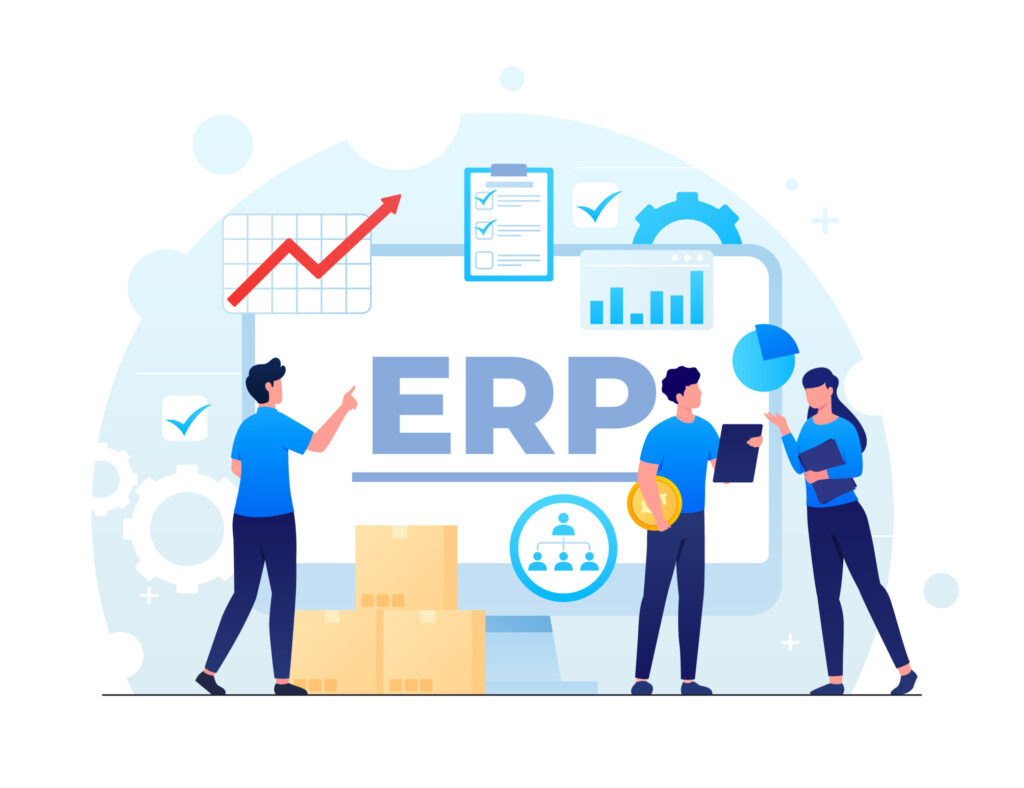
The purpose of ERP Applications are to support the business processes that support the company’s strategic opportunities. There are some basic tenets of ERP that should guide management’s actions and decisions. There is no magic in ERP software system. ERP’s benefits are a direct result of effective preparation and implementation, and appropriate use. This seems obvious, but most of the organizations don’t get it right the first time around. Expecting a quick fix, silver-bullet solution is a dangerous mindset. Another matter is no amount of advanced information technology can offset the problem of a flawed business strategy and poorly performing business processes. This area, in particular, is something that ERP software implementer may not fully address because it can slow system deployment. The companies must define a business strategy that will give them a competitive advantage or, at the very least, make them competitively equal. Then, analyze your current business processes and develop objectives. Once this step is done, the following steps for preparation, ERP software selection and implementation can support the strategic and process objectives better. Acquire flexible ERP information technology that can accommodate rapidly changing business conditions. The high-velocity flow of information needed to support action up and down the supply chain is a major step forward for most manufacturers. It will be mandatory in the future just to compete, much less stay ahead of, the competition. You must have the implementation led by a senior executive who has the authority to make changes happen and happen quickly. Make sure there is a sense of urgency and true accountability for completing preparation and implementation activities on time. Moving away from functional silos and creating effective cross-functional processes that are truly integrated via an ERP system is not an easy task. When ERP is not fully integrated into day-to-day business operations, however, it is not likely to be very beneficial. If enterprise integration or more advanced supply chain management strategies are to have any chance of complete success it will be due, to a large extent, to the removal of traditional cross-functional barriers. These silos comprise the organizational boundaries where information flow and often cooperation, stop. You must ask, “How will we use the ERP system?” Some not-so-obvious issues will surface as you try to answer that question. For example, will you combine demand-based flow and lean manufacturing techniques, which will negate the need for some traditional ERP functionality? Focus on your business strategy and not just software selection and implementation. Many problems are reinforced by contradictory objectives and performance measures that actually create inconsistent value and belief systems, to the company’s detriment. No amount of information technology will correct these problems. Management must aggressively remove them once and for all through business process redesign. Also Read – ERP for packaging industry
ERP finance module helps see your ‘tomorrow’ today In today’s business enterprise, you need to know that your financial decisions are based on today’s data, not numbers from records closed a month ago, or even a week ago. And you need to know that this same data represents every segment of your organization’s activities, whether your enterprise stretches across a room or around the globe. This is essential, because the most efficient way to get your enterprise to where you want it tomorrow is to know exactly where it is today. Whatever the financial goals of your organization may be, the financial application components of eresource ERP software solution work hand-in-hand to improve the bottom-line. This is true because the financial functionality is tightly integrated across all business areas and all geographic areas. This tight integration includes all the other different modules, from materials management to human resource to logistics. Because eresource ERP system automatically links related areas, it eliminates the need to repeat procedures. You enter your data only once. Within the eresource ERP system all areas work in coordination, creating a new level of efficiency in handling your financial data. The finance module of eresource ERP system provides financial functionality and analysis support to lot of medium and large scale enterprises in Indian and abroad. The finance module of eresource ERP system has the following sub-systems. Financial Accounting General Ledger Account Receivable Account payable Fixed Asset A/C Debut Note/ Credit Note/ Journal Entries Bank Reconciliation Statutory & Regulatory Value added tax analysis & reporting TDS & service tax Excise Enterprise Controlling Executive Information System Business Planning & budgeting Profit centre accounting In addition, eresource ERP’s financial accounting provides company-wide integration that is essential to strategic decision making. The financial accounting module in eresource ERP gives you the ability to centrally track financial accounting data within a single framework, of multiple companies, multiple branches and chart of accounts. Also Read – ERP for Plastic industry
When a company decides to implement an ERP system, what they are primarily looking for is the improvement in the management of their financial section. But a hurriedly taken decision about ERP implementation can bring the negative impact. Therefore selection of a suitable ERP system is most important as it must not only suite your business process but also your finance management. By now everyone knows that the continuous changes in the global business environment, efficiency and effective in the management of companies cannot be compromised. For efficiency and effectiveness in the business operation the management must create path for bi-directional relationship of the different areas and processes of the company. Nowadays team work becomes an essential part for a successful business, which includes the planning and administrative functions of all the corporate areas. The use of eresource ERP in the Financial Department is a best way to manage the account records updated in a reliable and effective way. The General Accounting, the centre of the financial activities of the system, helps to capture and integrate the transactions made inside the module, allowing you to see the influence in financial terms over the enterprise as a joint system. Whatever the financial goals of your organization may be, the financial application components of eresource ERP software solution work hand-in-hand to improve the bottom-line. This is true because the financial functionality is tightly integrated across all business areas and all geographic areas. This tight integration includes all the other different modules, from materials management to human resource to logistics. Because eresource ERP system automatically links related areas, it eliminates the need to repeat procedures. You enter your data only once. Within the eresource ERP system all areas work in coordination, creating a new level of efficiency in handling your financial data. All the audits include information details such as who made an entry and when, as well as who created and modified the last time, is recorded in our ERP system in order to maintain a proper order in an organized manner. The display can also be made simpler by opting for filtering the details by date entry. One of the most advantages of finance management module eresource ERP is that the accounting information of several years can be maintained online without affecting the performance; and it also has specific features to leave tracks of audits to determine the origin of the transactions. Also Read – ERP Software for Manufacturing Industry