One ERP. Every Industry. Global Presence. Powered by Azaalea AI
22272e9fb58a47b7d605950c6cdff7b550d0b71e
One ERP. Every Industry. Global Presence. Powered by Azaalea AI
Final white Azaalea Ai Middle East FZ LLC logo (1)

eresource Azaalea AI offers multi-platform ERP Software Ideal for All Business

ERP Software Ideal for All Business We were at Nigeria GITEX. Now meet us at Dubai GITEX Global 2025. eresource’s Low Code/No Code ERP software, which is cloud-deployed, enables you to gain a 360-degree view of your organization at any time and from any location by integrating all of your business activities onto the Azaalea Ai platform and automating and integrating them from start to finish. You can increase productivity, lower costs and time to market, and spur innovation throughout the value chain with this cohesive approach to business. Additionally, the complete product line is available online, allowing you to access information from anywhere in the world with just a browser click, whether you’re using a laptop, PDA, mobile phone, or tablet PC. With improved Azaalea AI integration support, we offer multi-platform ERP software that is ideal for your business’s requirements. By putting into practice a contemporary industrial data strategy that permits a scalable, unified, and integrated mechanism to harness data as an asset, you can unlock the value of operations data. With the greatest industrial operational knowledge, a dedicated industrial partner competency network, and the most secure and extensive suite of purpose-built services and solutions, eresource Azaalea Ai assists you in liberating your precious data and using it to innovate across operations. eresource  Azaalea Ai Advantages: Easy customization With dependable, powerful virtual desktops for all workloads, the most comprehensive computer platform, and generative AI services to produce whole new product designs, you can work safely, from any location, to accelerate time to market, lower development costs, and innovate like never before. This no-code application allows customers to design their ERP application as per their requirement. Streamline processes A contemporary industrial data strategy and the most extensive suite of specially designed services and solutions, such as machine learning, generative AI, and IoT, may boost productivity, availability, and quality while hastening digital transformation. Create new sources of income By securely storing large data sets on a scalable infrastructure and connecting and managing global products remotely, you may improve the customer experience and create new revenue streams. Increased protection Because your workloads are running on the most adaptable and secure cloud computing infrastructures, you can run and scale them anywhere with confidence. eresource uses Azaalea AI integration with cloud technology to revolutionize manufacturing operations In order to streamline and expedite digital transformation, manufacturers are seeking to develop a contemporary industrial data strategy. Discover how eresource Azaalea Ai system under cloud technologies can support you on that path, helping you meet sustainability goals, optimize production, cut costs, and speed time to market across five solution areas and several industrial segments. Azaalea Ai can handle the intricate activities Process optimization, cost reduction, and performance enhancement are critical in manufacturing. To address these problems, manufacturers have embraced cutting-edge technologies and solutions. eresource ERP developed under Azaalea AI technology that can handle the intricate activities seen in manufacturing is artificial intelligence (AI) and machine learning (ML) in manufacturing ERP. Production control with AI and ML Throughput and OEE are two important operational metrics that can be significantly improved with the use of machine learning models built on operational data from eresource ERP. Production scheduling may be enhanced, production processes can be streamlined, and insights regarding machine loads can be obtained by combining AI and ML with real-time data from linked equipment. By analyzing machine data from this ERP, AI and ML can forecast when equipment may break, enabling prompt maintenance and minimizing downtime. Azaalea AI assisted eresource ERP can help industries with cost reduction, waste reduction, and resource and material optimization. For more information on eresource ERP developed on Azaalea Ai platform and a FREE PRODUCT DEMO, please get in touch with now: sales@eresourceinfotech.com

The Role of AI-Powered ERP in Modern Warehouse & Distribution

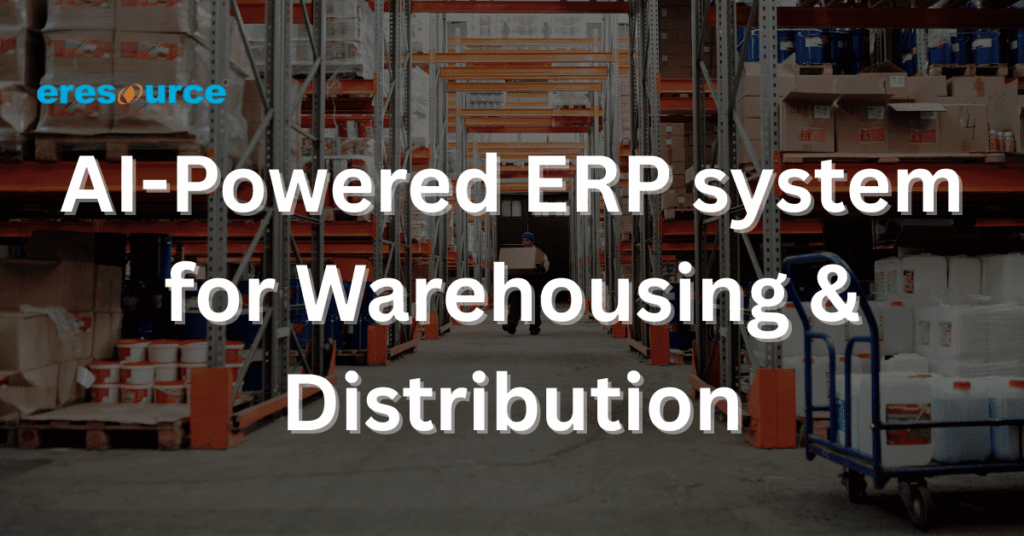
AI-Powered ERP in Modern Warehouse & Distribution The concept of an AI-powered ERP solution for warehouse and distribution management system has become crucial for businesses seeking to increase efficiency, accuracy, and customer satisfaction. In the current day, it is essential to optimise supply chain operations through the use of advanced AI technology and integration in distribution and warehouses. The global expansion of manufacturing, transport, and e-commerce has made it essential to understand and use modern technological advancements. AI-Powered ERP system for Warehousing & Distribution There is more to modern warehouses than just traditional storage spaces. This integrated hub manages distribution, inventories, supply chain visibility, speeds up operations, and promptly fulfils orders through the use of advanced technology, automation, and optimised processes. Technological Integration:  Making use of Artificial Intelligence features to automate the distribution process and warehouse management systems (WMS). Sustainability: Using eco-friendly procedures and energy-efficient systems. Scalability: The capacity to adjust to shifting business volumes and requirements. An ERP system with AI capabilities can revolutionise conventional warehouse practices By incorporating AI-powered technologies, conventional warehouses become intelligent hubs that can satisfy demands. The foundation of contemporary warehousing is technology, which propels advancements in precision, velocity, and general effectiveness. Modern warehousing relies heavily on AI-powered Warehouse Management integrated ERP software like eresource. Businesses may improve decision-making, optimize storage, and streamline operations with its real-time inventory tracking, order management, and analytics features. Advantages of Artificial Intelligence and Machine learning The enormous volumes of data are analyzed by AI and machine learning algorithms to enhance route planning, optimise inventory levels, and estimate demand. With the help of these technologies, warehouses may proactively modify operations and predict market trends, guaranteeing a responsive supply chain. Best Practices and Techniques for AI-powered Warehousing Application Warehouse operations are guaranteed to be precise, efficient, and responsive to market demands when best practices are put into practice with the help of AI-powered ERP solutions like eresource. 1. Cross-docking reduces storage time by directly unloading the goods from the incoming vehicle onto departing vehicles for delivery. 2. Cycle Counting ensures accuracy without stopping activities, conducts inventory audits regularly and counts all of the items. 3. Slotting optimisation is the process of putting things strategically to speed up operations and cut down on picking time. 4. Maintaining ideal stock levels and storage to cut down on holding expenses and wasted space is known as lean inventory management. Please contact sales@eresourceinfotech.com  right now for more details and a PRODUCT DEMO of the AI-powered eresource ERP system coupled with intelligent warehouse and distribution capabilities created on the Azaalea AI platform.

AI-powered eresource ERP System Revolutionize Manufacturing Process

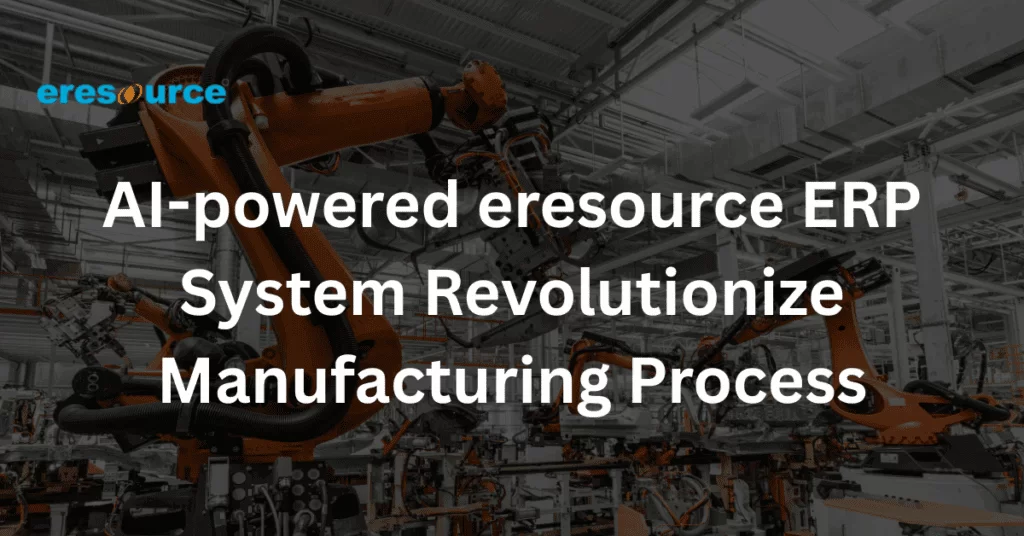
AI-powered-eresource-ERP-System-Revolutionize-Manufacturing-Process-1024x536 Benefits of Generative AI for Manufacturing A subclass of artificial intelligence called generative AI may produce original designs or material without the requirement for training data. Generative AI learns the underlying patterns and structures of input data to generate similar but novel outputs, in contrast to classical AI, which mostly examines already-existing data. This can involve developing better design options for components or goods in the production process. Manufacturers are starting to use generative AI in the creation of new products. Businesses can get optimum design solutions that not only satisfy their requirements but also offer possibilities they would not have thought of by entering parameters and requirements into generative design software. Information summarization is another application of generative AI. By helping production workers learn how to use their ERP to better understand and solve problems, it could help address the skilled labor crisis in manufacturing. Artificial intelligence (AI) and machine learning (ML) in manufacturing ERP Process optimization, cost reduction, and performance enhancement are critical in manufacturing. To address these problems, manufacturers have embraced cutting-edge solutions like eresource ERP with AI-powered technologies. This new area of technology that can handle the intricate activities seen in manufacturing is artificial intelligence (AI) and machine learning (ML) in manufacturing ERP. Without a doubt, AI and ML will play significant roles in determining how industrial ERP develops in the future. The use of AI and ML to boost productivity, creativity, and efficiency in manufacturing will grow in the wake of recent advancements in computing and the capacity of AI models to learn and adapt. AI and ML advantages for industrial ERP Supply chain optimization, productivity, process control, and maintenance are a few typical areas where AI and ML might influence manufacturing ERP. For many years, industrial engineers have obtained prescriptive and predictive insights through the use of physics-based simulation, what-if analysis, and heuristic-based rules. These days, AI and ML may supplement and improve such heuristics to produce answers more quickly and offer more thorough analysis to assist manufacturers in better monitoring and managing operations and processes. Production control with AI and ML Production scheduling may be enhanced, production processes can be streamlined, and insights regarding machine loads can be obtained by combining AI and ML with real-time data from linked equipment. By analyzing machine data from this manufacturing ERP, AI and ML can forecast when equipment may break, enabling prompt maintenance and minimizing downtime. AI can assist industry-based eresource ERP systems with cost reduction, waste reduction, and resource and material optimization. Supply chain and inventory management using AI and ML 1. By optimizing inventory levels to match demand through the analysis of ERP data on sales history, customer behavior, and industry trends, artificial intelligence (AI) can lower forecasting errors and costs. 2. AI powered ERP can detect possible supply chain interruptions and recommend substitute sources by examining external data. 3. By identifying patterns in data from intelligent sensors on trucks and packages, artificial intelligence (AI) ERP can assist in resolving complicated delivery limitations and lowering logistics costs. 4. Manufacturers may assess supplier performance and determine which shipment centers are best at identifying problems by integrating AI with shipping and supplier data. ML and AI in quality control 1. ERP quality management and testing can be enhanced by using AI to assess component photos on the manufacturing line and spot quality standard deviations in real time. Other benefits of AI and ML for manufacturing ERP 1. Artificial intelligence (AI)-powered decision support technologies can swiftly identify patterns and trends in the vast volumes of data found in manufacturing ERPs, assisting managers in making well-informed decisions. 2. A-powered ERP systems are capable of simulating a wide range of situations, assessing possible outcomes, and determining the best course of action. 3. By examining user responsibilities, historical data exchanges, and standard workflows, AI combined with systems like ERP can offer more individualized experiences. 4. By evaluating client data and tailoring interactions, AI models can also enhance customer service. For information on AI-powered ERP system for  Manufacturing, please get in touch with now: sales@eresourceinfotech.com

Is your business showing signs of negative growth?

7016016 Many reasons to choose eresource ERP as your business solution Web Based ERP software Solution: HAVE you ever thought why your business needs an effective ERP system? If any of the following matters hamper your business growth then it is time to think of implementing an ERP system. When you are not able to keep pace with the changing business environment with your current supporting elements like financial management, sales forecasting methods, fail to determine the need of your customer’s requirement, losing track of your inventory then you must definitely go for an ERP system. Integrated solution makes all the difference There are companies that use different software applications for their operations and it affects communication between various sections and department, as these applications are not networked. Time lost in exchanging information from one section to another section can make a big effect in your business strategy. As these software works as standalone applications, you cannot blame the system for the delay. Therefore the only remedy to overcome the above hardship is to depend on an ERP system, which is an integrated and automation software. Also Read – Manufacturing ERP Software A study of how your employees carry out their routine work will help you understand the importance of having a intelligently integrated ERP system like eresource. None of your business operations are going to be smooth if the staff use different system for different operations. For example what will be scenario if the staff in the account section use one system for receivables and payables, and sales use another to enter in customer orders? Also, it is going to be a complete mess if the employees in warehouse use a completely different solution to track shipping and receiving.In the same manner when various front- and back-end systems run separately, it can wreak havoc in your business processes. You are aware that without accurate data from sales, inventory management may suffer, while not having the latest information from accounting can trigger a ripple effect on everything from marketing budgets to payroll. Easy access to information will make your business process smooth Quick access to information regarding everything that is related to your business can make all the difference. In today’s fast paced business life sending and receiving information at your will and convenience is the prime requirement. With the deployment of eresource ERP system for your business purpose, every operations can be performed and every information can be accessed with the just help of an internet connect and your laptop. Our ERP system will make your PC or laptop your office. Everything that is happening in your business organization can be accessed from anywhere at any time with help of our cloud and web based ERP software solution. Decision makers in your company can get a clear view of business operations at any time. Every staff can get the information they need to do their jobs more effectively. The days that have depended on soiled system and spreadsheets will become history once eresource ERP system comes as your business solution. Automating your financial operations Once the eresource ERP becomes your business solution, it will automate your financial operations. Your employees don’t have to rely on paper-based invoices and sales orders—and spend hours every week manually entering them into different accounting and sales systems. You can image how much time can be saved on with ERP system when it handles the above operations. With all accounting details in a single database, accounting staff won’t have to spend hours cross-posting information, rekeying numbers, or reconciling data manually. Deployment of this ERP system will make the accounting staff more productive, freeing them to deliver critical reports without delays and frustration. Also Read – Construction Management ERP Don’t allow too many cooks to spoil your food As the saying goes, too many cooks can spoil the food, having more than one software application to manage your business bring nightmares. Therefore it is important for companies to implement an efficient ERP system for all your business operations. ERP system like eresource provides end-to-end solution for all your business operations. Being an integrated and web based ERP software solution it takes care of every that is needed to successfully operate a business. Those companies that are planning to upgrade their patchwork systems like on-premises, legacy system must realize that these kind upgrades can only bring more troubles than they are worth. Not only these are a time-wasting exercise but expensive affair too, that will have no positive result. It is therefore companies are advised to go for more advantages, effective, intelligent and reliable ERP system like eresoure for their successful business operations which can assure an effective ROI (Return On Investment). Also Read – Manufacturing ERP Software Businesses all around the world are increasing their reliance on ERP systems as a cost efficient alternative to their software applications. An ERP system provides organizations, especially industries like manufacturing, with a solid foundation, incorporating all of the fundamental aspects of running a business. Expectations run high when an organization deploys an ERP package – if the solution is a good fit for the company, the company stands to gain tremendous cost savings and service improvements across the enterprise. ERP for Manufacturing Industry In the earlier days ERP system was largely used only by the manufacturing industry and a wrong assumption was carried over that the system is made for only Manufacturing industry. It was basically due to the way in which ERP was historically developed from the methods of Material Requirement Planning (MRP) and Manufacturing Resource Planning (MRP II), which are relevant to manufacturing organizations. In the manufacturing industry, MRP became the fundamental concept of production management and control. At this stage BoM (Bill of Materials), which is purchase order management that utilizes parts list management and parts development, was the prevailing trend. ERP is for all industries The large organizations have wide resource to manage. Handling massive volume of resources using the various software applications or with the help of legacy systems is something that these organizations

ERP is An Essential Business Tool

7016016 Implement eresource ERP software that is truly professional eresource ERP software are developed professionally with utmost care that would address every issues and problems faced all industries. As it is very complex and difficult process to understand every functions of each industries and integrating all these functions into the system. As we said the development is a complex exercise because to ensure the ERP developments are going to be fit for the business purpose and have a positive substantial impact the business, developers need to take the time to prepare and include all the relevant stakeholders within the industry, all the way from the initial idea, through to testing. There are number of steps that to be followed while developing an efficient ERP software that will suit your business functions. The development team headed by professionals who are well versed with the industry practices plays a key role in shaping up a ERP system that will match your requirement. If the ERP development team understands well about your business there’s a much better chance everything will work out as planned. Constant communication between the developers and the members of your IT team also plays a major part in making the ERP project more success because it helps the developers clarify their doubts and expectations with the in-house IT team. ERP Project – What the companies must do first It is very important for the companies that are plans to implement an ERP system to understand what their actual requirement is. Once the companies are clear about their requirement the matter to be passed on to the development team with a clear picture of your requirements with all the specifications and if you leave anything to chance, the result may not be what you have expected. Therefore, it is imperative you create a detailed list of specifications and lay them out in a document. Whether it’s data samples, process requirements or timeline expectations, the more information you can provide the better. Users must be trained to handle the system properly ERP training is an essential part of implementation process. Having a modern car won’t help you if doesn’t know how to drive it. A modern-era ERP system like eresource system are used to properly as per the guidelines provided during the time of training must be strictly followed for a desired result from the ERP system. In most of the implementation failure cases the developers only talk to the executive people, while for a successful operations of an ERP system training to be provided users through a constant interaction between the trainers and users. Provide reliable data Give your developer access to reliable data. If the data is a good reflection of what you’re using now, there’s a better chance the development will work as expected. Additionally, you’ll be able to see how the application reacts when it’s been fed data that is inputted incorrectly. Follow a true professional approach in every stage of implementation You must have the implementation led by a senior executive who has the authority to make changes happen and happen quickly. Make sure there is a sense of urgency and true accountability for completing preparation and implementation activities on time. Moving away from functional silos and creating effective cross-functional processes that are truly integrated via an ERP system is not an easy task. When ERP is not fully integrated into day-to-day business operations, however, it is not likely to be very beneficial.. Also Read – Manufacturing ERP Software

eresource Xcel Manufacturing ERP Software

7016016 An ERP system that suits well for every manufacturing companies The endless benefits of eresource Xcel ERP Software for SMEs in the manufacturing industry making more and more companies in this segment implement the system for their business and operational process. As the system is highly focused on customer relationship and end results, companies can expect their business growth to reach a new height in a short period of time. The system will also help the companies with standard set of business practice that ultimately helps produce better products. eresource Xcel allows easy and quick communication with suppliers, vendors, and customers as well as among every department, branches at various locations within the organization. This easy communication method makes decision making easier which is very important for a successful business. eresource Xcel, one of the best ERP software for manufacturing industry can be implemented on the premises or on the Cloud as per the requirement and budget of each company. The system streamlines all your business process that includes sales, purchase, billing, customer, vendor, production Finance and Inventory. An ERP that has everything for your business operations eresource Xcel ERP system for manufacturing industry consists of modules of Purchase Management, Sales and Billing Management, Customer Management, Vendor Management, Product Management, Financial Reporting, Account Management, Statutory Compliance and Inventory Management. Purchase Management. The system automates all important functions, eliminates human errors and makes every process function as per the schedule and planning. The system offers an efficient Inventory management that helps move inventory to the right place, time and cost. Xcel ERP gives you an in-depth, real-time view into key supplier, inventory and shop floor performance indicators for better management of your business process. Also Read – ERP Software for Construction Numerous reasons to implement eresource Xcel Though there are numerous reasons cited to implement an ERP system, the absolute reasons to implement an ERP system like eresource Xcel are the transparency that system can bring to your business operations, its data reliability, ability to integrate new technology into the system whenever the situation demands,  a system that is affordable for SMEs which can also reduce operational risk. Vendor Management in the system enables efficient management of supplier and vendor data to gain a competitive edge. Intelligently designed Product Management promotes integration and data exchange among all business users who interact with products. Financial Reporting empowers the finance department to record, organize, maintain and analyze data captured from all functional systems included in the system. Also Read – Project-Based ERP Software Grow big, grow more with eresource Xcel Case studies in organizations that have implemented eresource ERP Xcel reveal a variety of different business-specific benefits. One of the case studies revealed that by replacing legacy systems with an our web-based ERP system, one manufacturing company has reduced its inventory levels by 30 percent, reduced its warehouse space requirements by 38 percent, improved its month-end close process by five days and increased sales by 100 percent without hiring new employees. With Cloud-based eresource Xcel Manufacturing ERP in place, all manual processes are automated, production scheduling is more efficiently managed and inventory is more accurately assessed. Also, business performance can be measured in a much more holistic fashion than ever before. This gives executives real-time visibility into all business processes, enabling them to make better strategic decisions. In short, with eresource Xcel manufacturing ERP software, all small and medium companies can compete more aggressively in global markets. eresource Xcel ERP software for manufacturing industry can also deliver significant improvements in other areas, enhancing many non-financial processes such as payroll, quality control, resource allocation and scheduling for project management teams, supplier relationship management for purchasing and procurement departments, and training and time and attendance tracking for human resources groups.   Also Read – ERP system for Automotive Industry

GST-ready ERP system is ready for quick implementation.

7016016 GST ready ERP system is ready for quick implementation. With the introduction of Goods and Services Tax (GST) the way organizations doing business will see a massive change. If the surveys conducted by various agencies can be believed, there going to be a substantial increase in businesses in the country. The increase in business will definitely reflect in the use of software systems such as ERP solutions. As far as the ERP system is concerned, even a small taxation change would make a big impact in the basic structure. There need to be restructuring of whole accounting module. As the prime job of an ERP system is to generate invoice and payroll management, these sections also witness realignment of its structure that would match with the new taxation methods. Having said that, eresource being one of the most flexible ERP solution to match with the business process of variety of industrial verticals as such as Manufacturing, Pharmaceuticals, Construction and Infrastructure, Feet Management, Trading and Automotive, we have successfully integrated the new taxation method in the system. Our GST ready ERP system is safe and reliable solution that can be implemented in short period of time in any industrial segments. eresource is India’s awarding winning ERP system and one of first to be ready with GST integrated ERP system which will reduce overall tax burden. Introduction of GST would reduce the impacts of cascading taxes and allow the cross-utilization of tax credits across the supply chain. With the announcement of GST, eresource has started to upgrade, fix and design new functions and processes in our ERP software to prepare for the change. Though, as we said earlier, it all were very time consuming exercise, because any change in rates is still a major ERP event and have to create new tax codes, conditions and update information about products and materials. Understanding all these aspects we have succeeded in making our system cent per cent GST ready and any implementation process can be completed within 90 days of time. Mainly the following modules have been redesigned to fit accommodate the new GST method successfully. Procurement or Materials modules Sales or supply chain modules Financial management modules With the introduction of GST almost any types of goods or services will be taxable and GST transitions the taxable event from sales, distribution, manufacture, and provision to simply the event of a supply.   Also Read – Power ERP

What is Manufacturing ERP Implementation: When, Why and How Implementation Works ?

7016016 A methodical manufacturing ERP implementation starts from the preliminary analysis of ERP readiness audit for the client. What is discussed here is the key issue concerning the implementation methodology. The current business performance of the client, forthcoming strategic plans, investment potentials, culture and general human resource characteristics, expectations, and objective settlings for ERP should included in this analysis. Once the study report is submitted based on the above analysis, the client has to accept the recommendations emphasized on it. Keeping with the current trend, it will be very risky from the client side to reject ERP based on poor readiness audit results. To sustain competitiveness ERP cannot be substituted by fragmented legacy systems. The only way out is the proper reengineering programme for ERP adoption. Though may seem critical, this is the main focus of the methodology. A blue print should be drawn with details of migration and other things and scientific analysis of ‘to be adoption’ and its phase-execution to be discussed thoroughly. The activities for the overall implementation programme should be planned with time units. The consulting firms overlook the time required for data collection and policy decisions on masters settings. ERP master setting can be regarded as the heart of ERP implementation. Sufficient time must be allocated to identify, clarify, validate and simulate the exact information about all the master level entries. In India, such exercise is the only opportunity for the companies to do for their life time better performance. It will not be false to say that an organization of size more than 1000 crores should take at least three months to set Item Master. No consulting company or the client will agree on such figures in today’s jet age. The idea is to sell ERP quickly and to start utilizing it. One more important element is the parallel user training and knowledge upgrading. The best practice what eresource recommend is to take users to the actual ERP implemented sites to show them the process flow. What you see is the best training you never thought of, especially when you have no idea or clue for such concepts. What is to be kept in mind while going live is, the time to be planned properly and the organization should be equipped with abilities to face whatever shortcomings they may encounter with. There are ideal implementation methodologies, which not only will keep the customer satisfied, but also will boost the confidence of the users. One of the methods used is mentioned here for readers’ reference. The method was applied in one of the manufacturing companies. It was recommended ten transactions every day to be carried out in ERP without any entry in legacy system. Then it generated all the documents from ERP as supporting papers for the manual entries and reports. The rest of the entries in a day used to be carried as manual entries in the legacy system. Soon users understood ERP is better on all the grounds. This formula worked wonderfully well for generating confidence and reduction in resistance in users’ mind. Another question is, should ERP implementation be carried out module wise or all the modules at one go? The answers to these questions are case specific. It will be difficult for to generalize the theory for it. Mostly decision on this depends on the readiness audit result, available strength of consulting human power – both internal and external – relevance of ERP at various sites, timeframe, and the budget. But it is highly recommend that the organization should go for the implementation of all the modules at one site, and then go for roll out strategy for all sites. Finally, there is a wrong concept about the BPR and ERP system. The main doubt persist in the mind of many decision makers is whether the organization should first carry out BPR and then implement ERP, or vice versa. Actually, one has to understand that the physical form of the BPR concept is the ERP system. In some organizations where BPR is carried out first then ERP was implemented. In all these places, the BPR document was thrown into dustbin and new ‘to be document’ was prepared suitable to ERP. Such cases clearly show that BPR benefits as such don’t exist without ERP reference, and ERP just cannot be carried out without proper BPR. What we assume is that the BPR must be the outgrowth of ERP implementation and, therefore, it should be carried out during implementation only. But the major element of BPR is the change in the mindset, which can be initiated before ERP adoption, may be during the preliminary analysis by way of user training. The best thing to do in these situations is to carry ‘noiseless BRP’ which triggers the implementation smoothly.   Also Read – ERP for packaging industry

Quick implementation, quick business and quick RoI

7016016 Quick ERP Implementation, Quick Business and Quick ROI ERP software like the eresource can bring all the difference to a business organization with the integration of internal and external management information. The award winning leading Web-based eresource ERP solution that has been developed in Indian soil allows you to maximize efficiency across departments and identify key areas for improvement producing real cost savings. Not only just choosing the right ERP but also the effective implementation contributes to the successful functioning of the ERP. What also to be considered is the time taken to implement. Everyone knows time is precious. An ERP implementation must be completed within stipulated time. Apart from the timely implementation, employee training is also essential for the successful functioning of any ERP software. Without proper training of employees the organizations won’t succeed in enjoying the full advantage of the new systems and may even feel uncomfortable using them. Make it sure that your employees are trained thoroughly during and after implementation as well as a periodical training method must be adopted to ensure everyone is getting used to the system without facing hardship. eresource ERP once implemented, brings greater efficiency in all the business operations. Having said that what is to be remembered is that, there may be a certain amount of data migration and conversion will inevitably be involved. This may cause a slight disruption of business operations including data migration and employee training, during the implementation of the ERP system. As eresource ERP implementation is efficient and adopting the time saving exercise, the disruption time is going to be negligible. To get the most out of eresource ERP software, it has been integrated with all the modules that are required for every verticals in a systematic way. Any additional facilities required by companies could be integrated as per the requirement. Web-based ERP system is scalable. Companies that have implement only limited modules could be upgraded with our full fledged ERP system in a quick session. Over the years many companies that have evaluated many ERP tools to run their business been finally settled with eresource ERP after finding that it only gives them value for money but also brings a substantial ROI soon. A quick ERP implementation that makes a quick business with a quick ROI, that’s eresource.   Also Read – ERP for packaging industry

Indian SME’s take eresource ERP in their side

7016016 ERP Software for SMEs The first and foremost reason being that it has been designed by an Indian software solution company exclusively for the Indian manufacturing industry, especially the Small and Medium scale Enterprises. Needless to say that the contribution made by the SME’s in the Indian manufacturing industry incomparable. What is more appreciable is that all these years they were contributing largely into the growth of Indian industry with their limited resources and infrastructure facilities. Growth of any industry depends on what basic environment they work with. An advanced work environment will not only boost morale of their employees but also the outcome will be reflected in the quality of their product. Also Read – ERP for Electronics Industry   eresource ERP Software for SMEs (Small and Mid-size Enterprises) There was a time when implementation of ERP solution was a long lost dream for many of the SME’s in India. They never imaged implementation of ERP could be within their reach in near future. But introduction of an affordable low-cost ERP by eresource Infotech was a dream comes true for the Indian SME’s. The reason why we have come out with this kind of a solution is that if Indian SME’s could perform tremendously with the limited resources they have, they can also bring miracles in the industry if they are armed with right working environment. We were sure that the implementation eresource ERP will definitely change the way they work and also it can make the impact on their production sector, in both quality and quantity wise. Another matter of success with eresource ERP is its quick implementation. The ERP system should be implemented quickly, efficiently, on time and on budget and with no interruption to the business. As far as Indian SME’s are concerned time factor is very important and fully understanding this scenario eresource ERP gives maximum priority in implementation process. Over and above, eresource Infotech serves all our ERP customers directly, unlike some ERP vendors who have a strategy to serve the large client directly whilst, directing SME’s to their re-sellers or consultants. Though our client list too include many large enterprises, when it comes to business we are impartial. That’s our policy practice, indeed.   Also Read – Best ERP for Automotive industry

ERP software training holds the key

7016016 ERP Software Training it was discussed earlier how an ERP implementation could turn success or failure depend upon the user. There are different views expressed by Indian users towards ERP, but mostly it is based on organizational culture. The word ‘culture’ is used here to connote the average IT acquaintance of the overall users. In India, normally four different cultural transformations prevailed during ERP implementation. From no system to ERP system From manual system to ERP system From computerized system to ERP system From ERP system to ERP system In the normal circumstances at least two scenarios do exist in most of the Indian companies and sometimes all the four types exist in one organization itself. As the characteristics of the users differ in all the four cases the situation must be managed accordingly. An assessment of ERP by the users is that ERP is a ‘job killer’; hence attempts are made to kill ERP first. Most of the users of this school of thought found successful in their mission but unsuccessful in retaining their job. ERP has nothing to do with the downsizing of employment, but it may possibility recommend redeployment of people in appropriate areas. We have to agree on certain issues like so many years the organization had built a mentality of not owning responsibility in the employees, which immediately cannot be changed within a year or so. ERP expects boundary-less flat organization structure where every employee is a decision maker and not a mere follower. Secondly, the decision-making must be scientific than based on ‘gut feel’. Thirdly, ERP assumes that the user has an in-depth knowledge of the process he is associated with. He has to work in a team as a key resource element. The objective of the user is to pass maximum value to the customer than to create his own convenience. The user must be analytical in his thinking and be able to use information generated through data iterations for more effective and informed decisions. eresource ERP plays successfully when it comes to the training part and our hardcore training session makes the user fully equipped with handling of the system independently. The solution provider must pay attention while providing training to the user in the right manner. To become a good user, one has to get trained and trained well, and later self trained. But what is the disappointing factor is, unlike eresource ERP, most of the ERP training in India is more of software training rather than going deeply into the functionality and technicality of the ERP system. Normally the user is shown various screens of the ERP system and taught how to enter what he was doing previously. Actually the trainer must explain to the user why he should enter there, what are the repercussions of his entries in other modules, how to use the best out of multiple settings, why a particular setting is made like that, etc. In fact, the reality that every entry is the financial entry and ultimately gets posted into General Ledger and posted in turn into Profit & Loss Account or Balance Sheet is never realized by the user during training or even after ERP implementation. This feel of responsibility is extremely essential for the user to become a mature ERP user. To enhance the interest of users Indian companies must make a point of user training, focusing on ERP software functionalities and not merely on tools for ERP. Ideally, the training program should be designed to cater to individual needs and hence carefully planned. Secondly, the empowerment has to be planned slowly but positively over a period. This should include removing ridiculous and conflicting targets, thus helping the users to participate in making ERP a success.   Also Read – Benefits of ERP in Construction Industry

Making ERP success: Identifying the right elements

7016016 Ways to ensure ERP success: In our last article we have discussed what makes a business grow. It was explained in details the basic qualities, applications and dedicated efforts are necessary to succeed in a business field. What we would like emphasis in coming series of articles are that just implementing ERP solution won’t make your business grow. To make ERP implementation sensible, we have to consider some other elements along with its focusing styles and then formulate the overall plan of actions. There are five important elements that have been identified and these are analyzed in details in the following articles. The Client: The first and foremost element The client is, who suggests focusing on the organization’s main line of business. As ERP implementation is more of business strategy than IT strategy, one has to analyze the key business driver’s specific to the industry and also for the company. It is customary to redefine the business processes with proper synchronization of these drivers along with improved customer interactions. The term ‘customer ‘ includes internal as well as external. The organization must plan for leaving traditional functional set-ups and re-configuring its resources across pull type process set-ups where every transaction has specified supplier, customer, and the activities known in all aspects. What is happening in most of the Indian companies is that even after adopting ERP, the organization continues with traditional functional style of departmentalization. This is mainly because of the absence of customer driven strategic plan or its incomplete ERP implementation. In such set-ups or typically in make-to-stock environment, we find the traditional atmosphere of rivalry between various functional departments. For example, Marketing is the main ‘culprit’ for the production planning inefficiencies because of the dynamic, non-standard requirements which do not make sense. Also Read – Eresource plays big role in global ERP market Similarly, production planning department is regarded as the ‘worst’ ever planner by the purchase department. The accounts department is the common enemy of all. Such culture is the outgrowth of the multi-hierarchy organization structure in which cohesive and common language for business performance is missing. The organization is operating with fragmented departmental optimum results and no orientation is observed for the integrated business strategies. ERP completely fails to address such environment the underlying reason being misunderstanding and lack of coordination between different departments. ERP cannot ‘fulfill’ the requirements of these users. For example, a sudden change in released marketing plan without consent of planning and purchase will create complete nervousness in the organization. Also, the targets given to purchase will conflict with production and maintenance targets. Such local optimum objectives lead to overall fragmentation and under utilization of organizational resources. ERP never supports these practices and the corresponding deviation between the Sucessfull ERP software concept and the organization practice will make ERP a costlier affair for the organization. If the client is not able to switch over to lean products and still wishes to eliminate these problems, then S&OP (Sales and Operations Planning) must be followed sincerely. It is the only way out for the Indian companies to improve their existing ERP performance. A few organizations already started this, but it should become a general feature across all sectors. The main idea of SOP is to collaborate internally and find out workable and naturally optimistic plans for particular planning horizons. Participating regularly in such meetings will boost the morale of participants for driving ERP towards success. An important point to be noted here is that this recommendation is applicable to each and every industrial sector including manufacturing and service.   Also Read – Major benefits of ERP in production planning

eresource ERP implementation and Return on Investment

7016016 ERP implementation and ROI it is not only the successful implementation of ERP is the prime objective of eresource project management team, but also to help achieve a return on investment (ROI) in the shortest possible time. Return on investment does not just imply in terms of financial gain. It can be in terms of the growth in productivity, efficiency, or in terms of overall improvement in the performance of the company or even to the extent of better transparency in the operations being carried out by the firm and of course, the satisfaction of the users. eresource ERP implementation also results in bringing together various sections of the organization like personnel, material and processes. This may help change the organization’s working culture. Also Read – Construction ERP Software in UAE   Issues in ERP implementation Every organization has its own cultural or organizational structure. In this situation, it is natural for them to be sceptical about ERP, since it is felt that their businesses are unique, organizations varying and cultures different. However, there is no need of such concern as eresource ERP package has been designed and is being continually upgraded to incorporate the best industry practices to suit most industry segments. With thorough and dedicated BRP study and adapting those changes in the business process well before implementing the eresource ERP shall help make things smoother. It is therefore recommended that this methodology is followed; otherwise there is chance that most of the time users are left frustrated. This leads to poor participation and costly delays. It is important to understand that an ERP packages not necessarily fit in completely with the existing business practices of most organizations and hence, the onus is on the users to appreciate this fact and to work with the implementation consultants in trying to adapt to the package. In doing so, they don’t have to feel that they are compromising on their business effectiveness; rather, by accepting the package, they are adopting the best of breed business practices and ensuring the successful implementation of new system. Also Read – ERP Software Company in India The other important factor is that the users do not expect a reduction in their workload immediately after the implementation of ERP and should not look for a miracle to happen. An ERP package is only an enabling tool and improves the flow of information and formalizes all the business processes and workflow that exists in an organization. It helps users to do their jobs better, which may call for additional efforts. If one has to have more information in a system, it entails more work for more users, but the benefit is that this information is properly stored and can be fruitfully uses by other users in making better decisions. As the flow of information throughout the organization improves, the company starts performing better and this in turn benefits the users who have collectively improved their way of working. The package design and the architecture facilitate the availability of information to all authorized users in a useful way.   Also Read – Manufacturing ERP Software in UAE

Changing Indian ERP Scenario

7016016 ERP Market in India ERP Market growth in recent times, the ERP scenario in India is witnessing rapid growth. Several manufacturing firms, automotive, steel, oil, textile and pharmaceutical companies have already implemented ERP solutions thus making ERP dominate the overall picture in these organizations. For the early adopters of ERP solutions, Finance and Accounting, Sales and Distribution, Materials Management/Purchase, and Manufacturing are the most popular ERP modules implemented. In recent times Plant Maintenance, HR, Transportation and Service modules are also growing in popularity. We find different industrial sectors like the cement sector, power sector, and food sector are going for ERP solutions. The construction or project companies have also implemented different ERP solutions suitable to their needs. Currently, the SME segment in India has been one of the most aggressive adopters of ERP software. In fact almost 60 per cent of companies in the SME segment have already implemented ERP. This substantial increase in the penetration level in the SME segment is attributed to the introduction of low cost ERP solutions such as eresource ERP which also caters the country-specific localizations and the availability of a large pool of skilled functional and technical talents. The primary objectives that the SMEs have for switching to ERP is to get aid in smooth inventory management, timely scheduling of production cycles and shipment of goods, managing human resources and online data communication. According to estimates, the ERP market in India has witnessed a growth rate of 70 per cent in the last decade. As a result, the market has leapfrogged over the years to a tremendous volume in terms of monetary gains. Many reports underlined the tangible quantitative benefits accrued by Indian companies in the post-ERP implementation era. Most of the time these benefits are difficult to prove on statistical grounds as soft benefits like comfort in work life, maturity in planning, attitude changes, transparency, visibility etc are either practically impossible to measure or correlate such improvements to ERP implementation. Companies are supposed to set their objectives before implementation followed by measuring the achievements after implementation, and only then should they conclude about the effects of ERP.   Call +91 77389 72222 or Email us at info@eresourceinfotech.com for FREE Online ERP Software demo!

Demand grows for ERP solution

7016016 Demand grows for ERP there is no doubt that the Enterprise Resource Planning (ERP) systems are in great demand today. Industry analysts are forecasting growth rates of more than 30% for at least the next five years. According to a study conducted on ERP solution, corporate growth has been indicated as the most compelling driver for adoption of ERP amongst senior management respondents. Improved customer service, efficient distribution system, and reduced operation expenses are some of the other important business imperatives that are driving top management to implement ERP solutions. Majority of CEOs/Senior managers share the same view that ERP is an important tool to achieve competitive advantage. Following are some of the major factors of ERP popularity. ERP enables improved business performance through cycle time reduction. Cycle time is the time available at each station for the performance of the work allocated or the time elapsing between completed units coming of an assembly line. It also helps in increased business agility, inventory reduction and order fulfillment improvement. ERP supports business growth requirements through new products/product lines, new customers, global requirements including multiple languages and currencies. ERP provides flexible, integrated, real-time decision support in improving responsiveness across the organization. ERP eliminates the limitations of the legacy system such as fragmentation of data and process, inflexibility to change and insupportable technologies. ERP takes advantage of the untapped mid-market (medium size organizations) through increased functionality at a reasonable cost. These are some of the reasons for the explosive growth rate of the ERP market. As more and more companies are entering into the market, the ERP solutions providers are facing a competitive market which brings out the best in them. Initially the huge cost involved in the implementation of ERP solution has kept many medium scale industries away from it. However, with the introduction of affordable ERP solutions like eresource ERP, which is basically intended to serve the small and big players in the field alike, is bringing good benefit for Indian SMEs. This also contributed to the growth of ERP demand in the Indian market.   Also Read – ERP system for Construction Industry

ERP implementation is a ‘User Driven’ project

7016016 User-driven ERP Implementation: User driven project every organization has its own cultural or organizational structure. In this situation, it is natural for them to be sceptical about ERP, since it is felt that their businesses are unique, organizations varying and cultures different. However, there is no need of such concern as an ERP package has been designed and is being continually upgraded to incorporate the best industry practices to suit most industry segments. With thorough and dedicated BRP study and adapting those changes in the business process well before implementing the ERP shall help make things smoother. It is therefore recommended that this methodology is followed; otherwise there is chance that most of the time users are left frustrated. This leads to poor participation and costly delays. It is important to understand that an ERP package not necessarily fit in completely with the existing business practices of most organizations and hence, the onus is on the users to appreciate this fact and to work with the implementation consultants in trying to adapt to the package. In doing so, they don’t have to feel that they are compromising on their business effectiveness; rather, by accepting the package, they are adopting the best of breed business practices and ensuring the successful implementation of new system. The other important factor is that the users do not expect a reduction in their workload immediately after the implementation of ERP Software and should not look for a miracle to happen. An ERP package is only an enabling tool and improves the flow of information and formalizes all the business processes and workflow that exists in an organization. It helps users to do their jobs better, which may call for additional efforts. If one has to have more information in a system, it entails more work for more users, but the benefit is that this information is properly stored and can be fruitfully uses by other users in making better decisions. As the flow of information throughout the organization improves, the company starts performing better and this in turn benefits the users who have collectively improved their way of working. The package design and the architecture facilitate the availability of information to all authorized users in a useful way. Also Read – ERP Software for Furniture Industry Another important factor is the role of the consultant. The consultants by virtue of their industry experience and package expertise can help set the expectations of users at various levels keeping in mind the overall business objectives of the client. But it is also important to remember that a consultant is an external agent and all the business process of the organization is more akin to the management team and the users than the consultant. The consultant however, can work closely with key users, understanding their needs, analyzing the business realities and designing solutions that meet the basic objectives of the company. They, then, have to impress upon the users that individual needs can be met by keeping the organization’s needs in mind. It is the responsibility of the consultants and management team from the organization to guide them in this task and facilitate the overall implementation process. In essence, ERP implementation is predominantly a ‘User Driven’ project.   Also Read – ERP Software Company In India
Search

Request Demo Access
Fill in your details