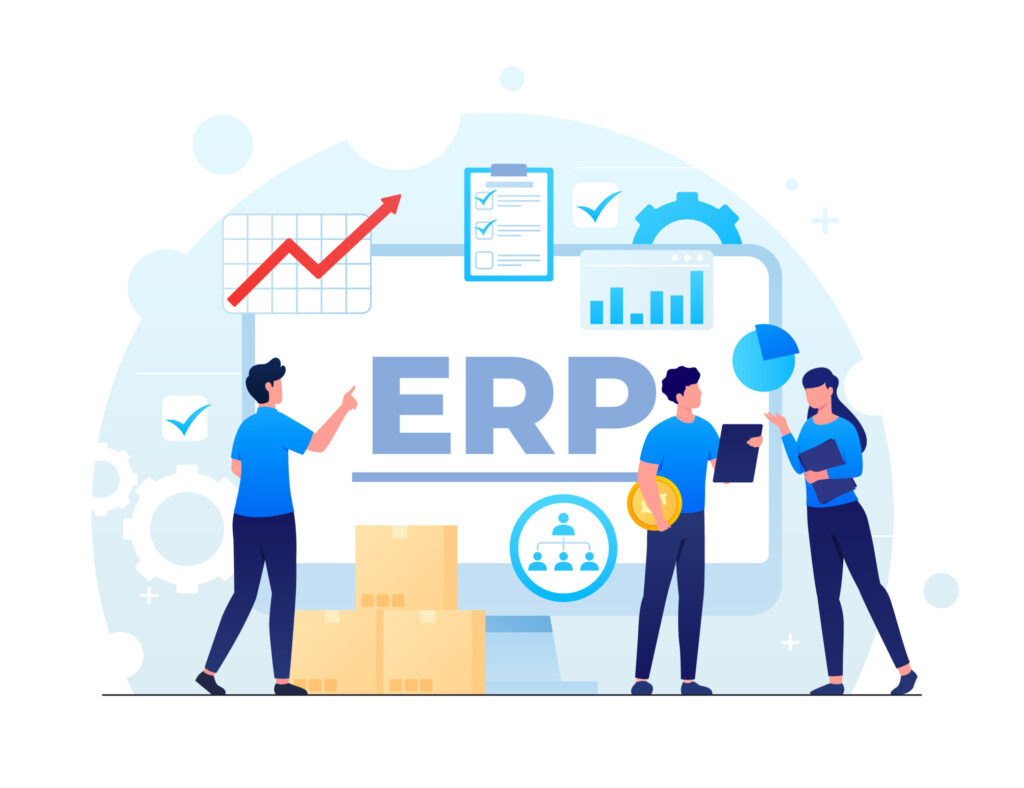
ERP finance module helps see your ‘tomorrow’ today In today’s business enterprise, you need to know that your financial decisions are based on today’s data, not numbers from records closed a month ago, or even a week ago. And you need to know that this same data represents every segment of your organization’s activities, whether your enterprise stretches across a room or around the globe. This is essential, because the most efficient way to get your enterprise to where you want it tomorrow is to know exactly where it is today. Whatever the financial goals of your organization may be, the financial application components of eresource ERP software solution work hand-in-hand to improve the bottom-line. This is true because the financial functionality is tightly integrated across all business areas and all geographic areas. This tight integration includes all the other different modules, from materials management to human resource to logistics. Because eresource ERP system automatically links related areas, it eliminates the need to repeat procedures. You enter your data only once. Within the eresource ERP system all areas work in coordination, creating a new level of efficiency in handling your financial data. The finance module of eresource ERP system provides financial functionality and analysis support to lot of medium and large scale enterprises in Indian and abroad. The finance module of eresource ERP system has the following sub-systems. Financial Accounting General Ledger Account Receivable Account payable Fixed Asset A/C Debut Note/ Credit Note/ Journal Entries Bank Reconciliation Statutory & Regulatory Value added tax analysis & reporting TDS & service tax Excise Enterprise Controlling Executive Information System Business Planning & budgeting Profit centre accounting In addition, eresource ERP’s financial accounting provides company-wide integration that is essential to strategic decision making. The financial accounting module in eresource ERP gives you the ability to centrally track financial accounting data within a single framework, of multiple companies, multiple branches and chart of accounts. Also Read – ERP for Plastic industry
ERP Finance Module Tyre Asia, published from Shanghai, in their August-September 2009 issue, highlighted the contribution made by eresource Infotech in transport industry through their Enterprise Resource Planning – ERP system. In an interview with eresource Infotech CEO Mr. Sudheer Nair, Tyre Asia has made the right attempt to make the automotive industry understand the important of having a rightly managed enterprise planning solution in place. The interview has also highlighted the working modules of Fleet Management ERP in details and the article will surely help our fleet industry in a big way. Tyre Asia is a highly focused bi-monthly publication with a true international profile covering the global tyre and tyre-related industries. This publication is intended to address the long-felt need of the global community for a world-class publication covering the tyre industry and other related segments like accessories, chemicals, retreading and automotive components. Also Read – Transport ERP Software
When a company decides to implement an ERP system, what they are primarily looking for is the improvement in the management of their financial section. But a hurriedly taken decision about ERP implementation can bring the negative impact. Therefore selection of a suitable ERP system is most important as it must not only suite your business process but also your finance management. By now everyone knows that the continuous changes in the global business environment, efficiency and effective in the management of companies cannot be compromised. For efficiency and effectiveness in the business operation the management must create path for bi-directional relationship of the different areas and processes of the company. Nowadays team work becomes an essential part for a successful business, which includes the planning and administrative functions of all the corporate areas. The use of eresource ERP in the Financial Department is a best way to manage the account records updated in a reliable and effective way. The General Accounting, the centre of the financial activities of the system, helps to capture and integrate the transactions made inside the module, allowing you to see the influence in financial terms over the enterprise as a joint system. Whatever the financial goals of your organization may be, the financial application components of eresource ERP software solution work hand-in-hand to improve the bottom-line. This is true because the financial functionality is tightly integrated across all business areas and all geographic areas. This tight integration includes all the other different modules, from materials management to human resource to logistics. Because eresource ERP system automatically links related areas, it eliminates the need to repeat procedures. You enter your data only once. Within the eresource ERP system all areas work in coordination, creating a new level of efficiency in handling your financial data. All the audits include information details such as who made an entry and when, as well as who created and modified the last time, is recorded in our ERP system in order to maintain a proper order in an organized manner. The display can also be made simpler by opting for filtering the details by date entry. One of the most advantages of finance management module eresource ERP is that the accounting information of several years can be maintained online without affecting the performance; and it also has specific features to leave tracks of audits to determine the origin of the transactions. Also Read – ERP Software for Manufacturing Industry
Financial Management is considered to be one of the most important modules of an ERP system. ERP financial management module includes features that support creation of ad hoc reporting as well as month-end closing, quarter closings and year-end reporting. eresoure ERP financial management system, which encompasses the functions that are required to maintain one or more sets of books, generate financial reports, manage cash and fixed assets and execute payment and receivable transactions. The financial management functionality in eresource ERP system minimizes manual data input on behalf of the user, thereby freeing the user from tedious, routine tasks and allowing greater focus on other, greater value added, tasks. As the module is keeping track of every movement in and out of the warehouse, it can deliver at any time clear value of what’s in stock. The financial module in ereosurce follows every individual step, including budget planning for production and billing. Apart from the above functions the Financial Management in eresource ERP software gather financial data from various functional departments and generates valuable financial reports such as Balance Sheet, Trial balance, General Ledgers, Quarterly Financial Reports, Account Statements, Gross Profit Analysis, Cost Center wise Analysis, Branch wise Profit Analysis, profitability report, Asset and Depreciation Management, Tax Management, ABC Analysis and many more. eresource ERP Finance module also has the capability of meeting all the accounting and financial needs of an organization. It is with this module that Financial Manager as well as other Managers within business can review the financial position of the company in real time and assist in better decision-making and strategic planning. Default charts of accounts. Linked accounting. Direct navigation from accounting entries to documents and vice versa. Journal entries. Trial balance. General ledger. P&L statements (income statements). Balance sheets. Receivables and Payables Generation of debt payments (from invoicing). Issue of debt payments. Management of accounting documents. Bank statements reconciliation. Asset Management Bank Accounts Management In addition to the above outlined features, provision for Bank Guarantee, Forward Contracts, Letter of credit is also available in eresource ERP.
Key ERP Modules An ERP software consists of many modules with each module is integrated with the major functional area of an organization. In normal procedure, each module is designed to interact with each other with easy accessing of information concerning a particular branch, section or department. ERP modules are tightly protected with efficient security system and the staff is trained to handle the system effectively during the training session by the consultants. The following are some important key ERP modules that being included in major ERP packages. ERP Finance Module The financial activities of an organization by the finance department are recorded using various user interfaces and these interface screens related to the finance department are grouped into a single menu option and these set of options are called the finance module. Financial module of an ERP system is used to record day to day transactions like receiving payments Customers, payments to vendors by raising cheques or through cash and journal entries. Financial module records the data during: Creating a Customer Account Creating a Vendor Account Creating a Bank Account. Creating a General Ledger Account Enhancing Chart of Accounts (when major changes to be made for preparing the financial statements) Financial application components of an ERP solution work hand-in-hand to improve the bottom-line. This is true because the financial functionality is tightly integrated across all business areas and all geographic areas. This tight integration includes all the other different modules, from materials management to human resource to logistics. The financial module of ERP also provides financial functionality and analysis support to lot of medium and large scale enterprises in Indian and abroad. Manufacturing Module in ERP This module is used to record data related to the manufacturing department of the organization. Data is recorded in this module when Bill of Materials, Work Orders and WIP receipts are to be created for work orders. In modern manufacturing operations, information starts at the top and the bottom simultaneously. Data originates at the machines, the process and the workers. It indicates what is being made, how and where, when it will be done, and why it won’t be on time. ERP allows companies to balance customer demands impacted by multiple interrelated items and multiple plant locations. ERP adds applications for financials, supply chain, and distribution and requirements planning for multiple sites. It facilitates intelligent resource planning in the face of rapidly changing constraints such as materials availability, market readiness, plant capacities, personnel certification and business costs per location. In short ERP systems will allow decision makers to champion ‘an intelligent, agile and responsive’ organization in the global marketplace of the next century. ERP Sales and marketing Module This module comprises of Contact Management and Sales Order Processing Management. It is an integrated solution comprising of marketing and sales activities. Organization can act immediately to improve sales, service and marketing effectiveness by using this module. Sales and Marketing module also help to you getting your customer order management easier day by day. Use of this also includes maintaining customer information, quickly creating a quote or migrating them to sales order. ERP Purchase Module ERP Purchasing module streamline procurement of required raw materials. It automates the processes of identifying potential suppliers, negotiating price, awarding purchase order to the supplier, and billing processes. Purchase module is tightly integrated with the inventory control and production planning modules. Purchasing module is often integrated with supply chain management software. ERP Inventory Management Module ERP Inventory Management module facilitates recording of data in the inventory department. Activities of the Inventory department such as receipt of goods, delivery of goods, maintenance of material in the stock sections, classifying all the materials, issuing of materials to the manufacturing department, rejections from the suppliers are recorded with full details. ERP Human Resource module Human Resource (HR) module in ERP streamlines the management of human resources and human capitals. It comprises of four broad sections, mainly Training, Recruitment, Payroll and Attendance. HR module routinely maintains a complete employee database including contact information, salary details, attendance, performance evaluation and promotion of all employees. Also Read – Streamlining construction operations with ERP systems