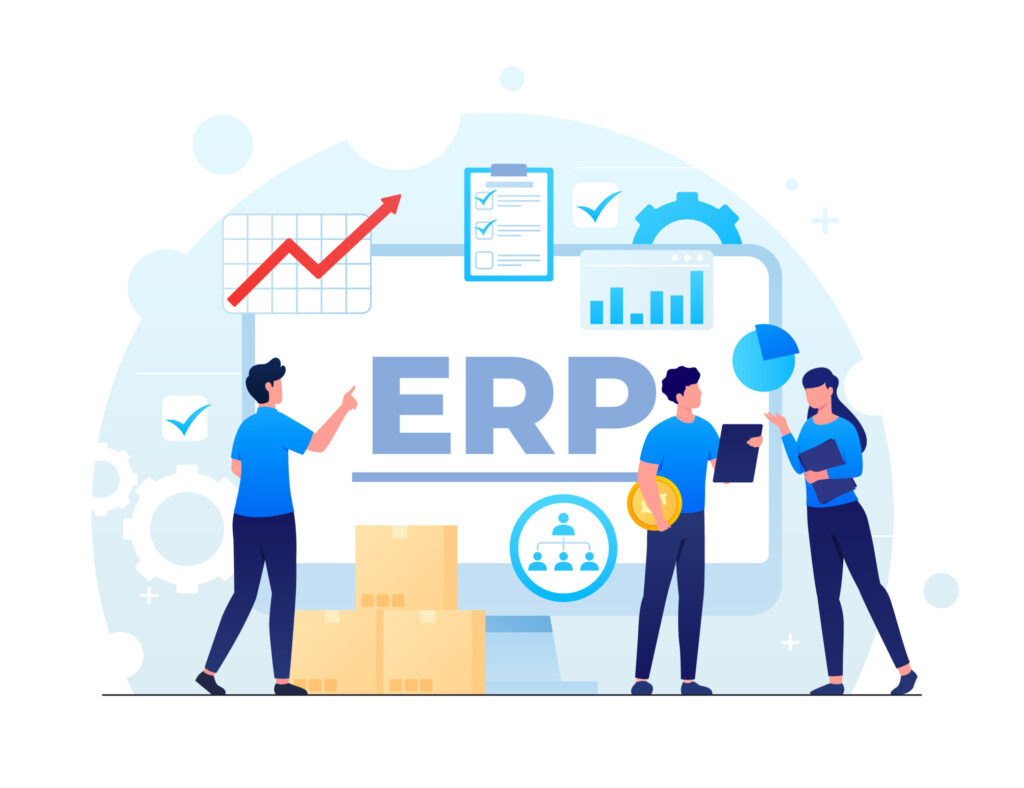
ERP and ROI: During our deliberation about ERP with some of our clients we have came across questions raised on the necessity of an ERP system. They can’t be blamed for their doubts. Because their organizations typically have software systems that performed much of the component functions of ERP. In this case it is our duty to make them understand the functioning of web-based eresource ERP system and what makes our system different from a standalone system. The integrated eresource ERP software provides a degree of interoperability that was difficult and expensive to achieve with standalone, custom-built systems. eresource’s web-based ERP serves many industries and numerous functional areas in an integrated fashion and automate operations from supply chain management, inventory control, manufacturing scheduling and production, sales support, customer relationship management, financial and cost accounting, human resources and almost any other data-oriented management process. Web-based ERP systems have become increasingly prevalent in almost all major industries and it is gaining wide acceptance among Indian SMBs. Being the most affordable ERP system available in India today, it is not a surprise that the usage of eresource ERP is growing rapidly. With a cent percent success rate in implementation eresource is becoming the first choice for organizations looking for substantial return on investment (ROI) though their enterprise system. With eresource, business operations have become much easier. For example, when a salesperson enters an order in the field, the transaction can immediately flow through to other functional areas both within and external to the firm. The order might trigger an immediate change in production plans, inventory stock levels or employees’ schedules, or lead to the automated generation of invoices and credit evaluations for the customer and purchase orders from suppliers. Every growing organization must realize that ERP systems have become the most significant IT investment for most companies in their capital budgeting. It is the business category that plays a very important role in choosing the right ERP and the successful implementation. Because of the specific features of resource ERP system, it is expected to go well with majority of the business process. eresource is being implemented successfully in major industrial segments and there is no concern about its functionality and module compatibility. Numerous case studies conducted successfully proves eresource ERP is one of the best enterprise software solution available in Indian market today. Also Read – ERP system for Construction Industry
ERP and ROI Though many organizations spend lot of time and money researching, analyzing and justifying an enterprise resource planning (ERP) purchase, they hardly spend any time to scrutinize whether the application performs satisfactorily and gives the required output. If organizations don’t establish specific performance metrics, it will be very hard to gauge how well that product is working to meet their objectives, let alone correct any performance gaps. Given that ERP system is somewhat expensive, some might wonder why more organizations don’t engage in a thorough, after-the-fact audit. Reasons range from a lack of involvement by senior management to anxieties about whether the project will live up to its promise-and whose feet will be held to the fire if it doesn’t. And somewhat surprisingly, after-the-fact audits are often skipped because no one agrees on what precisely constitutes a successful ERP program. When the majority of the people you ask not may not sure about what an ERP is, it makes little difficult for your to search for the people who may know it thoroughly. On a technology level, ERP software integrates a company’s departments and functions into a single program running on one database, a valuable step forward for improving efficiencies, because integration speeds up business processes. For a HR manager, ERP system is something different application from a production manager. For him/her it is a system for the employees to interact with each other. But getting bogged down in definitions is beside the point. The point is whatever methodology you use to measure your ERP, it should be applied consistently across the organization at specific points following the implementation. How often you measure your ERP system will depend on the size of your organization and the depth of your software change. Typically, an audit should occur halfway through the implementation, again at three-quarters of the way through the implementation, and when it’s complete. Then, you should follow up every quarterly. There may be some further questions that how can the ERP applications be measured up? Only a systematic, disciplined approach to measuring ROI can provide the answer. However, if the ERP audit focuses only on productivity gains, such as how many steps it takes to complete a shipping label, you won’t get the clear of ROI. To get a clear picture the audit must take into account how well employees interact with the ERP software. Whether the system empowers them to accomplish key tasks? How quickly do they adjust with its functioning methods? To get the actual result, user surveys should be conducted immediately after the training period and again six months later. A polite approach to the employees to enquire about the functioning of your ERP system could get you closer to the software and its functioning. It will help you understand any shortcomings in the system as well as the need of further training to the employees which could make them more comfortable with the system. A logical and systematic approach to the ERP system by the employees is a must for a good result that ultimately reflected in the organization’s return on investment (ROI). Also Read – ERP Software for Manufacturing