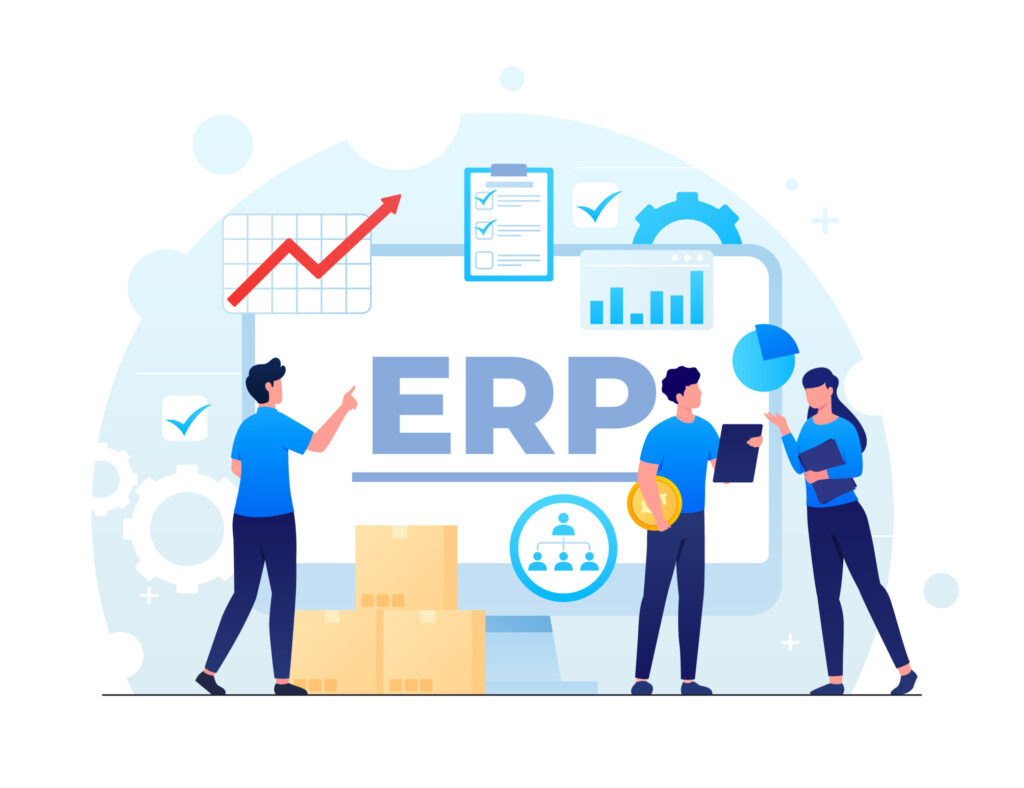
Implementation of Enterprise Resource Planning (ERP) system is not only about automation of the corporate system and control expenses but also it is an effective business tool which can control sales and commercial planning. However, the planning should be lead to the back-office area where the ERP system can be used extensively to accelerate the return on investment. eresource ERP software for trading and distribution industry area facilitates efficient structure of all company processes. It enables to streamline the whole corporate operations and curtails unwanted expenses. Every commerce and distribution activities in the organization and its branches are integrated and operations can be easily monitored. In today’s situation, where businesses are facing stiff competition, to have an efficient planning system in place cannot be avoided. Apart from managing the in-house operations, to keep track with customers and clients, the organizations need to be equipped with a reliable resource planning system. eresource’s web-based ERP system enables every organization to be on working mode on 24 hours of a day. All the requirement of logistics, commercial and trading business is being integrated in eresource ERP, which may suit all type of business. To be more elaborate, it is an ideal ERP solution for retail and wholesale stores, import and export stores, distribution and service, shipping and transport. Nowadays, all major and minor industries are using the ERP system alike, these includes, manufacturing, pharmaceuticals, logistics and transport, chemicals, construction and infrastructure as well as trading companies. Many advantages and benefits further enhanced with flexibility to run the organization in a more organized way is the main reason for the success an ERP system. With eresource ERP system what we promise is more than that. A decision to implement eresource ERP system will allow businesses to make the daily tasks simpler through the correct control and systematic operational methods. There are specific modules for the satisfaction and needs of all industry segments. Our sales team is always ready to serve you with a smile. They are just a call away. Call now, let a bridge a relationship. Also Read – ERP software for manufacturing
Adopt global best business practices Best practice is the process of finding and using ideas and strategies from other companies and industries to improve performance in any given area. Business has used best practice bench marking over the decades and realized billions in savings and revenues in all areas of business operations and sales. ‘As-Is’ best practice addresses or includes the present practice followed by the specific company which is planning to implement the changes required to keep itself in the league of other top companies in the industry. This is done in all functional areas like HR, Operations, Finance, and Maintenance. etc. ‘To be’ best business practices are generally the best practices which exist in the industry and have been refined over a period of time. Companies should aim at adopting their industry specific best practices for their future benefit. Preventive maintenance, activity-based costing etc. are considered as best practices. ‘To be’ best practice includes some of the practices which are already adopted globally and are taken as industry standards for swiftly operating businesses in a competitive global scenario. Also Read – Significant changes in business after using cloud ERP software Some of the best practices that can be adopted are as follows: Information Liquidity Much like cash liquidity, the liquidity of information is a measure of business success. In a successful company, data flows smoothly and information is transformed into economic value. Information liquidity is obtained by integration of processes and systems at all levels. Integration should be the driving force behind design, methodology, development and deployment of all IT systems. Availability As most companies become more and more dependent on IT, it is very important to ensure the maximum availability of the eservices. This does not mean that all IT systems have to be absolutely flawless and foolproof, but good through has to be given to what could be the consequences for the company if all or part of the IT services are temporarily unavailable, and what can be done to minimize these consequences. Also Read – Best ERP Software in India Agility Market changes constantly and so does legislation and technology. It is said that the product life cycles and their time to reach the market are getting shorter and shorter. As a consequence, IT systems have to be built for maximum agility. Cross-compatibility, reuse and lightweight functionality are the ideas to be considered. Costs Especially in times of economic slowdown, the costs of IT are under constant scrutiny. Unfortunately, it is very difficult to quantify the benefits of IT in terms of money and it is relatively meaningless to approach IT investments singularly from an accountant’s point of view. These costs also have to be related to non-quantifiable benefits for the company. Also Read – How ERP software is beneficial for pipe manufacturing industry
ERP growth is skyrocketing Demand for Enterprise Resource Planning (ERP) solution growing day by day. Experts are forecasting a huge growth of demand for ERP mostly in mid-sized organizations. The demand is due to the specialty of an ERP system to manage the increased customer service, efficient distribution system and reduced operational costs. Majority of CEOs/Senior managers share the same view that ERP is an important tool to achieve competitive advantage. The number of employees in an organization using the ERP system is increasing and organizations that have started with the basic modules are now expanding their system with subsequent applications. This is also another reason for the ERP growth. Another factor for the growth is many organizations replace customized system with standard application packages. Most of the medium ERP vendors are targeting the mid-sized organizations. This is because many of the mid sized organizations are working with applications which are non-integrated and on disparate technology architectures, built in-house. This has resulted redundant technology, loss of support, non availability of critical information at the right time resulting in overall business loss. ERP vendors in India have found it an ideal market by exploring the SME segment. There are lot of demand persisted in this market, which on the other hand helped to growth the ERP market in substantially. Also Read – How web based ERP software helps remote workers Knowing that majority of Indian manufacturers are small by global standards and requiring easy-to-use ERP solutions to meet their specific process requirements, ERP vendors in India have come out with ideal solutions which can not only match their needs but also their budget. Now almost all small and medium enterprises across industry verticals and micro verticals, such as pharmaceuticals, chemicals, fleet management, automotive, modular kitchen, construction, infrastructure, and textiles, are leveraging ERP solutions to gain sustainable competitive advantages. With the advent of on-demand deployment of ERP software and also web-enabled ERP solution, the user can access the software through license as a Web-based service. The increasing popularity of the web-based applications account for the ERP growth, as the enterprise resources are maintained by a service provider. Growth factor also includes the competition prevailing in Indian ERP market. With the entry of international companies in the local market, the local vendors also steadied their products which are going to be a good sign as far as mid-sized organizations are concerned. Now they can find a wider market with ERP product suitable to their needs also in their limited budget. As the market is getting more competitive reliability and compatibility about the smaller players are unwanted. Today SMEs can choose the right ERP at their will with confidence which is, indeed a good sign. Also Read – What are the future trends for a construction ERP software?
Set targets and Budget Before ERP Implementation 1. Phased approach: It is important to break as ERP project down to manageable pieces by setting up pilot programs and short-term milestones. Depending on the IT experience, some organizations choose the easiest piece as the pilot project, while others may implement a mission-critical application first. The pilot project can both demonstrate the benefits of ERP and help gain hands-on ERP implementation experience. 2. Data conversion: Second generation ERP systems use relational database management systems (RDMBS) to store enterprise data. If large amounts of data are stored in other database systems or in different data formats, data conversion is a daunting task, which is often underestimated in ERP implementation. A two-hour data conversion task could be turned into a two-month effort as a result of the DBA group’s lack of technical experience and the management’s incompetence or ignorance. Also Read – Why is ERP system important for solar industry 3. Organization commitments: The involvement of ERP implementation goes far beyond the IT department to many other functional departments. The commitment and smooth coordination from all parties is the key to the success of ERP project. The commitments come from the understanding of how ERP can benefit each functional department. For example, if the warehouse staff is not completely sold on the benefits of the inventory control module, they may not input the kind of usage data that is essential to the project’s success. 4. Create partnership between your software vendor and your stakeholders: While this concept may seem obvious, it has been found that the vendor-client relationship is often contentious and sometimes outright hostile. This fact is particularly true if the organization is severely divided regarding the choice of vendor software. As problems arise during implementation, and they will arise, the blame game often begins. Before long, the project evolves into a standoff with neither vendor nor client willing to admit fault. A third-party project director or manager is often the best solution for this dilemma. This person can usually serve as an objective mediator to bring the parties together, finding solutions, rather than allowing the project to slow down to a crawl. Also Read – How ERP software is beneficial for pipe manufacturing industry 5. Sell, sell, and continue to sell the ERP to your stakeholders: Implementing ERP systems are extremely complex and take months or even years, to implement it. If your stakeholders understand the long-term benefits of the system, they are much more willing to accept any perceived temporary steps backward. 6. Build and leverage process expertise: Process focus is if anything, more important after going live since the company now has an even greater core of process expertise. Successful companies fully capitalize on this expertise and the power of ERP-enabled process. One way is by sending process experts from the implementation team back into the organization, or by having some serve at centers of excellence, some as key process performers and some as business managers. Successful companies never forget the point of the integrated enterprise – that it is not about ERP so much as it is about people involved in ERP-enabled processes. 7. Adequately resource your project: Ensure that replacements are in place to release key team participants. The people who do the daily work of running functional departments are the same people who will be essential to implementing an ERP system. No surprise. The people with the most knowledge will be needed for the majority of the project. Priorities will conflict between the demands of the office and demands of the project. The most effective solution we have seen is hiring or contracting with additional resources to serve as back-fill for key office personnel. Admittedly a new resource cannot do everything that an experienced resource normally does; however, the replacement can handle routine work and coordinate with the experienced person for critical decision. Also Read – How can ERP system help the cosmetic manufacturing process? 8. Define metrics and manage them: ERP systems are capable of producing dramatic productivity improvements if successfully implemented and properly operated. But expecting ERP to perform miracles will be asking for trouble. The management and employees should be made aware of the benefit so that there are no over expectations. If ERP is touted as a panacea, then there will be dissatisfaction and disappointment about it, which can lead to failure of the system. 9. Communicate and manage expectations at go-live: Many stakeholders in the organization expect the ERP to be an ‘everything for everybody’ solution. Even in the best-case scenario, this is rarely true. And inevitably, some functionality must often be re-scheduled into a post “go-live” phase. All of this combined could crate disillusionment with the new system. If the project teams are struggling to meet deadlines, they may have to make decisions on the functionality that needs to be delayed in order to meet the original “go-live” date and avoid delays. These decisions must be communicated and “sold” in the stakeholders to ensure expectations are effectively managed. The organization needs to know what will be in place at “go-live” and when they can expect the additional functionality. Read More – ERP Software In India