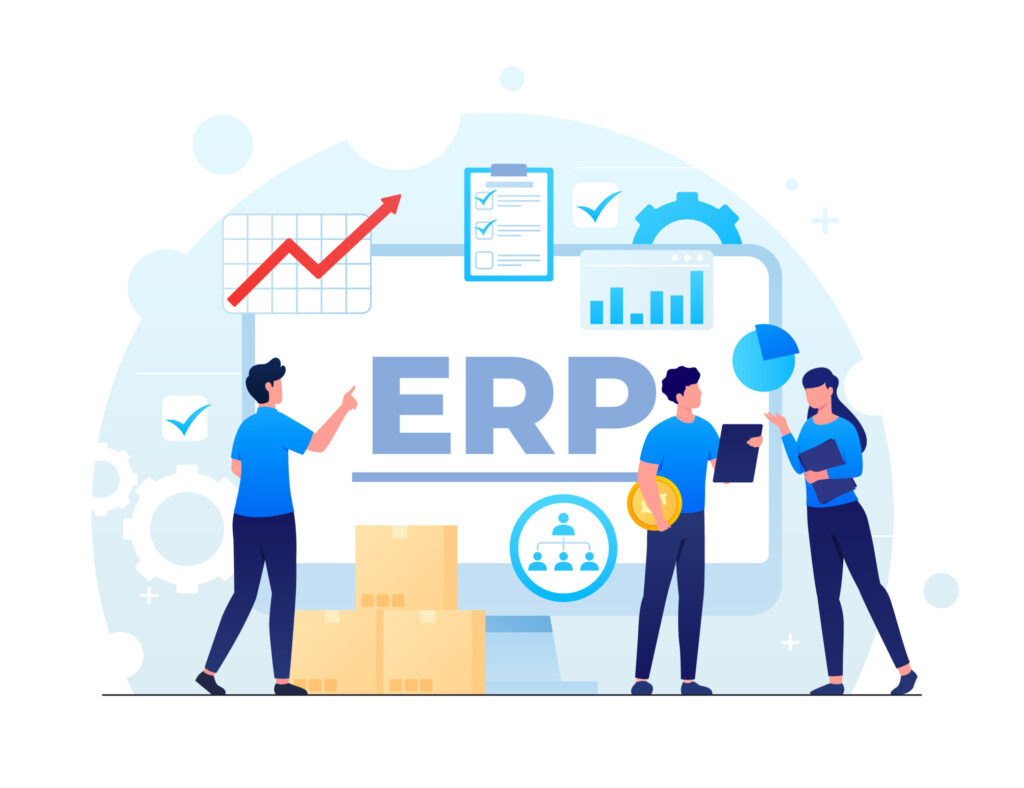
One ERP. Every Industry. Global Presence. Powered by Azaalea AI
22272e9fb58a47b7d605950c6cdff7b550d0b71e
One ERP. Every Industry. Global Presence. Powered by Azaalea AI
Final white Azaalea Ai Middle East FZ LLC logo (1)

Is your business showing signs of negative growth?

7016016 Many reasons to choose eresource ERP as your business solution Web Based ERP software Solution: HAVE you ever thought why your business needs an effective ERP system? If any of the following matters hamper your business growth then it is time to think of implementing an ERP system. When you are not able to keep pace with the changing business environment with your current supporting elements like financial management, sales forecasting methods, fail to determine the need of your customer’s requirement, losing track of your inventory then you must definitely go for an ERP system. Integrated solution makes all the difference There are companies that use different software applications for their operations and it affects communication between various sections and department, as these applications are not networked. Time lost in exchanging information from one section to another section can make a big effect in your business strategy. As these software works as standalone applications, you cannot blame the system for the delay. Therefore the only remedy to overcome the above hardship is to depend on an ERP system, which is an integrated and automation software. Also Read – Manufacturing ERP Software A study of how your employees carry out their routine work will help you understand the importance of having a intelligently integrated ERP system like eresource. None of your business operations are going to be smooth if the staff use different system for different operations. For example what will be scenario if the staff in the account section use one system for receivables and payables, and sales use another to enter in customer orders? Also, it is going to be a complete mess if the employees in warehouse use a completely different solution to track shipping and receiving.In the same manner when various front- and back-end systems run separately, it can wreak havoc in your business processes. You are aware that without accurate data from sales, inventory management may suffer, while not having the latest information from accounting can trigger a ripple effect on everything from marketing budgets to payroll. Easy access to information will make your business process smooth Quick access to information regarding everything that is related to your business can make all the difference. In today’s fast paced business life sending and receiving information at your will and convenience is the prime requirement. With the deployment of eresource ERP system for your business purpose, every operations can be performed and every information can be accessed with the just help of an internet connect and your laptop. Our ERP system will make your PC or laptop your office. Everything that is happening in your business organization can be accessed from anywhere at any time with help of our cloud and web based ERP software solution. Decision makers in your company can get a clear view of business operations at any time. Every staff can get the information they need to do their jobs more effectively. The days that have depended on soiled system and spreadsheets will become history once eresource ERP system comes as your business solution. Automating your financial operations Once the eresource ERP becomes your business solution, it will automate your financial operations. Your employees don’t have to rely on paper-based invoices and sales orders—and spend hours every week manually entering them into different accounting and sales systems. You can image how much time can be saved on with ERP system when it handles the above operations. With all accounting details in a single database, accounting staff won’t have to spend hours cross-posting information, rekeying numbers, or reconciling data manually. Deployment of this ERP system will make the accounting staff more productive, freeing them to deliver critical reports without delays and frustration. Also Read – Construction Management ERP Don’t allow too many cooks to spoil your food As the saying goes, too many cooks can spoil the food, having more than one software application to manage your business bring nightmares. Therefore it is important for companies to implement an efficient ERP system for all your business operations. ERP system like eresource provides end-to-end solution for all your business operations. Being an integrated and web based ERP software solution it takes care of every that is needed to successfully operate a business. Those companies that are planning to upgrade their patchwork systems like on-premises, legacy system must realize that these kind upgrades can only bring more troubles than they are worth. Not only these are a time-wasting exercise but expensive affair too, that will have no positive result. It is therefore companies are advised to go for more advantages, effective, intelligent and reliable ERP system like eresoure for their successful business operations which can assure an effective ROI (Return On Investment). Also Read – Manufacturing ERP Software Businesses all around the world are increasing their reliance on ERP systems as a cost efficient alternative to their software applications. An ERP system provides organizations, especially industries like manufacturing, with a solid foundation, incorporating all of the fundamental aspects of running a business. Expectations run high when an organization deploys an ERP package – if the solution is a good fit for the company, the company stands to gain tremendous cost savings and service improvements across the enterprise. ERP for Manufacturing Industry In the earlier days ERP system was largely used only by the manufacturing industry and a wrong assumption was carried over that the system is made for only Manufacturing industry. It was basically due to the way in which ERP was historically developed from the methods of Material Requirement Planning (MRP) and Manufacturing Resource Planning (MRP II), which are relevant to manufacturing organizations. In the manufacturing industry, MRP became the fundamental concept of production management and control. At this stage BoM (Bill of Materials), which is purchase order management that utilizes parts list management and parts development, was the prevailing trend. ERP is for all industries The large organizations have wide resource to manage. Handling massive volume of resources using the various software applications or with the help of legacy systems is something that these organizations

Is your ERP system ripe for replacement?

7016016 What is the need of ERP software? Some may ask. The answer is not simple. Though we must understand that today there are lots of midsize companies face challenges specific to their industries. Businesses that make consumer product goods are concerned about regulations and reporting requirements, while public-sector organizations are worried about maintaining customer loyalty. Also, manufacturers are concerned about the commoditization of their products. A robust ERP package can help address these issues, as well. Though some companies have already implemented an ERP there are still many who don’t have any of these systems. At the same time, it is also to be noted that many ERP implementations in the midmarket are quite mature and ripe for replacement. Many midmarket companies must now also choose an ERP system on which to standardize after multiple systems were installed, perhaps through mergers, across the enterprise. Although it’s not necessary, midsize companies seem to prefer consolidating their business-management applications in one ERP package, at least in part to cut down on integration headaches. Vendors are aggressively vying for customers, launching new ERP solutions designed to meet needs particular to the midmarket and pricing them to meet a midmarket company’s budget. To further entice midmarket customers, vendors are also developing vertical solutions that target certain industries, such as manufacturing, pharmaceuticals, fleet management and construction, with built-in functionality that cuts down on customization. In an effort to simplify the notoriously difficult implementation process, vendors are also developing ERP systems that can be delivered in ways friendly to organizations with limited IT resources. Web-based ERP solution has become an ideal system for many of these mid-sized organizations as it is very cost-effective with easy implementation process. There are some companies that may try to develop its own ERP system in-house. Since designing and implementing ERP systems is not the business of most companies, the systems developed by the team will never equal in quality, scope, functionality, or technology with those created by software firms. These software firms or ERP package vendors can produce sophisticated packages and provide their clients with products that allow them to maintain a focus on their own chief activities, thus improving revenues, profits and shareholder returns. Thus, it always better to buy ERP packages ERP systems are getting better, bigger and have more features. Also, people who are specialized in developing such types of tools have developed them. Most of the tools would be customized to suit your needs. So unless and until your project or organization has a need that cannot be fulfilled by the available tools, it is better to buy the tools rather than make them.   Also Read – Live ERP Software Demo

Benefits of ERP for Manufacturing industry

7016016 Benefits of ERP for Manufacturing industry Initially, Enterprise Resource Planning (ERP) solution was developed for the big organizations. It has also involved huge investment which was out of reach of small and medium sized industries (SMEs). However considering the benefits the ERP solutions have, the smaller organizations also explored the way to implemented it. This attitude has paved the way for many locally made ERP solution providers entering the market with very effective applications which have turned to be ideal for small and medium sized companies. As the local ERP vendors were targeting the SMEs, they also kept the price tag in mind, which ultimately resulted in existence of some effective and affordable ERP products in the market. Manufacturing was one of the sectors that have benefited most from ERP solution. It was due to timely ERP implementation. Other sectors also followed suit. Today, all industry segments are taking advantage of ERP solution and it is becoming a necessity rather than a luxury to have ERP implemented in an organization for its successful business operation. Also read – eresource xcel helps manufacturing industry on increased productivity Before the evolution of ERP, manufacturing sector were running on manufacturing resource planning system. The manufacturing resource planning included all the sources in relation to the manufacturing such as material, human resource, equipment and finances. When the competitive strategy changed from low price and great variety to speed, ERP found the right place to give profit to this new strategy. Contrary to the other applications, the ERP system connects to all the offices of a group of business throughout the entire world. ERP system allows the organizations to design products with the entrance of engineers all over the globe, installing factories in various areas to produce pieces and components for many countries, and the information of all the parties involved. ERP offers solution that enables manufacturers to compete in the prevailing market atmosphere. It has the capacity of both finite and infinite planning capabilities which assist manufacturers to develop original schedule. ERP solution can also transform the supply chain to achieve production plan with sales plan, manufacturing, finance and customers. ERP is changing the competitive landscape for SMB manufacturers. Small to midsize manufacturing companies can benefit from a fully integrated solution designed to reduce costs, improve customer service, increase margins and generate new revenue streams. Further, SMB manufacturers can improve business performance with a deeply functional, yet easily affordable, ERP solution. As the technology changed ERP solution also found its way to the web. Today web-enabled ERP solutions are the most effective solution available in the market. What is to be cautious about the selection of an ERP system is, before you commit to any ERP system, you should first evaluate the system such as what your organization needs and wants to accomplish with its ERP strategy. The outcome of this evaluation will help you determine which applications and what kind of functionality your organization requires as well as go a long way toward easing the implementation.   Also Read – ERP Software In India

Live demo of ERP gives you a real picture

7016016 Benefits of Live demo of ERP Software Solution The real picture of a proposed ERP product can become clear when the live demonstration of the product is given. The sincerity of the solution providers and efficiency of the product becomes evident in the live demonstration. The demo also makes it possible for both the parties to propose feasible modifications in the package. The credibility of the system can also be scrutinized here. Moreover, it acts as a cross check for the functionalities offered by the developers in the compliance of the product. The top management and all the other people connected to an organization must realize that whatever be the reason for the changeover to an ERP system, i.e. technical or strategic, it is impossible to separate them, since they affect each other. Also Read – Live ERP Software demo   Live demo of ERP is a better tool to understand the various integration/touch points and the participants could experience the different functionalities as well as they can also check for any shortcomings in the system which can be rectified as per their requirement. It is usually better to get a brief about the product before seeing the demo, which can be obtained through the website of its developers. The time and method of the demo could be finalized by the demonstrator and let set their own sequence. Any doubts about the product can also be cleared in the demo stage. Demo scripts in the form of brochure or function details through the website are a better tool to present the demo as there is uniformity in the flow of the demo and the various integration/touch points among the different functionalities can be checked. The workflow becomes clear during the demo, and users can have a feel of the proposed product at the demo itself. This will determine the acceptability of the product in the minds of the customer. The quality of the product also becomes clear at this stage. Based upon the markings obtained in all the above-mentioned points, those products that cross the threshold mark get qualified to be evaluated. Before finalizing one more important point to be considered is the cost factor. Though all the products have its own price line, all developers may be willing to for a negotiation considering the competitive mindset existing in the market today. However, some developers of the product won’t alter the price tag, majority of them will agree to some climb down. Once it has been agreed on technical and the terms and conditions in the financial front, a suitable product can be finally selected for the ERP implementation.   Also Read – What is the best ERP for the electronic manufacturing industry?

Retaining customers makes perfect business sense

7016016 Customer loyalty has a powerful effect on the business bottom line. The dramatic economic power of customer retention is revealed when customers are viewed in terms of lifetime value. The value of retaining customers makes perfect business sense when one considers that a consumer retained for life is more cost-effective, requires less service, provides more business and contributes to new customer acquisition by offering positive referrals. For the average business, studies indicate that repeat customers account for 70 per cent of total revenues. Thus, customer retention, creating longitudinal investment in customers, guarantees significant current and future economic benefit. ERP integration enables businesses to better comprehend and thereby, better serve customers with each and every interaction. The ERP integration is not an easy task. The good news is that there are a growing number of solutions available. Before adopting a course of action there are a few common rules to follow. Firstly, make sure you understand the problem before you undertake the solution. ERP integration is a corporate-level problem requiring a corporate level strategy. Also Read – ERP for civil engineering its role and benefits Enterprises must consider the use of an ERP as an obligation instead of an option in order to be competitive. With old systems the information that comes from daily activities are difficult to handle. This will ultimately affect the relation the company has with its customers. Customer satisfaction is the most important element of a successful business and ERP plays an important role in fulfilling this commitment. Everybody knows that communication improves relationship. Therefore it is important to understand that ERP can bring data from one area to another without any extra effort, and with almost no chance of mistakes. In addition to this, the information becomes available in real time. Therefore, by the time an order is entered, it can be prepared and invoiced at the same time. This helps a lot with customers as they always expect a quick response. Organizations implementing ERP applications have to explore the areas of integrating these applications to the other enterprise applications. What approach to take will depend on the need for integration. Diverse tools and methods available in the market are evaluated and tested professionally before implementation. Organizations have to adopt very cautious approach while selecting these tools and methods to keep their leadership in the market. In small organizations every department has its own needs, and they ask technical department to provide software capable of matching them. Sometimes this is provided from the outside through vendors, and it might not even exist. This is a common mistake happening with many small and mid-sized organizations. For an effective business process and customer relation management, it is necessary to have an efficient ERP system deployed in the organization and it must be done professionally to achieve the expected result in the terms of functional, technical and economical.   Also Read – How ERP system useful in pharmaceutical manufacturing industry?

Adopt global best business practices

7016016 Adopt global best business practices   Best practice is the process of finding and using ideas and strategies from other companies and industries to improve performance in any given area. Business has used best practice bench marking over the decades and realized billions in savings and revenues in all areas of business operations and sales. ‘As-Is’ best practice addresses or includes the present practice followed by the specific company which is planning to implement the changes required to keep itself in the league of other top companies in the industry. This is done in all functional areas like HR, Operations, Finance, and Maintenance. etc. ‘To be’ best business practices are generally the best practices which exist in the industry and have been refined over a period of time. Companies should aim at adopting their industry specific best practices for their future benefit. Preventive maintenance, activity-based costing etc. are considered as best practices. ‘To be’ best practice includes some of the practices which are already adopted globally and are taken as industry standards for swiftly operating businesses in a competitive global scenario.   Also Read – Significant changes in business after using cloud ERP software   Some of the best practices that can be adopted are as follows: Information Liquidity Much like cash liquidity, the liquidity of information is a measure of business success. In a successful company, data flows smoothly and information is transformed into economic value. Information liquidity is obtained by integration of processes and systems at all levels. Integration should be the driving force behind design, methodology, development and deployment of all IT systems. Availability As most companies become more and more dependent on IT, it is very important to ensure the maximum availability of the eservices. This does not mean that all IT systems have to be absolutely flawless and foolproof, but good through has to be given to what could be the consequences for the company if all or part of the IT services are temporarily unavailable, and what can be done to minimize these consequences. Also Read – Best ERP Software in India Agility Market changes constantly and so does legislation and technology. It is said that the product life cycles and their time to reach the market are getting shorter and shorter. As a consequence, IT systems have to be built for maximum agility. Cross-compatibility, reuse and lightweight functionality are the ideas to be considered. Costs Especially in times of economic slowdown, the costs of IT are under constant scrutiny. Unfortunately, it is very difficult to quantify the benefits of IT in terms of money and it is relatively meaningless to approach IT investments singularly from an accountant’s point of view. These costs also have to be related to non-quantifiable benefits for the company.   Also Read – How ERP software is beneficial for pipe manufacturing industry

ERP growth is skyrocketing

7016016 ERP growth is skyrocketing   Demand for Enterprise Resource Planning (ERP) solution growing day by day. Experts are forecasting a huge growth of demand for ERP mostly in mid-sized organizations. The demand is due to the specialty of an ERP system to manage the increased customer service, efficient distribution system and reduced operational costs. Majority of CEOs/Senior managers share the same view that ERP is an important tool to achieve competitive advantage. The number of employees in an organization using the ERP system is increasing and organizations that have started with the basic modules are now expanding their system with subsequent applications. This is also another reason for the ERP growth. Another factor for the growth is many organizations replace customized system with standard application packages. Most of the medium ERP vendors are targeting the mid-sized organizations. This is because many of the mid sized organizations are working with applications which are non-integrated and on disparate technology architectures, built in-house. This has resulted redundant technology, loss of support, non availability of critical information at the right time resulting in overall business loss. ERP vendors in India have found it an ideal market by exploring the SME segment. There are lot of demand persisted in this market, which on the other hand helped to growth the ERP market in substantially. Also Read – How web based ERP software helps remote workers Knowing that majority of Indian manufacturers are small by global standards and requiring easy-to-use ERP solutions to meet their specific process requirements, ERP vendors in India have come out with ideal solutions which can not only match their needs but also their budget. Now almost all small and medium enterprises across industry verticals and micro verticals, such as pharmaceuticals, chemicals, fleet management, automotive, modular kitchen, construction, infrastructure, and textiles, are leveraging ERP solutions to gain sustainable competitive advantages. With the advent of on-demand deployment of ERP software and also web-enabled ERP solution, the user can access the software through license as a Web-based service. The increasing popularity of the web-based applications account for the ERP growth, as the enterprise resources are maintained by a service provider. Growth factor also includes the competition prevailing in Indian ERP market. With the entry of international companies in the local market, the local vendors also steadied their products which are going to be a good sign as far as mid-sized organizations are concerned. Now they can find a wider market with ERP product suitable to their needs also in their limited budget. As the market is getting more competitive reliability and compatibility about the smaller players are unwanted. Today SMEs can choose the right ERP at their will with confidence which is, indeed a good sign.   Also Read – What are the future trends for a construction ERP software?

Evaluation of ERP software is the first step

7016016 Evaluation of ERP software   Lot of articles have been written about preparation, planning and implementation of ERP project. Which organization needs an enterprise resource planning solution (ERP) and at which stage is to be discussed. Every organization which is planning to implement an ERP solution must perform an honest and thorough assessment of business needs and alternatives. This is an important factor of taking ownership in the ERP or any alternative solutions. Though there are plenty of good reasons to implement ERP including many “no brainers”, in most organizations the decision is not so obvious and one must objectively evaluate the validity of the proposed business case and timing, Therefore, businessmen must ask these questions before spending on ERP to bring some sanity to the decision-making process :  Are the business and technical strategies that integrated in the new ERP system compatible with your business? What is the real problem you have with your existing software or your business processes?  Would an ERP project be one of the top two priorities within the organization given other internal and external projects, initiatives, or probable events?  The claims of the new ERP system actually result in better decision-making or make lousy managers more effective?  Does anyone understand the data or capabilities of the current software?  Can the new ERP system bring result-oriented performance so that the existing application which seems to be working fine could be discarded?  Is the current application software gives you a sleepless nights?  Is the current software is too old to be customized and no not supported by any vendor?  Can a few purchased (and integrated) “bolt-on” applications do the trick vs. buying an entirely new package?  Should a limited pilot project to be deployed to check the efficiency of the software before going to the full fledged implementation of new ERP system?  Are the proposed operational benefits and cost savings of new ERP system authentic?  Should all the implementation and support cost in the ROI be considered? It is advisable to hire independent business consultant to analyze the situation comprehensively. A need assessment is the first step which will be followed by the ERP readiness assessment, which are two different things. So think right and act right. No doubt, success will follow you.   Also Read – ERP Software for renewable energy

Make your business process more efficient

7016016 Make your business process more efficient   Organizations must realize that after the implementation of an effective ERP system all of its process becomes more efficient. ERP system will help all the major decision making including retaining a client. However, the organization that plans to implement an ERP system must be well prepare to integrate the system effectively. Organizations are advised to seek the help of an external consultant to find out how suitable is the organization when it comes to working with an ERP system. The external consultants are capable of evaluating and they identify the effective needs of the moment. It is a good idea if the decision about an ERP project could be carried out by a team of professionals from both internal and external for a more adequate design. This is because the main aim is not just about purchasing software, but to order all the pieces to match with it. In most cases some internal processes need to be redesigned before implementing an ERP. In addition to this, software is often modified to fit the ERP according to the enterprise objectives and activities. The combination must be as perfect as possible. Also Read – Top ERP Software solution for food industry In spite of its benefits one of the most important factor to be remembered is that ERP is not a just another software application in your organization. The system involves every internal process and must be preceded by a reevaluation of every section together with its functions. It is also important to note that an ERP will not change the management functioning on its own. You must keep in mind that it is an important and decisive tool, but in order to obtain a correct development you will have to decide carefully who is going to command it, as well as the way in which the data will be saved and how information will flow. Just implementing an ERP solution alone won’t help the organization make any success. Though the effectiveness of an ERP system could be measured by the improvement in the ROI, the goal of measurement is not to measure; rather, it is to improve performance and processes are the point at which this can be best accomplished. A well-performed ERP system can be maintained till about 15-20 years. In the later stages the package will have old architecture. It will become very difficult to make changes in the program code without inflicting hazardous damage to the system’s stability. It is possible to give older systems a ‘facelift’ with modern tools. Though those ‘facelift’ can extend the life cycle of the package for some years, they will certainly speed up the appearance of the useless codes. If your ERP system is under-performing, it is better to go for an overhaul of the system. There are numerous efficient ERP systems available in the market. Do the right evaluation as per your requirement and implement a suitable ERP system that could take your business success to new heights. As the saying goes – “It is better late than never”.   Also Read – The best ERP system for trading distribution business

ERP is an essential application for business growth

7016016 ERP Application for Business Growth The latest reports shows that majority of the midsize organizations are using ERP to support a variety of business issues, including globalization, lean manufacturing, conducting e-business, consolidation, shared services, collaborating with suppliers and meeting the requirements of new customers. Further studies reveal that very few midsize companies that don’t already have an ERP implemented are facing numerous problems in their production and sales departments. For those businesses, the reasons to take a leap into ERP, which is largely considered necessary infrastructure for midsize companies, are many and compelling. Many midsize companies cited the availability of low-cost options; pressure from the parent company, suppliers or customers; “explosive” growth; compliance with regulatory requirements; and a “disastrous event” as factors convincing them of the value of ERP. Just implementing an ERP system alone wont’ do any miracles. To get the most benefits from an ERP application, an organization has to use it to its fullest capabilities. But surprisingly this is not happening with every case. Considering the expense of acquiring and deploying an ERP package, in most of the cases it is being underutilized. As per the available survey reports from the market, the average midsize company uses only about 11 out of 24 generic ERP modules, or approximately 72 % of the available functionality. Today the ERP market is sufficiently occupied with some effective and efficient ERP products apart from the more popular Oracle and SAP, that are dominating the market among large global companies. But it’s not an easy fight – several vendors that cater to the midmarket are entrenched, including Infor, Lawson Software, Epicor Software, QAD, Sage Software and Microsoft apart many others. On the other hand some of underplaying mid-market ERP vendors offers their business-management applications on a modular basis, so they usually can be deployed individually and integrated as more ERP modules are phased in. What is more important is the investment in ERP solution which should be planned efficiently. ERP is somewhat expensive, and the cost is highly variable depending on the organization. Company size, number of ERP users, the depth and breadth of purchased functionality, and the business benefits gained from the ERP deployment all contribute to the TCO (total cost of ownership) of an ERP package. As midmarket companies extend their reach into markets around the world, they require increasingly sophisticated systems to support and run their business. With ERP, they can use enterprise-grade technology as a competitive weapon, managing costs, introducing efficiencies throughout the supply chain and manufacturing processes, and streamlining and automating business processes across the organization. For some companies, ERP can mean the difference between success and failure.   Also Read – Benefits of ERP Software in the pharma sector

Selection of right ERP holds key to success

7016016 ERP Selection How to select the ERP brand perhaps becomes difficult today. Most of the time budget was the main criteria for elimination round and then companies used to see the live customer list of ERP vendor. We can very well say that the ERP buying decision is like any other procurement decision. For example, when a buyer purchases bearing, normally he analyzes quality, cost, service and response time to choose the particular vendor. All these parameters were applied in ERP buying also. In fact, a few ERP vendors have come up with industry specific solutions, which, in the true sense, Is more of a marketing strategy than an operations specificity. Secondly, because of the very competitive environment and market saturation, ERP vendors have decreased their prices and hence the SME segment is also aspiring for such world-class solutions. While selecting the ERP brand, the focus should be the availability of the best practices or the world-class practices in the software. If we examine closely, we find various ERP products are strong in various functional modules. This strength could be in terms of availability of various planning opinions, tight control on orphan processes, excellent functions flow, easy and user-friendly reporting, graphical presentation, automatic routing through world-class valued added processes. The problem is how to know which ERP is strong where and how that will synergize the client’s business results. To solve the first question, to some extent, we can refer literature in the form of reports and articles. The commercial presentation of the ERP vendor and later discussions may help further. The commercial presentation of ERP vendor and later discussions may help further. The main question is which strength one should look for. This problem has to be handled with a detailed case study of the organization. From the strategic point of view, the organization has to understand the vital processes for the revenue impact as well as the bottom-line. Thus efforts should be directed to find the thrust area with proper reasoning. Accordingly, one can match the requirement with the strengths of ERP to proceed further. It is also observed that some clients go for multiple ERP products to get equipped with all the strengths available. ERP packages have different architectures, concepts and sets of functionality and they are designed to address a variety of user requirement. The marketing literature from ERP vendors will no doubt give the impression that their tool is just as good as any other. Such literature is valuable for giving the reader an overview of functionality and a glimpse at the differentiator for that vendor’s offering. But, if you compare the literature or listen to a vendor’s presentation, it would be very difficult to evaluate which package is the best or which would be most suitable for your organization. So if you go by what is written in the product brochure or what the salespeople say, you will find it very difficult to make a decision and might end up with the wrong choice. So ERP package selection is something that should be done on a systematic and scientific manner. While studying the history of ERP packages and finds out how each package evolved, it becomes evident that every ERP package grew out of the experience or opportunity of a group of people working in a specific business who created systems that could deal with certain business segments. It is generally accepted that most ERP packages are stronger in certain areas than in others and each one is trying hard to add functionality in areas where they have been lacking. So after the decision to go for an ERP package is taken, the company needs to develop the ERP selection criteria that will permit evaluation of all the available packages on the same scale. To choose the best system, the company should identify the system that meets the business needs, matches the business profile and identifies with the business practices of the company. It is impossible to get a system that will perform, exactly as the company does business, but the aim should be to get the system that has the least number of differences.   Also Read – Best ERP Software In India

ERP benefits for the midmarket businesses

7016016 Businesses all around the world are increasing their reliance on ERP systems as a cost efficient alternative to their software applications. However, high cost involved in deployment of this marvelous technology prevents the small/mid size organizations enjoy the tremendous benefits of ERP. Since the introduction of an affordable, low-cost ERP from eresource ERP, many of the midmarket organizations also started to administer their businesses effectively using this latest technology. An ERP package should provide an organization with a solid foundation, incorporating all of the fundamental aspects of running a business. Expectations run high when an organization deploys an ERP package – if the solution is a good fit for the company, the company stands to gain tremendous cost savings and service improvements across the enterprise. Manual processes are automated, production scheduling is more efficiently managed and inventory is more accurately assessed. Also, business performance can be measured in a much more holistic fashion than ever before. This gives executives real-time visibility into all business processes, enabling them to make better strategic decisions. In short, with the right ERP package, a midmarket company can compete more aggressively in global markets. According to a survey an ERP implementation can reduce costs in three primary categories: inventory costs, manufacturing operating costs and administrative costs. The survey’s best-in-class respondents reported a 21 percent decrease in inventory costs, a 17 percent decrease in manufacturing operating costs and a 16 percent decrease in administrative costs. The average respondents’ reductions were 11 percent, 8 percent and 9 percent, respectively. Because an ERP solution has its fingers in all aspects of running a business, its benefits are myriad and go beyond tangible cost reductions. It can improve an organization’s customer service and response time when solving issues. It can solve issues of interoperability among multiple manufacturing locations. It can standardize and accelerate manufacturing processes in all of a company’s manufacturing sites. It can streamline a manufacturer’s order-fulfillment processes. It can facilitate connecting with ‘partners’ and ‘suppliers’ enterprise systems. ERP can even help an organization maintain compliance with government regulations, from hiring practices to environmental laws. Case studies done on specific ERP implementations reveal a variety of different business-specific benefits. One of the case studies revealed that by replacing legacy systems with an integrated ERP package, one travel-accessories manufacturer reduced its inventory levels by 30 percent, reduced its warehouse space requirements by 38 percent, improved its month-end close process by five days, reduced its DSO (Days Sales Outstanding) by 44 percent and increased sales by 100 percent without hiring new employees.   Also Read – Best ERP Software for Construction Industry

Basic concept of ERP (Enterprise Resource Planning)

7016016 Basic Concept of ERP In today’s competitive world many major companies have decided to use a popular tool that has evolved over the past few decades. ERP, the descendant of MRP II offers the “answer” to the economic and productivity troubles of manufacturing and service enterprises. Thus, understanding the basic concept of ERP software is very important. In order for a software system to be considered ERP, it must provide an organization with functionality for two or more systems. While some ERP packages exist that only cover two functions for an organization (QuickBooks: Payroll & Accounting), most ERP systems cover several functions. The term ERP originally referred to how a large organization planned to use organizational wide resources. In the past, ERP systems were used in larger more industrial types of companies. However, the use of ERP has changed and is extremely comprehensive, today the term can refer to any type of company, no matter what industry it falls in. In fact, ERP systems are used in almost any type of organization – large or small. ERP systems today can cover a wide range of functions and integrate them into one unified database. For instance, functions such as Human Resources, Supply Chain Management, Customer Relations Management, Financials, Manufacturing functions and Warehouse Management functions were all once stand alone software applications, usually housed with their own database and network, can now fit under one umbrella As in any integrated System or Unit, the performance of each one of the parts of an Enterprise has an impact in his cumulative performance results. Specifically, we can say that a 95% performance in independent vital enterprise elements (Item master, Bills of Materials, Production Master Schedule Adherence, Inventories Accuracy, Production Orders Accuracy and Purchase Orders Accuracy), will reflect a cumulative 75% in a ERP environment. This means a percentage of failure possible in productivity terms. Here is where we should support and combine this useful tool with a business strategy based on the desired administration tendency or theory. On this sense, it is vital to note the point on administration before deciding which ERP solution is the one you will be using, you need to have solid administration principles (no matter which administration tendencies you decide to choose) and strong knowledge of ERP methodology. This will translate into synergy between areas that will allow organizations to have highly effective processes with a continuous success. Only by creating a deep understanding of this philosophy you will have the certainty of obtaining the best results, as well as being in position to face and take proactive actions for any obstacle you could find in the road. If you have not this reference point, your efforts will deliver the wrong results.   Also Read – Best ERP Software for Manufacturing in India

Basic Features of ERP

7016016 Basic Features of ERP Comparing mid-market ERP packages is not exactly an apples-to-apples type of exercise. Each vendor wraps its mid-market offering with different functionality, tailored to the needs of the kinds of companies the solution is intended for and based on the vendor’s particular areas of expertise. However, almost every mid-market ERP suite shares several basic features of ERP modules: BI, CRM, Financial Management, HCM, Manufacturing Operations and SCM. The differences among solutions tend to be quite granular within these modules. Also, even if different packages offer the same feature – say, sales-order management – it might not be bundled in the same module; some vendors include sales-order management in their CRM suites while others package it in their SCM suites. Key to an ERP package is tight integration between modules, so that all of the core business modules are related. For instance, manufacturing operations are integrated with customer service, logistics and delivery. Also Read – Advantages of ERP solution in printing industry   Basic Features of ERP Software are: • Business Intelligence One of the newer components of most modern mid-market ERP packages, BI shines a bright light into the heart of a company’s performance. In general, an ERP suite’s analytics or BI tools allow users to share and analyze the data that the ERP applications collect from across the enterprise from a unified repository. The end result is more informed decision making by everyone from executives to line managers to human-resources professionals to accountants. A variety of automated reporting and analysis tools can help streamline operations, as well as improve an organization’s business performance. With greater control and visibility of data across the enterprise, business leaders can better align the company’s operations with its overarching strategic goals.   • CRM (Customer Relationship Management) CRM has long been a core component of any ERP offering, giving manufacturers a way to improve customer service by pulling together tools to fulfill customers’ orders, respond to customers’ service needs, and often, create marketing campaigns to reach customers. Most vendors include sales tools to provide customers with sales quotes, process their orders and offer flexible pricing on their products. Another important CRM component is service management, which may arm customer-service agents with scripts for talking to customers, as well as allow them to authorize product returns and search a knowledge base of support information. The third main component is usually marketing, which may include tools to manage campaigns, create sales literature and develop a library of marketing collateral. Additionally, CRM often has tools for account management, SFA, and opportunity or lead management, as well as self-service tools for customers and an e-commerce storefront builder. Also Read – ERP Software streamline the cosmetic manufacturing process?   • Financial Management Of all the ERP modules, the financials applications tend to be the most frequently utilized. Across the board, these include general ledger, accounts receivable and accounts payable, billing, and fixed asset management. Because many mid-market companies deploy ERP to support efforts at breaking into global markets, it is imperative that their ERP packages support multiple currencies and languages. The financial-management applications may also include tools for creating and adhering to budgets, cash-flow management, expense management, risk management and tax management.   • HCM (Human Capital Management) For the most part, the HCM module includes tools for human-resources management, performance management, payroll, and time and labor tracking. Some vendors also provide functionality for administering benefits, managing compensation, dealing with salary taxes, recruiting new employees and planning workforce needs. Some also include self-service tools for managers and employees. Even though HCM is generally considered core ERP functionality, some vendors offer it as an add-on module. Also Read – ERP Software in India   • Manufacturing Operations The manufacturing module is where much product differentiation happens, including industry-specific functionality. In general, these applications are intended to make manufacturing operations more efficient and simple. Most vendors support different modes of manufacturing, include configurable product capabilities, perform different types of job costing and offer a BOM (bill of materials) tool. Applications often include PDM (Product Data Management), CRP (Capacity Requirements Planning), MRP (Materials Requirements Planning), forecasting, MPS (Master Production Scheduling), work-order management and shop-floor control.   Also Read – How can cloud ERP help solar installers reduce soft costs?

Success factors of an ERP Implementation

7016016 Organizations must understand and study key success factors of an ERP Software before Implementation, as it is a major investment and commitment for any organizations. The size and complexity of ERP projects are the major factors that impact the cost of ERP implementations. Different companies may implement the same ERP software in total different approaches and the same company may integrate different ERP software applications by following the same procedures. However, there are factors common to the success or failure of ERP implementation regardless of the ERP systems they implement and the methodologies they use.   KEY SUCCESS FACTORS OF AN ERP IMPLEMENTATION 1. Project Planning ERP implementation starts with project planning – setting project goals, identifying high-level business requirements, establishing project teams and estimating the project costs. Project planning offers the opportunity to re-evaluate the project in great details. If the ERP project is not justified at the planning phase, organization should not hesitate to cancel the project. For every successful ERP project there are projects that are cancelled before implementation. 2. Align the organization on the true destination You should make sure that everyone in the organization has the same vision about the original motivations for implementation ERP-enabled processes: what the targeted capabilities were, as well as the targeted benefits. Only then can an organization really know how close its ERP program is to being complete. This alignment needs special focus on people: communicating, expectations, education, and top management support. 3. Architectural Design While high-level architectural decision is made in the process of ERP vendor selection, it remains a crucial successful factor in integrating ERP with other eBusiness applications, e-commerce applications or legacy systems. Choice of middleware interface software or programming languages drastically impact the implementation cost and release date.   Also Read – How does ERP software deliver better ROI for your business?   4. Transition project roles to a way of life Information technology people, ERP expert, process expert, site leaders, the project manager and the steering committee – going live can involve hundreds of people, in dozens of roles. But at go-live, once the program is operational, the way roles change and the way such change is orchestrated can be an even larger undertaking. Companies successful in the post-implementation phase are simply better at mobilizing and guiding such efforts. They are also better at preparing people for the critical shift, moving from being team members to champions. 5. Data Requirements Unlike in-house e-Business applications, much of the packaged ERP implementation involves the integration of ERP systems with existing eBusiness software (CRM, SCM and SFA) and legacy information systems. Appropriate level of data requirements is critical for an ERP to interact with other applications. Data requirements usually reflect details of business requirements. It costs ten times to correct a mistake at later phase of ERP implementation than the effort to correctly define requirements at analysis and design phase. 6. Apply planning and program management practices throughout the program life cycle If there is one thing that companies should master by the time they go-live, it is program management and planning. Companies that will succeed are those that accept the fact that if they are to achieve their benefits, the operation and maintenance phase demands at least as much planning as the implementation phase did. 7. Achieve balanced people, progress and technology chances across all areas Companies undertaking the ERP journey must make changes and take action in all areas of the modern enterprise. They need the best-of-breed technology tools, the most effective work processes using world-class practices and people who are trained and motivated. They will also need strategies that fully leverage these new organizational abilities. Far from being a one-dimensional project, the ERP journey must keep change in play and in balance, in all these areas – a fact that successful companies never forget. 8. ERP must be driven by business case In other words, the work must be directed toward improving specific business metrics: improved cash flow, faster hiring, reduced costs and accelerated shipments. Both line and IT managers must identify the processes that need improvement. Focusing on business process improvement is the only way to know whether you have got your money’s worth. 9. Active executive direction Executive direction in this case means more than just oversight or support. People do not adapt to doing work in new ways without some inspiration from the top. ERP systems are huge, influencing thousands of people, processes, practices and policies. There are thousands of decisions to be made – both large and small. Someone at the top of the organization has to make the call.   Also Read – How does ERP help in the plastic manufacturing industry?   10. Focus on capabilities and benefits, not just going live The ERP implementation was initiated because of its benefits. So it will not matter much if a schedule is missed by a few days or even weeks. However, if you miss out on an expected feature or benefit, then it is going to hurt. So make sure that all the features that were planned are implemented. 11. Make ERP-related decisions quickly How about a rule that all decisions must be made within three days? This may seem arbitrary, but setting a fast and deliberate implementation pace is critical. Experience has shown that when an ERP project stretches more than 10-12 months, it is at risk – mostly because key team members move on. 12. Put the very best people on the implementation team The natural tendency is to staff projects with people who are the most available. But these people may not have the skills or process knowledge required to get the job done. This is complex stuff. An ERP project will require the best talent that you have. And if you assign only part-time talent, then work gets prolonged and the project is at risk. ERP work is not just a project. It is the beginning of a continuous improvement process. There are at least five years of benefits to get out of any ERP implementation.   Also Read

Failure factors in ERP implementation

7016016 Having discussed about the success factors in the previous articles it is time to analyze on failure factors in ERP implementation.   FAILURE FACTORS IN ERP  IMPLEMENTATION : ERP implementation is, at its core, a people project : The biggest challenge before and after implementation is not the technology; the biggest issues are related to people. At every stage, companies must work harder to manage change, secure buy-in, communicate with and educate their employees. Top human resources issues are related to changing management, training and internal staff adequacy. Employee Resistance : If the employees are not educated and informed about the benefits of the ERP system and assured about the security of their jobs by the top management, they will start believing in the rumors that float around and will either resist or sabotage the ERP implementation.  Lack of top management commitment : The top management should pledge and demonstrate that the ERP implementation has its full support. They should assure the employees about their jobs, clear any doubts and explain why the ERP system is a necessity for the organization. The CEO or some senior level manager should sponsor the ERP project in order to demonstrate the management commitment.  Inadequate training and education : All users of the ERP system should be trained properly in using the system to its fullest. Different groups of people in the company will have different training needs. Managers need more focus on the decision-making and analysis features of the system, while the clerical staff need more focus on how to perform their jobs. But all the users must be trained in the ERP basics, overview of the system and its working, how an action by an employee triggers a host of events through the organization, how automation will help, what processes are changed and so on.When the employees do not understand what the new system is and what it is supposed to do and how to operate it, they will not use it or use it incorrectly. This can lead to failure of the system. Train process owners (department managers) in how to use the system. Have them train the users.   Also Read – ERP Software in the paper industry    Inadequate requirements definition : If the requirements of the new system or what is expected from a new system are not adequately defined, then the implementation team will find it very difficult to plan the project. Only if the requirements are specified correctly, the ERP package that is best suited can be selected.  Inadequate resources : ERP implementation is a complex, costly and lengthy project. The initial budgets are very often exceeded and there are still many hidden costs in an ERP implementation. So, while preparing the budget and allocating resources for the ERP implementation care should be taken to consider all the factors that could affect the costs, manpower requirements, infrastructure needs and then reserve a reasonable amount of buffer of buffer for any contingencies that might occur during implementation. A poor fit between the software and users procedures : If the selected package is a poor fit then either the organization has to change its business processes or the package has to be customized to follow the organization’s processes. If the company’s processes are efficient and cannot be changed the only option is to customize. This is a time-consuming, costly and error-prone process. So while selecting the ERP package care should be taken to select a package that offers the best fit with the company processes.  Unrealistic expectations of the benefits and the ROI : ERP systems are capable of producing dramatic productivity improvements if successfully implemented and properly operated. But expecting ERP to perform miracles will be asking for trouble. The management and employees should be made aware of the benefit so that there are no over expectations. If ERP is touted as a panacea, then there will be dissatisfaction and disappointment about it, which can lead to failure of the system.   Also Read – Which ERP solution is best for EPC contractors?    Poor ERP package selection : If the right package – the one that is best suited for the company – is not selected, it will create a lot of problems for the implementations and customization teams as well as the end-users and will result in failure. Choosing an ERP package that is not suited for the company or one that will require huge amounts of customization is one of the major factors that contribute to the failure of the ERP project. So the package selected should be one that addresses the basic business functions of the organization.  Extensive customization : Be prepared for people to argue that they need to customize a report or tell you that your new software does not accommodate the way your company pays invoices. However, you should always challenge those arguments aggressively. Most companies can live with standard business processes. When you over-customize an ERP installation, you not only add time and costs, you also make installing the next release of the ERP software increasingly difficult and costly. Change management : Long and expensive customization efforts often result in the lapse of the release deadline and budget overrun. Customizations make the software more fragile and harder to maintain when it finally goes to production. Major changes may be required in the later stage of the implementation as a result of incomplete requirements and power struggles within organizations.  Failure of accommodating evolution of business processes : Business process fall into three levels – strategic planning, management control and operational control. Organizations continuously re-align their business processes at all levels in response to the ever-changing market environment. Many ERP systems are not flexible enough to accommodate evolution of business processes. An ERP system that worked well last year may need major overhaul.   Also Read – Best ERP software for the oil and gas industry
Search

Request Demo Access
Fill in your details