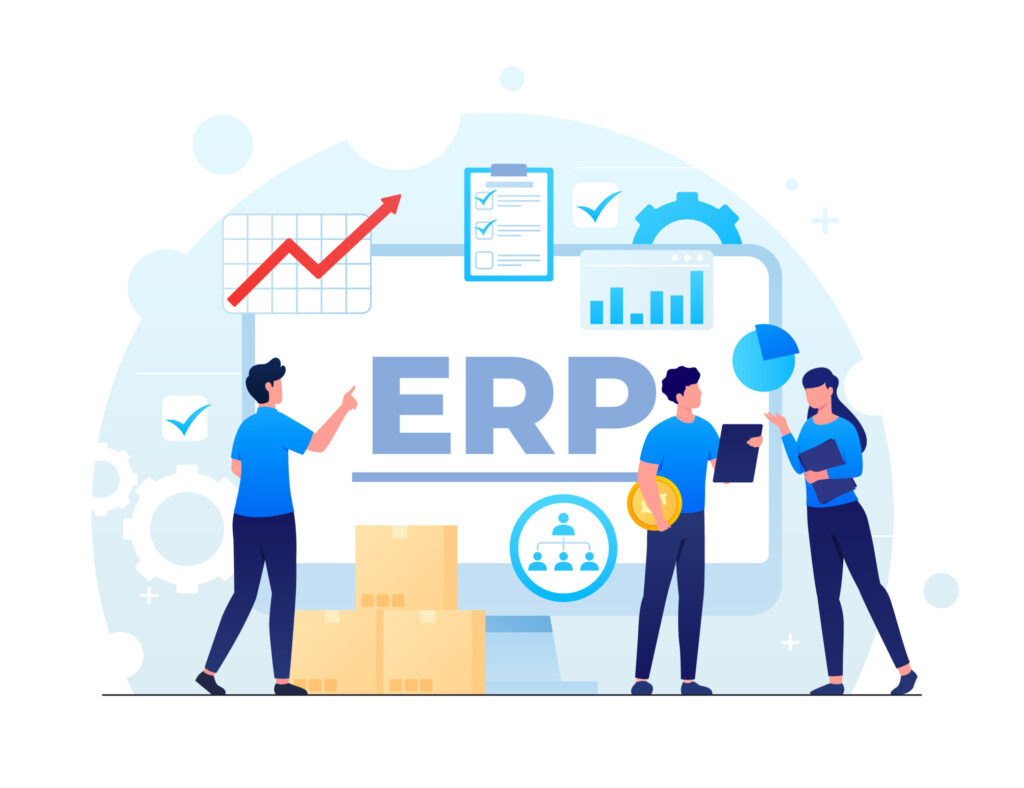
Common Myths of ERP (Enterprise Resource Planning): There are a lot of ERP myths that surround the concept, infrastructure, implementation and practice of Enterprise Resource Planning. Very often people are not willing to adopt ERP because of these wrong notions. In this section we will see some of the most common myths about ERP and will try to demystify them. ERP MEANS MORE WORK AND PROCEDURES Properly implementing and managing an ERP system is not an easy task. The transition period from the traditional system or manual processing to ERP is difficult as new skills have to be learned; new procedures and processes have to be followed, and so on. Many employees think that ERP will add more work, make the work more difficult and will force unnecessary procedures. Transformation from the old system to the ERP system is a difficult process. However, if the management and the implementation team do their job properly, ensuring that the employees are told what to expect and given proper training, then the transition can be smooth. Once the employees get used to the new system, they will understand the potential benefits and the effort saved through automation of talks and jobs. Today’s ERP tools automate many of the repetitive, monotonous and tedious procedures, tasks and processes thus making the life of the employees a lot easier. ERP WILL MAKE MANY EMPLOYEES REDUNDANT AND JOBLESS Another popular misconception about ERP system is that its implementation will make many jobs redundant (because of the automation) and hence, many employees will lose their jobs. A properly implemented ERP system will automate many tasks in the organization. This does not mean that the ERP system will make people redundant. Yes, there will be changes in job descriptions and in the activities people used to do. Many tasks will be automated and this will make the people who were doing those jobs unnecessary. But ERP system also create new job opportunities and they very same people whose jobs were automated could be used to fill the new positions after giving them proper training on the new tasks. Hence, the amount of planning that goes into re-location and re-training of the employees by the management and the implementation team can go a long way in reducing the anxieties of the employees. ERP is a people system made possible by computer software and hardware. ERP IS THE SOLE RESPONSIBILITY OF THE MANAGEMENT Making an ERP system work is the responsibility of all the employees. It involves virtually every department and every person within the company. The company management is not responsible for the day-to-day operation of the ERP system. Their main job is to create an organizational environment in which ERP can thrive – give ERP the full backing of the management. They should also be involved in the development of ERP policies, usage guidelines, allocation of budget, package selection and appointment of competent professionals to implement and manage the ERP system. Only when the ERP team has the full backing and support of the management, they will be able to implement the system smoothly. The management should monitor the implementation and operation of the system, review the progress and status periodically and should take necessary corrective action, if required. The management should also ensure that the ERP implementation team gets the support and co-operation of all the departments, But, thinking that the ERP system will succeed just because the management is fully committed to its implementation and operation is one of the biggest mistakes that an organization can make. In fact, it is the employees – the day-to-day users of the system – who will decide the fate of the ERP system. If the employees are not fully appraised, trained, satisfied and are not happy with the system and are not using it properly, then the ERP system will be a failure. ERP IS JUST FOR MANAGERS OR DECISION-MAKERS The managers and decision-makers are the major users of the ERP system. They are the people who benefit the most from the properly implemented ERP system. They will have all the information they need at their fingertips for making informed decisions. The quality of the decisions and the speed with which the decisions are made are dramatically improved as the ERP systems provide high-quality, timely and relevant information. But every employee in an organization benefits from the ERP system. An ERP system gives the store clerk access to the inventory record and enables him to find out the exact quality of an item. It allows the production supervisor to plan his activities. It allows all employees to apply for leave, get loads approved, gets the travel expenses reimbursed and so on. But for making the best use of the information processing power of an ERP system the users should be trained on how to make the best use of the various features available. If people are ignorant about these, they will find it useless and if they are not properly trained, they will find the experience frustrating and tedious. These people will not use the ERP system or if forced will use it but not to its fullest potential. They will see ERP as a waste of time and do it just because they are forced to do it. This hostility towards ERP can be eliminated if the users are properly educated and make aware of the benefits of the ERP system. ERP IS JUST FOR MANUFACTURING ORGANIZATIONS This assumption is basically due to the way in which ERP was historically developed from the methods of Material Requirement Planning (MRP) and Manufacturing Resource Planning (MRP II), which are relevant to manufacturing organizations. In the manufacturing industry, MRP became the fundamental concept of production management and control in mid 1970s. At this stage BoM (Bill of Materials), which is purchase order management that utilizes parts list management and parts development, was the prevailing trend. And this concept unfolded from order inventory management of materials to plant and personnel planning and distribution planning, which in turn became MRP II. This incorporated