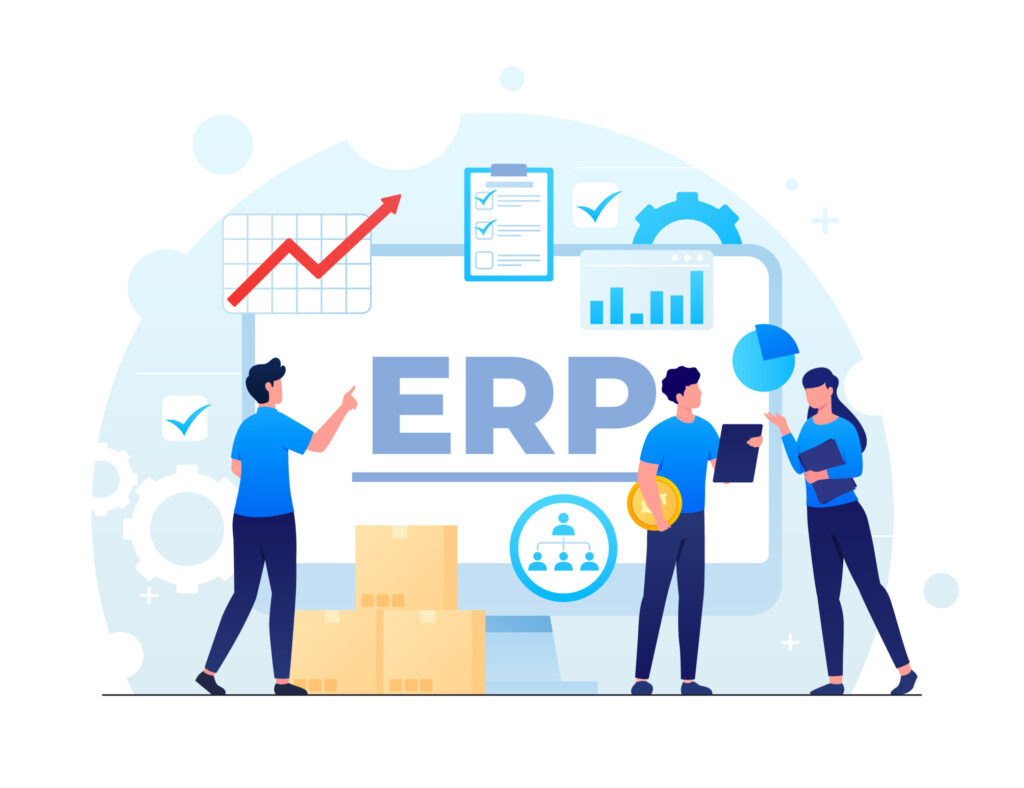
Basic Concept of ERP In today’s competitive world many major companies have decided to use a popular tool that has evolved over the past few decades. ERP, the descendant of MRP II offers the “answer” to the economic and productivity troubles of manufacturing and service enterprises. Thus, understanding the basic concept of ERP software is very important. In order for a software system to be considered ERP, it must provide an organization with functionality for two or more systems. While some ERP packages exist that only cover two functions for an organization (QuickBooks: Payroll & Accounting), most ERP systems cover several functions. The term ERP originally referred to how a large organization planned to use organizational wide resources. In the past, ERP systems were used in larger more industrial types of companies. However, the use of ERP has changed and is extremely comprehensive, today the term can refer to any type of company, no matter what industry it falls in. In fact, ERP systems are used in almost any type of organization – large or small. ERP systems today can cover a wide range of functions and integrate them into one unified database. For instance, functions such as Human Resources, Supply Chain Management, Customer Relations Management, Financials, Manufacturing functions and Warehouse Management functions were all once stand alone software applications, usually housed with their own database and network, can now fit under one umbrella As in any integrated System or Unit, the performance of each one of the parts of an Enterprise has an impact in his cumulative performance results. Specifically, we can say that a 95% performance in independent vital enterprise elements (Item master, Bills of Materials, Production Master Schedule Adherence, Inventories Accuracy, Production Orders Accuracy and Purchase Orders Accuracy), will reflect a cumulative 75% in a ERP environment. This means a percentage of failure possible in productivity terms. Here is where we should support and combine this useful tool with a business strategy based on the desired administration tendency or theory. On this sense, it is vital to note the point on administration before deciding which ERP solution is the one you will be using, you need to have solid administration principles (no matter which administration tendencies you decide to choose) and strong knowledge of ERP methodology. This will translate into synergy between areas that will allow organizations to have highly effective processes with a continuous success. Only by creating a deep understanding of this philosophy you will have the certainty of obtaining the best results, as well as being in position to face and take proactive actions for any obstacle you could find in the road. If you have not this reference point, your efforts will deliver the wrong results. Also Read – Best ERP Software for Manufacturing in India
Basic Features of ERP Comparing mid-market ERP packages is not exactly an apples-to-apples type of exercise. Each vendor wraps its mid-market offering with different functionality, tailored to the needs of the kinds of companies the solution is intended for and based on the vendor’s particular areas of expertise. However, almost every mid-market ERP suite shares several basic features of ERP modules: BI, CRM, Financial Management, HCM, Manufacturing Operations and SCM. The differences among solutions tend to be quite granular within these modules. Also, even if different packages offer the same feature – say, sales-order management – it might not be bundled in the same module; some vendors include sales-order management in their CRM suites while others package it in their SCM suites. Key to an ERP package is tight integration between modules, so that all of the core business modules are related. For instance, manufacturing operations are integrated with customer service, logistics and delivery. Also Read – Advantages of ERP solution in printing industry Basic Features of ERP Software are: • Business Intelligence One of the newer components of most modern mid-market ERP packages, BI shines a bright light into the heart of a company’s performance. In general, an ERP suite’s analytics or BI tools allow users to share and analyze the data that the ERP applications collect from across the enterprise from a unified repository. The end result is more informed decision making by everyone from executives to line managers to human-resources professionals to accountants. A variety of automated reporting and analysis tools can help streamline operations, as well as improve an organization’s business performance. With greater control and visibility of data across the enterprise, business leaders can better align the company’s operations with its overarching strategic goals. • CRM (Customer Relationship Management) CRM has long been a core component of any ERP offering, giving manufacturers a way to improve customer service by pulling together tools to fulfill customers’ orders, respond to customers’ service needs, and often, create marketing campaigns to reach customers. Most vendors include sales tools to provide customers with sales quotes, process their orders and offer flexible pricing on their products. Another important CRM component is service management, which may arm customer-service agents with scripts for talking to customers, as well as allow them to authorize product returns and search a knowledge base of support information. The third main component is usually marketing, which may include tools to manage campaigns, create sales literature and develop a library of marketing collateral. Additionally, CRM often has tools for account management, SFA, and opportunity or lead management, as well as self-service tools for customers and an e-commerce storefront builder. Also Read – ERP Software streamline the cosmetic manufacturing process? • Financial Management Of all the ERP modules, the financials applications tend to be the most frequently utilized. Across the board, these include general ledger, accounts receivable and accounts payable, billing, and fixed asset management. Because many mid-market companies deploy ERP to support efforts at breaking into global markets, it is imperative that their ERP packages support multiple currencies and languages. The financial-management applications may also include tools for creating and adhering to budgets, cash-flow management, expense management, risk management and tax management. • HCM (Human Capital Management) For the most part, the HCM module includes tools for human-resources management, performance management, payroll, and time and labor tracking. Some vendors also provide functionality for administering benefits, managing compensation, dealing with salary taxes, recruiting new employees and planning workforce needs. Some also include self-service tools for managers and employees. Even though HCM is generally considered core ERP functionality, some vendors offer it as an add-on module. Also Read – ERP Software in India • Manufacturing Operations The manufacturing module is where much product differentiation happens, including industry-specific functionality. In general, these applications are intended to make manufacturing operations more efficient and simple. Most vendors support different modes of manufacturing, include configurable product capabilities, perform different types of job costing and offer a BOM (bill of materials) tool. Applications often include PDM (Product Data Management), CRP (Capacity Requirements Planning), MRP (Materials Requirements Planning), forecasting, MPS (Master Production Scheduling), work-order management and shop-floor control. Also Read – How can cloud ERP help solar installers reduce soft costs?
Organizations must understand and study key success factors of an ERP Software before Implementation, as it is a major investment and commitment for any organizations. The size and complexity of ERP projects are the major factors that impact the cost of ERP implementations. Different companies may implement the same ERP software in total different approaches and the same company may integrate different ERP software applications by following the same procedures. However, there are factors common to the success or failure of ERP implementation regardless of the ERP systems they implement and the methodologies they use. KEY SUCCESS FACTORS OF AN ERP IMPLEMENTATION 1. Project Planning ERP implementation starts with project planning – setting project goals, identifying high-level business requirements, establishing project teams and estimating the project costs. Project planning offers the opportunity to re-evaluate the project in great details. If the ERP project is not justified at the planning phase, organization should not hesitate to cancel the project. For every successful ERP project there are projects that are cancelled before implementation. 2. Align the organization on the true destination You should make sure that everyone in the organization has the same vision about the original motivations for implementation ERP-enabled processes: what the targeted capabilities were, as well as the targeted benefits. Only then can an organization really know how close its ERP program is to being complete. This alignment needs special focus on people: communicating, expectations, education, and top management support. 3. Architectural Design While high-level architectural decision is made in the process of ERP vendor selection, it remains a crucial successful factor in integrating ERP with other eBusiness applications, e-commerce applications or legacy systems. Choice of middleware interface software or programming languages drastically impact the implementation cost and release date. Also Read – How does ERP software deliver better ROI for your business? 4. Transition project roles to a way of life Information technology people, ERP expert, process expert, site leaders, the project manager and the steering committee – going live can involve hundreds of people, in dozens of roles. But at go-live, once the program is operational, the way roles change and the way such change is orchestrated can be an even larger undertaking. Companies successful in the post-implementation phase are simply better at mobilizing and guiding such efforts. They are also better at preparing people for the critical shift, moving from being team members to champions. 5. Data Requirements Unlike in-house e-Business applications, much of the packaged ERP implementation involves the integration of ERP systems with existing eBusiness software (CRM, SCM and SFA) and legacy information systems. Appropriate level of data requirements is critical for an ERP to interact with other applications. Data requirements usually reflect details of business requirements. It costs ten times to correct a mistake at later phase of ERP implementation than the effort to correctly define requirements at analysis and design phase. 6. Apply planning and program management practices throughout the program life cycle If there is one thing that companies should master by the time they go-live, it is program management and planning. Companies that will succeed are those that accept the fact that if they are to achieve their benefits, the operation and maintenance phase demands at least as much planning as the implementation phase did. 7. Achieve balanced people, progress and technology chances across all areas Companies undertaking the ERP journey must make changes and take action in all areas of the modern enterprise. They need the best-of-breed technology tools, the most effective work processes using world-class practices and people who are trained and motivated. They will also need strategies that fully leverage these new organizational abilities. Far from being a one-dimensional project, the ERP journey must keep change in play and in balance, in all these areas – a fact that successful companies never forget. 8. ERP must be driven by business case In other words, the work must be directed toward improving specific business metrics: improved cash flow, faster hiring, reduced costs and accelerated shipments. Both line and IT managers must identify the processes that need improvement. Focusing on business process improvement is the only way to know whether you have got your money’s worth. 9. Active executive direction Executive direction in this case means more than just oversight or support. People do not adapt to doing work in new ways without some inspiration from the top. ERP systems are huge, influencing thousands of people, processes, practices and policies. There are thousands of decisions to be made – both large and small. Someone at the top of the organization has to make the call. Also Read – How does ERP help in the plastic manufacturing industry? 10. Focus on capabilities and benefits, not just going live The ERP implementation was initiated because of its benefits. So it will not matter much if a schedule is missed by a few days or even weeks. However, if you miss out on an expected feature or benefit, then it is going to hurt. So make sure that all the features that were planned are implemented. 11. Make ERP-related decisions quickly How about a rule that all decisions must be made within three days? This may seem arbitrary, but setting a fast and deliberate implementation pace is critical. Experience has shown that when an ERP project stretches more than 10-12 months, it is at risk – mostly because key team members move on. 12. Put the very best people on the implementation team The natural tendency is to staff projects with people who are the most available. But these people may not have the skills or process knowledge required to get the job done. This is complex stuff. An ERP project will require the best talent that you have. And if you assign only part-time talent, then work gets prolonged and the project is at risk. ERP work is not just a project. It is the beginning of a continuous improvement process. There are at least five years of benefits to get out of any ERP implementation. Also Read
Having discussed about the success factors in the previous articles it is time to analyze on failure factors in ERP implementation. FAILURE FACTORS IN ERP IMPLEMENTATION : ERP implementation is, at its core, a people project : The biggest challenge before and after implementation is not the technology; the biggest issues are related to people. At every stage, companies must work harder to manage change, secure buy-in, communicate with and educate their employees. Top human resources issues are related to changing management, training and internal staff adequacy. Employee Resistance : If the employees are not educated and informed about the benefits of the ERP system and assured about the security of their jobs by the top management, they will start believing in the rumors that float around and will either resist or sabotage the ERP implementation. Lack of top management commitment : The top management should pledge and demonstrate that the ERP implementation has its full support. They should assure the employees about their jobs, clear any doubts and explain why the ERP system is a necessity for the organization. The CEO or some senior level manager should sponsor the ERP project in order to demonstrate the management commitment. Inadequate training and education : All users of the ERP system should be trained properly in using the system to its fullest. Different groups of people in the company will have different training needs. Managers need more focus on the decision-making and analysis features of the system, while the clerical staff need more focus on how to perform their jobs. But all the users must be trained in the ERP basics, overview of the system and its working, how an action by an employee triggers a host of events through the organization, how automation will help, what processes are changed and so on.When the employees do not understand what the new system is and what it is supposed to do and how to operate it, they will not use it or use it incorrectly. This can lead to failure of the system. Train process owners (department managers) in how to use the system. Have them train the users. Also Read – ERP Software in the paper industry Inadequate requirements definition : If the requirements of the new system or what is expected from a new system are not adequately defined, then the implementation team will find it very difficult to plan the project. Only if the requirements are specified correctly, the ERP package that is best suited can be selected. Inadequate resources : ERP implementation is a complex, costly and lengthy project. The initial budgets are very often exceeded and there are still many hidden costs in an ERP implementation. So, while preparing the budget and allocating resources for the ERP implementation care should be taken to consider all the factors that could affect the costs, manpower requirements, infrastructure needs and then reserve a reasonable amount of buffer of buffer for any contingencies that might occur during implementation. A poor fit between the software and users procedures : If the selected package is a poor fit then either the organization has to change its business processes or the package has to be customized to follow the organization’s processes. If the company’s processes are efficient and cannot be changed the only option is to customize. This is a time-consuming, costly and error-prone process. So while selecting the ERP package care should be taken to select a package that offers the best fit with the company processes. Unrealistic expectations of the benefits and the ROI : ERP systems are capable of producing dramatic productivity improvements if successfully implemented and properly operated. But expecting ERP to perform miracles will be asking for trouble. The management and employees should be made aware of the benefit so that there are no over expectations. If ERP is touted as a panacea, then there will be dissatisfaction and disappointment about it, which can lead to failure of the system. Also Read – Which ERP solution is best for EPC contractors? Poor ERP package selection : If the right package – the one that is best suited for the company – is not selected, it will create a lot of problems for the implementations and customization teams as well as the end-users and will result in failure. Choosing an ERP package that is not suited for the company or one that will require huge amounts of customization is one of the major factors that contribute to the failure of the ERP project. So the package selected should be one that addresses the basic business functions of the organization. Extensive customization : Be prepared for people to argue that they need to customize a report or tell you that your new software does not accommodate the way your company pays invoices. However, you should always challenge those arguments aggressively. Most companies can live with standard business processes. When you over-customize an ERP installation, you not only add time and costs, you also make installing the next release of the ERP software increasingly difficult and costly. Change management : Long and expensive customization efforts often result in the lapse of the release deadline and budget overrun. Customizations make the software more fragile and harder to maintain when it finally goes to production. Major changes may be required in the later stage of the implementation as a result of incomplete requirements and power struggles within organizations. Failure of accommodating evolution of business processes : Business process fall into three levels – strategic planning, management control and operational control. Organizations continuously re-align their business processes at all levels in response to the ever-changing market environment. Many ERP systems are not flexible enough to accommodate evolution of business processes. An ERP system that worked well last year may need major overhaul. Also Read – Best ERP software for the oil and gas industry
Set targets and Budget Before ERP Implementation 1. Phased approach: It is important to break as ERP project down to manageable pieces by setting up pilot programs and short-term milestones. Depending on the IT experience, some organizations choose the easiest piece as the pilot project, while others may implement a mission-critical application first. The pilot project can both demonstrate the benefits of ERP and help gain hands-on ERP implementation experience. 2. Data conversion: Second generation ERP systems use relational database management systems (RDMBS) to store enterprise data. If large amounts of data are stored in other database systems or in different data formats, data conversion is a daunting task, which is often underestimated in ERP implementation. A two-hour data conversion task could be turned into a two-month effort as a result of the DBA group’s lack of technical experience and the management’s incompetence or ignorance. Also Read – Why is ERP system important for solar industry 3. Organization commitments: The involvement of ERP implementation goes far beyond the IT department to many other functional departments. The commitment and smooth coordination from all parties is the key to the success of ERP project. The commitments come from the understanding of how ERP can benefit each functional department. For example, if the warehouse staff is not completely sold on the benefits of the inventory control module, they may not input the kind of usage data that is essential to the project’s success. 4. Create partnership between your software vendor and your stakeholders: While this concept may seem obvious, it has been found that the vendor-client relationship is often contentious and sometimes outright hostile. This fact is particularly true if the organization is severely divided regarding the choice of vendor software. As problems arise during implementation, and they will arise, the blame game often begins. Before long, the project evolves into a standoff with neither vendor nor client willing to admit fault. A third-party project director or manager is often the best solution for this dilemma. This person can usually serve as an objective mediator to bring the parties together, finding solutions, rather than allowing the project to slow down to a crawl. Also Read – How ERP software is beneficial for pipe manufacturing industry 5. Sell, sell, and continue to sell the ERP to your stakeholders: Implementing ERP systems are extremely complex and take months or even years, to implement it. If your stakeholders understand the long-term benefits of the system, they are much more willing to accept any perceived temporary steps backward. 6. Build and leverage process expertise: Process focus is if anything, more important after going live since the company now has an even greater core of process expertise. Successful companies fully capitalize on this expertise and the power of ERP-enabled process. One way is by sending process experts from the implementation team back into the organization, or by having some serve at centers of excellence, some as key process performers and some as business managers. Successful companies never forget the point of the integrated enterprise – that it is not about ERP so much as it is about people involved in ERP-enabled processes. 7. Adequately resource your project: Ensure that replacements are in place to release key team participants. The people who do the daily work of running functional departments are the same people who will be essential to implementing an ERP system. No surprise. The people with the most knowledge will be needed for the majority of the project. Priorities will conflict between the demands of the office and demands of the project. The most effective solution we have seen is hiring or contracting with additional resources to serve as back-fill for key office personnel. Admittedly a new resource cannot do everything that an experienced resource normally does; however, the replacement can handle routine work and coordinate with the experienced person for critical decision. Also Read – How can ERP system help the cosmetic manufacturing process? 8. Define metrics and manage them: ERP systems are capable of producing dramatic productivity improvements if successfully implemented and properly operated. But expecting ERP to perform miracles will be asking for trouble. The management and employees should be made aware of the benefit so that there are no over expectations. If ERP is touted as a panacea, then there will be dissatisfaction and disappointment about it, which can lead to failure of the system. 9. Communicate and manage expectations at go-live: Many stakeholders in the organization expect the ERP to be an ‘everything for everybody’ solution. Even in the best-case scenario, this is rarely true. And inevitably, some functionality must often be re-scheduled into a post “go-live” phase. All of this combined could crate disillusionment with the new system. If the project teams are struggling to meet deadlines, they may have to make decisions on the functionality that needs to be delayed in order to meet the original “go-live” date and avoid delays. These decisions must be communicated and “sold” in the stakeholders to ensure expectations are effectively managed. The organization needs to know what will be in place at “go-live” and when they can expect the additional functionality. Read More – ERP Software In India
Best Use of Consultant Knowledge • Implement pre-project readiness assessment and overall project planning: Most organizations have never been involved in a project as complex and cross-functional as an ERP implementation. Additionally, an ERP project requires near full-time participation. A readiness assessment conducted prior to the project kick-off can help identify areas of strength and potential problem areas in need of improvement. This information is extremely helpful when planning the project budget and the project tasks. • Implement aggressive project management processes: The magnitude of an ERP implementation requires aggressive and structured project management processes. An ERP implementation is complex and touches virtually everyone in the organization. Without the structure of project management processes and without a project manager who understands this methodology, the project runs significant risk in time, quality and costs. “Go-live” dates could be missed and the credibility of the project team and the ERP software itself could suffer dramatically. Also Read – Why automotive manufacturers must use ERP system • Create a project organization structure to provide planning and quick response for decision-making and issues management: The toughest problems with any project implementation involve people issues. Pre-project planning must include the creation of clearly defined roles and responsibilities. The following critical roles need to be filled by qualified people: project sponsor, project director and/or project manager, functional team leaders, technical team leaders, project coordinator/scheduler, etc. These people must have dedicated time to the project and they must be willing to be accountable for dealing with issues and making timely decisions. Many ERP implementations become paralyzed when issues are put on hold and are not dealt with quickly. • Make the best use of the external consultants and experts: These people are paid huge amounts of money for helping you in implementing the ERP system. So you must make the best use of their knowledge and skills and ensure that the knowledge transfer is complete before they leave the project. • Teach the organization to use new capabilities: The natural progression from building capabilities is actually using them. While this may sound obvious, many organizations are far better at building new capabilities than at teaching (and motivating) people to use them. Successful companies avoid this fundamental imbalance. For them teaching goes hand-in-hand with building new capabilities, from defining roles to developing skills to culture shifts. Also Read – ERP Software in Nigeria • Implementation review: This review must be performed after users are competent with the system. The goal is to ask the software vendor to suggest better ways to use the system. • Assign clear ownership of benefits: During implementation, it is usually clear that the responsibility for going live-on-time and on budget-ultimately belongs to one person, the project leader. But after going live, who owns the benefits that are being targeted? In many companies, this is a difficult question to answer – no one is identified as the owner. But in successful companies accountability for results is no mystery. The owner may be the business unit leader, a project sponsor, a process owner or someone else. What is important is that there is somebody whose responsibility is realizing the benefits. Read More here – Which is the most common ERP software used in dubai
Benefits of ERP for Manufacturing Industry in India The growth of auto component manufacturing industry in India is showing a positive trend for the couple of years and the trend is going to continue for years to come. This trend is giving a tremendous opportunity for the automotive components industry in India to rise to the occasion and serve the global automotive parts and components market through exports. According to reports, with this healthy growth rate, Indian automotive components industry is pegged to accrue an impressive US$100 billion in revenue by 2020, with expected exports in the region of US$35-40 billion. However, to keep pace with the growing industry needs, the auto components manufacturing companies in India need to upgrade their working system which could cope with growing demand of world market. Deployment of an effective enterprise solution is the need of the hour in many of these companies. eresource, is one of best ERP system for automotive industry which serve almost an decade now could be a right choice for companies in India to overcome any challenges. Also Read – Which ERP solution is best for EPC contractors eresource Web-based ERP Software is a fully integrated ERP system to Improve business processes, enhance collaboration, and boost competitive advantage. It is not an exaggeration to say many of the auto component manufacturing companies in India is looking for a reliable ERP solution and most of them are happy to be the beneficiaries of eresource. Not only auto component industry but also every industry is looking for an ERP solution to run their business smoothly. eresource ERP system serves as the foundation for daily customer interaction and execution in many areas, including material requirements planning, inbound delivery, goods receipt, production, delivery note creation, shipping, billing documents, and invoice creation and settlement. Keeping your organizations business process system compatible with the changing world business environment is an absolute necessary for the existence this industry. And most importantly, this industry is also one of the largest employers in the country along with a high concentration of export and should get special status and incentives from the government for a level playing field with other Asian counterparts. Therefore, be equipped with the best technology components to be in the forefront of any tough competition. In the eve-changing ever-growing and competitive marketplace, it is very important for Automotive manufacturers gain operational excellence. eresource ERP gives you visibility into strategic information at every juncture, which help you to take timely decision. Excellence regional markets are saturated and global capacity exceeds demand. While seeking to protect today’s business by adapting to changing customer requirements, suppliers are also trying to invest for tomorrow so that they can grow and expand into new markets. Also Read – Choose the best ERP software for the electronics manufacturing industry
A competitive ERP system for industries in Coimbatore Serving a wide range of industrial segments: Our manufacturing ERP product, eresource Xcel, that is being designed to match with all kind of business process of manufacturing companies going to be a big assistance for companies in Coimbatore. With the implementation of eresource Xcel ERP system in manufacturing companies, every function of these companies will become quick, flawless and transparent. The system is made to suit industries like Engineering, Manufacturing, Textile and Food Processing that have huge presence in Coimbatore. All these industries in Coimbatore need quick exchange of critical information between various sections, branches and locations that will enable the managers and other decision makers to act promptly and timely. This timely action can help companies achieve steady growth. Once implemented, eresource ERP system will support you every step of the way in your business functions. Being one of the most trusted ERP solution provider in India and in many other overseas countries, eresource ERP system has the appropriate architecture, customization features, installation procedures, and level of complexity. Also Read – Significance of construction ERP software in UAE and India Deep understanding of industry best-practice Our professionals work closely with your company IT heads to ensure that you have the correct suite of integrated applications to suit your needs and budget. eresource ERP system helps to identify and plan the enterprise-wide resources you need to best serve your customers. With a deep understanding of industry best practice, our professionals can guide you to procure and help you go for right modules and customization wherever required. Our cost-effective system could bring a tremendous changes and growth in your business in a short span of period. eresource, one of the most widely accepted ERP solution in India has many clients in Tamil Nadu that includes Coimbatore. Having our registered office in Mumbai, we have a branch office in Chennai. Our wide range of enterprise solutions includes various exclusive ERP product for many industry verticals CRM Software and HRMS. We also serve the logistic industry with our unique ERP solution known as eresource 3GL, which a very popular among transportation companies. Our services are customized to suit the preferences of our customers and enable optimum efficiency and performance. eresource product is also famous for its affordable prices and quick implementation process. For more information on all our ERP products, please calls us now or write to us. Also Read – ERP Software in India
eresource ERP 360 – an Enterprise Solution that can take you to new business heights eresource ERP, one of India’s leading and award-winning Enterprise solutions is a web-based business software that is designed to benefit the entire workforce in your organization to work together smoothly and efficiently with one integrated system. eresource offers both Off The Shelf and industry-specific customisable applications to meet the exact requirement of customers’ business process and terminology. You can request for a LIVE DEMO of this economical, powerful and easily implementable web-based ERP system and feel how this application can be helpful to your organization. eresource, a ERP 360 system provides a lot of working freedom to organizations. Many major organizations as well as as small and medium companies are in our clients’ list. These companies have implemented eresource ERP system as a cost effective alternative to their manual procedures or their piecemeal software applications. Under-performed legacy system and cost-factor involving the customization of existing outdated ERP systems in many companies are making the business process a time consuming exercise and, in many cases, impractical. Also Read – ERP for Plastic industry Keeping with our practice of moving ahead with the changing technology environment, eresource applications are getting updated on on regular intervals. Our aim to provide industry-specific ERP system for every Industrial verticals are getting fulfilled with introduction of eresource Xcel, eresource nfra, eresource Life Science, eresource e-Trade, eresource 3GL and eresource WMS etc. We have also recently developed exclusive system for Accounts and Finance, HRMS, PMS and Excise etc. that are the products that have been placed under our Off The Shelf option. All our systems have been incorporated with triggers, alerts and workflow procedures that ensures operational efficiency for any business. Being a web-based ERP system, implementation is not a cucumbersome process like in many other ERP packages. All customer-specific functionality has been included in the system effectively. Although eresource ERP systems have been developed in keeping with the Small and Medium Enterprises in mind many large-scale organizations in India and in Middle Eastern countries are opting for eresource today. Also Read – How cloud based erp software help the construction industry? The prime reason why eresource is concentrating more on SMEs is that the SME segments are the ignored sector by the large players in the ERP market. However this attitude of big ERP players towards SME segment has helped ERP firms like eresource Infotech realise the need of an economical and reliable ERP system for this sector. And the result is the birth of one of the most flexible and affordable ERP software in India — that is eresource. It must be admitted that developing such a package was not easy. As everyone knows that meshing the specific needs of thousands of customers into a single coherent package was not that easy. But eresource’s top quality expert to sift through this mature package, incorporating a massive volume of functionality processes as required by the customer. Being a web-based ERP solution, eresource has simplified the implementation process and it brings efficient operational methods and return on investment (ROI). Also Read – ERP for automotive In spite of its benefits one of the most important factor to be remembered is that ERP is not a just another software application in your organization. The system involves every internal process and must be preceded by a reevaluation of every section together with its functions. It is also important to note that the ERP system will not change the management functioning on its own. You must keep in mind that it is an important and decisive tool, but in order to obtain a correct development you will have to decide carefully who is going to command it, as well as the way in which the data will be saved and how information will flow. Just implementing an ERP system alone won’t help the organization make any success. Though the effectiveness of an ERP system could be measured by the improvement in the ROI, the goal of measurement is not to measure; rather, it is to improve performance and processes are the point at which this can be best accomplished. A well-performed ERP system can be maintained till about 15-20 years. In the later stages the package will have old architecture. It will become very difficult to make changes in the program code without inflicting hazardous damage to the system’s stability. It is possible to give older systems a ‘facelift’ with modern tools. Also Read – Key benefits of ERP software for the food and beverage industry? Though those ‘facelift’ can extend the life cycle of the package for some years, they will certainly speed up the appearance of the useless codes. If your ERP system is under-performing, it is better to go for an overhaul of the system. Do the right evaluation as per your requirement and implement a suitable ERP system that could take your business success to new heights. As the saying goes – It is better late than never. Mail Us at sales@eresourceinfotech.com for Live ERP Software Demo
Inspired by Gurudev Sri Sri Ravi Shankarji’s vision, Sri Sumeru Realty Private Limited (SSRPL) Bangalore is one of the prestigious Real Estate company with a team of over seventy highly motivated professionals, along with scores of associates, consultants and experts committed to achieving sheer excellence. . The company so far completed more than 2 million square feet of construction across residential, commercial, health & wellness, hospitality, infrastructure, institutional and educational sectors. The company is famous for the best utilization of space while being Vaastu compliant. All projects which have been completed so far being spacious and come with high quality interior fixtures and amenities. As the claims goes their mission is to create sustainable, world class, high energy residential & commercial spaces with exquisite workmanship offering unparalleled experience to their customers. Management team The management team of the company led by Devang Vora, one of the CEOs of SSRPL, is dynamic leader with over 15 years of experience in management positions. Devang brings with him a passion for making customers happy. Another CEO Vipul Shah, CEO, has over a decade of experience in being an entrepreneur and managing finances for large projects. The team is also consists of Chief of Operations Mr. B. S. Prabhakar, an Electrical Engineering graduate from RV College, Bangalore and Mr. Suresh Manikya, Head, Accounts, who is a graduate in commerce.. Also Read – ERP for Project Based Industry Choosing the right ERP With the changing business environment, the company has also decided to change its working patterns with the latest technology implementation. An efficiently integrated ERP software for construction in their workplace is one of them. The company management has decided to implement eresource Nfra ERP system and the deployment process are underway. As the company is involved in a vast areas of realty business, only a comprehensive ERP system for construction like eresource Nfra could match their requirement. Being a economical and extensively integrated system, eresource Nfra has been chosen after a thorough evaluation and number of deliberations. Challenges and opportunities The company management feels that their business portfolio echoes their vision to address new challenges and opportunities across diverse interests and to make long-term investments in developing and implementing infrastructural projects with state-of-the-art technology and global standards, Realty and Hospitality, Educational Institutions, Roads, Highways and Bridges, Airports and Sea Ports, Power, Water, Environmental Engineering, Petroleum and Natural Gas and Railways are some of the projects that are being undertaken by the company. Also constructing and reinventing spaces required for office, dwellings (individual structures or townships), industrial and commercial needs prescribes an attention to specific requirements that are both time consuming and call for domain specific knowledge across multiple sectors and multiple disciplines of engineering. The management is also looking forward to putting their steps into the Real Estate Franchising because it is seen as the next big step in the evolution of the organized real estate business. To manage all these activities company really need a solid technology back up and eresource Nfra is result of that thought. Also Read – ERP Software Company in india
It is quite understandable that the implementation methods used in some ERP systems differ from other ERP methods. Here are some important features for the effective usage of ERP implementation. Don’t modify the system at the early stage but try to maintain the normal software and arrange your action as such. If you are confident that changes in the ERP system will help you quickly then go for the modification or else be with the normal software. Data transfer is one of the most time-consuming aspects. Transfer only the data which is utmost necessary and important, the remaining data can be transferred later on. There will be many employees who will be devoting their time to implementation as well as to their daily routine work, but only one person will be fully committed to the project. Hiring people from outside to train the staff will be time-consuming instead of allotting the company employee itself which will not only save time but also the cost will be spent on an outside trainer. Having cost control is a basic right for an ERP system. Check out your financial status and if it does not fit your budget do not spend more on implementation by way of increasing your budget. Before implementing any ERP system the system has to be tested which is an important factor. Before scheduling one has to make a deep check of an ERP system. It has to be made sure that every person working in the organization must have full knowledge of an ERP system and its implementation process. The complete information must flow from the higher level to the lower level. This will not only build confidence but will also motivate them for the betterment of the business.
eresource , India’s most trusted ERP solution provider has designed an absolute ERP for all industrial markets which includes process manufacturing. Pharmaceuticals companies which come under process manufacturing are now using with an absolute ERP solution eresource Life science. Pharmaceutical companies can now implement an absolute worth ERP solutions. The system has been designed by having a thought process in their minds which will meet all the necessities of mid market manufacturers and distributors. eresource life science is an ERP business which is exclusively developed for process manufacturers. We also look into it, that our price fits to the budget while discharging our full ERP functionality. Our ERP system is Flexible, Scalable, Adaptable and easy to use, which will fetch timely return on investment to the customers. eresource products are designed as per the latest and advanced technology and with our continuous upgradation process will make sure that our ERP software for process manufacturing industry is the most trusted and can be used in the long run also. Modification and upgradation is possible whenever it is required. We have a well organized technical back up from our wizard development team who are always at our customer toe’s.On time implementation is our strong point. The clear layout and our innovative implementation could bring a good return on investment at shorter period. Our system once implemented, helps in increasing productivity, enhancement of operational clarity and service, increase in competition, saving cost and many more. This upper hand could bring cost benefit in user operation. eresource Pharmaceutical ERP Software can be modified as per the necessity and as per the need arise. Modification process needs to be talked with our technical team before implementing in the system. Let it be a business process or your database layouts such requirements can be easily brought into the system by our technical team. In short eresource Life science ERP system can easily fit which will suit your organizations lay out. After implementation the system will help your organization to rebuild all your organization process and helps in achieving goals in every quarter of your organizational process. The value and importance of eresource ERP for process manufacturing industry will have high regards every year. As a pharmaceutical company you can be a part of increasing success once your organization implement it.
If you’ve ever managed a construction project, you know the struggle. One day you’re chasing suppliers for delivery dates, the next day you’re trying to figure out why costs are going over budget, and all the while you’re getting calls from the site asking for urgent approvals. It’s a lot. And the truth is, when information is scattered in files, emails, spreadsheets, or people’s heads, mistakes happen. Deadlines slip. Costs go up. This is where eresource ERP for the construction industry changes the game. It’s one system that stores all your project details — from the first tender to the final accounts — in one place. Everyone sees the same up-to-date information, so you can make quick, smart decisions and keep your projects making money. Let’s go through 10 key ERP modules every construction business needs, and I’ll show you exactly how eresource helps in each one. 1. Tendering and BOQ Management: Winning the right projects starts with a solid tender and a clear Bill of Quantities (BOQ). If these aren’t accurate, you either lose the bid or take on an unprofitable job. How eresource Helps: Creates BOQs directly in the system, no need for multiple spreadsheets. Links every item to your cost database so prices are accurate. Updates the whole BOQ automatically if material prices change. With eresource, you can create tenders quickly and accurately, with all the details your team needs in one place. This helps you grab new project opportunities before your competitors. 2. Project Budgeting Your budget is the financial blueprint for your project. Without control over it, you’re flying blind. How eresource Helps: Lets you set budgets for materials, labour, and equipment. Tracks actual spending against your budget in real time. Sends alerts when you’re getting close to overspending. Say steel prices suddenly go up — eresource flags it instantly so you can adjust other expenses or negotiate with suppliers. You stay in control instead of getting nasty surprises at the end. 3. Job Costing and Estimation: Some tasks cost more than others, and if you don’t track them separately, it’s hard to know where the money’s going. How eresource Helps: Breaks costs down by job, phase, or subcontractor. Compares estimated costs with actual costs as work progresses. Uses historical data to improve future project estimates. That means if you overspent on a certain job — like plastering — eresource will show exactly why, so you can plan better next time. 4. Quantity Take-Off: Knowing exactly how much material you need is very important. If you get it wrong, you might run out during the job or be left with costly extra stock. How eresource Helps: Calculates material quantities directly from your project drawings. Connects with inventory and purchasing so orders match the actual need. Prevents wastage by ordering just enough, just in time. For example, eresource can figure out you need 2,500 bricks for a wall and create a purchase request automatically — no guesswork, no delay. 5. Project Management: Managing timelines, resources, and progress in a construction project can be really hard and messy. How eresource Helps: Shows you one dashboard with all your schedules, milestones, and tasks in one view. Allocates resources, people, equipment, and materials exactly where needed. Keeps your site team and office team connected in real time. If rain delays concrete work, eresource automatically updates dependent tasks and alerts everyone so plans can be adjusted instantly. 6. Subcontract Management: Managing multiple subcontractors without a clear system can cause chaos — missed deadlines, disputes, and quality issues. How eresource Helps: Stores all subcontractor contracts, compliance documents, and payment terms in one place. Tracks progress and payment schedules against the contract. Flags delays or issues before they become bigger problems. You get complete visibility into subcontractor performance, so you know who’s reliable for future projects. 7. Inventory and Material Management: Materials are money. Too much stock means wasted cash; too little means work stops. How eresource Helps: Shows your exact inventory levels in real time. Links usage data with project schedules so you order at the right time. Tracks materials from purchase order to delivery at site. If your cement stock is running low earlier than expected, eresource alerts you before it becomes a crisis. 8. Purchase and Supplier Management: Good supplier relationships help you save money and prevent delays, but handling them by hand is slow and messy. How eresource Helps: Keeps all supplier data and past performance in one place. Automates purchase requests, approvals, and order tracking. Links purchasing directly to BOQs and project plans. That means you always know which suppliers deliver quality materials on time, so you can negotiate better deals. 9. Project Accounting: You need to know if each project is making money — not just at the end, but while it’s happening. How eresource Helps: Tracks every project-specific expense and payment. Generates profitability and work-in-progress reports in seconds. Makes billing and invoicing smoother and faster. If profits are dipping mid-project, eresource shows you exactly where it’s happening so you can fix it immediately. 10. Accounts and Finance Management: Your company finances are bigger than just one project. Payroll, taxes, accounts payable and receivable — they all need to be in sync. How eresource Helps: Combines all financial data in one place. Links project expenses to your company accounts so you can see the full picture. Shows your cash flow in real time, helping you plan ahead. If a client pays late, you instantly see how it affects your cash flow — no need to wait for month-end reports. Conclusion: Construction is complicated. In construction, plenty of things can go wrong — but with the right system, you can keep control of them all. eresource ERP gives you everything in one place: from tendering and budgeting to tracking materials, managing subcontractors, and handling final accounts. It’s more than just software — it’s a smarter way to work. You make quicker decisions, avoid mistakes, and keep your projects profitable. Whether you’re building houses, roads, bridges, or offices, eresource helps you
For a number of reasons, including increased visibility, increased productivity, better customer service, cost savings, improved teamwork, regulatory compliance, scalability, data analytics, customization, and integration, logistics & Logistics & Fleet Management companies are looking for an ERP system. These businesses can increase their competitiveness in the market, streamline operations, and cut expenses by using the AI-powered No-Code eresource 3GL ERP system. AI-powered eresource 3GL ERP for Logistics & Fleet Management promises to completely transform the way you manage logistics and transportation problems. It can be very helpful for real-time traffic updates, weather forecast prediction, and information filtering that produces insights that can be put to use. Your fleet can adapt dynamically, avoid delays, and optimize routes with artificial intelligence. Another intriguing aspect of AI in Logistics & Fleet Management is its capacity for prediction. Artificial intelligence can anticipate potential issues and facilitate preventative measures by analyzing historical data. Think about identifying a potential repair issue before it becomes a costly malfunction. Artificial intelligence is not simply a sci-fi fiction; it is a real, tangible reality that empowers you. Knowing the business of logistics and fleet management Logistics & Fleet Management is the process of organizing, leading, and supporting a business or organization’s fleet of automobiles in its use and maintenance. Transportation is a strategic function as well as a procedural need for businesses and organizations whose supply of goods or services depends on it. Its primary objectives are to save costs, boost productivity, and reduce risk associated with fleet vehicle operations. This systematic strategy can provide a company with a number of important benefits, including improved fleet compliance, reduced carbon emissions, safer workplaces, more effective fuel management, and more economical automobile purchases. Fleet managers oversee a variety of tasks that make up Logistics & Fleet Management. These duties include vehicle upkeep, careful monitoring of fuel usage and related expenses, efficient driver management, asset optimization, route planning, and the implementation of initiatives meant to increase overall business productivity while reducing waste. Machine learning and artificial intelligence will probably have the most impact on Logistics & Fleet Management in the near future. From increasing fleet efficiency and lowering operational costs to improving driver and vehicle security, artificial intelligence integration helps transform data into a powerful strategic tool for managing challenges. The following are some crucial things to consider: Predictive Maintenance A range of vehicle data, such as component wear rates, mileage, and performance, are precisely assessed by AI-based eresource 3GL system. The system scans for recurring patterns that signal impending failures using machine learning models such as Random Forests to precisely forecast maintenance requirements. Furthermore, these employ digital twin technology to generate virtual automobile models, enabling simulation-based maintenance forecasts and optimization. Optimization of Routes The incorporation of machine learning into this Logistics & Fleet Management system has made it possible to process real-time traffic data, weather forecasts, road closure information, and historical route performance. This AI-powered route planning system use sophisticated dynamic routing algorithms to continuously adjust routes while accounting for delivery windows and fuel efficiency. This dynamic optimization leads to a significant boost in both fuel economy and delivery efficiency. Efficiency of Fuel AI-driven eresource 3GL ERP system looks at a variety of factors that affect fuel consumption, including driver behavior, vehicle specifications, and route characteristics. Based on the acceleration, braking, and idling patterns of the fleet, they may suggest specific driver training or vehicle modifications. Implementing these AI-generated insights can eventually result in a large reduction in fuel costs. Compliance and safety in the Fleet Advanced AI-powered system monitor driver behavior in real-time and give drivers urgent guidance by accurately identifying driving conditions like hard braking, rapid acceleration, or even fatigue. ML models collect and evaluate this data to foresee safety dangers, automate regulatory reporting, and generate proactive compliance alerts. By producing thorough data, fleet managers can track and improve accident rates, reduce compliance violations, monitor and improve overall fleet protection, and reduce associated costs. Integrated operations and increased visibility Artificial intelligence solutions collect data from all facets of fleet operations, including GPS tracking, fuel cards, and maintenance logs, in addition to external data like weather and traffic. Through the use of these multiple streams of data, artificial intelligence helps fleet managers make better decisions, tracks real-time statistics, and identifies trends or issues that may not be immediately apparent when looking at individual data sources. For more information and a PRODUCT DEMO of AI-powered eresource 3GL for Logistics and Fleet Management, please get in touch with now: sales@eresourceinfotech.com
These days, intelligent systems powered by AI form the core of Manufacturing, while information and communication technologies provide the foundation of smart manufacturing. New theories, models, algorithms, and applications aimed at mimicking, expanding, and improving human intellect are constantly being produced as AI technologies advance. Deep learning and large data analysis advancements have sped up AI’s transition into the second stage. Data-driven deep reinforcement learning intelligence, network-based swarm intelligence, technology-oriented hybrid intelligence of human-machine and brain-machine interaction, cross-media reasoning intelligence, and other forms of artificial intelligence are examples of today’s AI technology. As a result, AI has a lot to offer to smart manufacturing, particularly customised manufacturing in smart factories. AI solutions are generally applicable to a number of smart manufacturing domains. In a smart factory, AI algorithms may manage the production of customised goods. The goal of the AI-assisted Customised Manufacturing (CM) is to build intelligent manufacturing systems that are backed by autonomous decision-making, real-time data analysis, machine status sensors, and cognitive computing. Every link in the CM value chains—design, production, management, and service—is impacted by AI. The application of AI in the smart factory for CM involving architecture, manufacturing equipment, information interchange, flexible production line, and smart manufacturing services is the main topic of this article, which is based on these CM and AI insights. AI-driven customized manufacturing Industrial practitioners and researchers have started implementing AI technologies as they have shown promise in fields like market analysis, logistics, after-sales service, customer management, manufacturing management, manufacturing maintenance, and customized product design. Thus, the implementation of AI technology may make customized manufacturing a reality. Such customized manufacturing powered by AI is referred to as AI-driven CM. In conclusion, AI-driven ERP for CM offers the following benefits. Enhanced product quality and production efficiency Automated machines may be able to make choices in CM manufacturing with fewer human inputs. Cognitive abilities, learning, and reasoning are made possible by technologies like machine learning and computer vision (e.g., analysis of order quantities, lead time, flaws, errors, and downtime). Computer vision and foreign object identification are useful tools for identifying process irregularities and product flaws. Process irregularities can be reported to human operators. Making predictive maintenance easier The best possible condition of the equipment is guaranteed by scheduled maintenance. A production line’s sensors gather data for analysis using machine learning techniques, such as convolutional neural networks. For instance, it is possible to identify a machine’s wear and tear in real time and send out a message. The creation of intelligent supply chains Machine Leaning (ML) algorithms can be used to forecast the supply chains’ unpredictability and variability for CM. Additionally, the information gathered can be utilized to forecast abrupt shifts in consumer preferences. In summary, smart manufacturing benefits from the integration of AI with industrial IoT. AI-powered technologies increase the productivity of production. Products with greater value can be released into the market in the interim. We cannot, however, ignore the fact that when AI technologies are formally applied to real-world manufacturing scenarios, they still have limits. On the one hand, algorithms for AI and ML frequently have high demands on computer infrastructure. Features of specialized production Notwithstanding the advancements, the manufacturing sector still faces several obstacles, such as the inability of traditional mass production to keep up with the quick production of customized goods and the growing prominence of resource constraints, environmental contamination, global warming, and an aging world population. In order to overcome these obstacles, a new manufacturing paradigm is required. The notion of customer-to-manufacture embodies the features of customized production, in which a manufacturing system communicates directly with a client to satisfy his or her specific requirements. Realizing the quick customisation of customized goods is the aim. Better flexibility, transparency, resource use, and manufacturing process efficiency are all provided by the latest generation of intelligent manufacturing technology. The production structure of CM is more complicated, quality control is more challenging, and energy use requires attention when compared to mass manufacturing. The production limits in classical automation were strict in order to guarantee efficiency, cost, and quality. CM differs from traditional production in the following ways. Intelligent interconnectivity: Intelligent manufacturing encompasses a cyber-physical environment, such as storage, processing, detection, and assembly equipment, all of which function within a diverse industrial network. Dynamic reconfiguration: The goal of the smart factory concept is to quickly manufacture a range of goods in small quantities. System resources must be constantly rearranged since product types can change at any time. To negotiate a new system configuration, a multi-agent system is presented. Large amounts of data: An intelligent manufacturing system is made up of linked devices that produce data about process parameters and device status. Data analysis is now possible for decision-making, active preventative maintenance, and failure prediction thanks to cloud computing and big data science thorough integration. Cloud platforms, edge servers, upper monitoring terminals, and underlying intelligent manufacturing entities are all interconnected. In Cyber-Physical Systems (CPS), where information barriers are removed, data processing, control, and operations can all be carried out concurrently, achieving a deep integration of the information and physical environments. For more information on AI-powered ERP for customized manufacturing, please get in touch with now: sales@eresourceinfotech.com