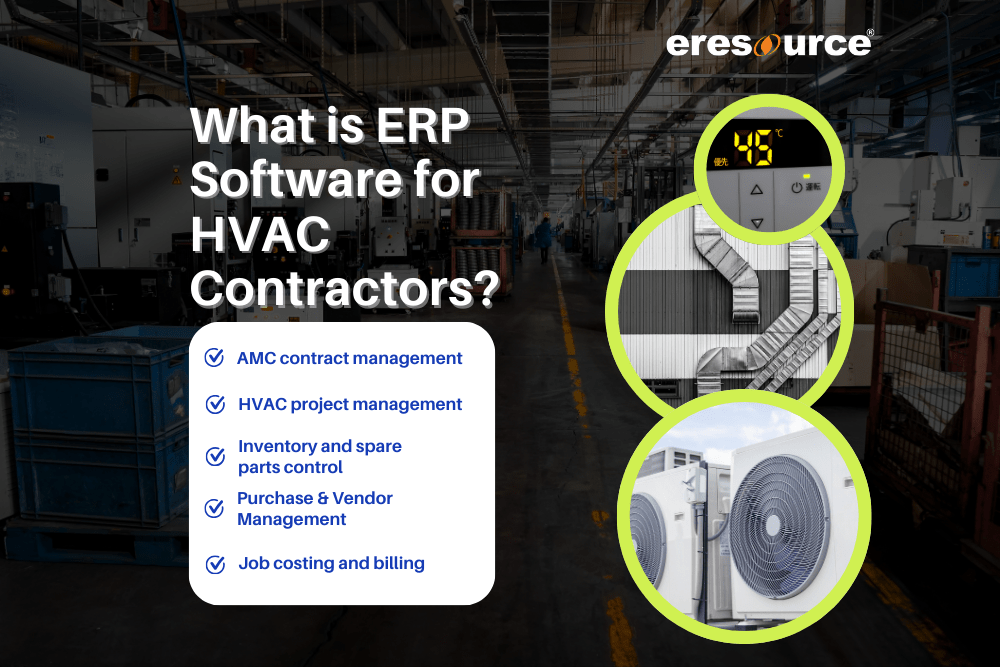
ERP Software for HVAC Contractors (Simple Explanation)
If you run an HVAC business, your daily work is not just about installing AC units or fixing chillers. You handle quotations, site work, technicians, spare parts, service calls, billing, and accounts — all at the same time.
Now imagine managing all of this using different Excel sheets, WhatsApp messages, phone calls, and accounting software. It works in the beginning. But as your business grows, things start slipping.
This is where ERP software for HVAC contractors comes in.
Let’s break it down in simple words.
What Does ERP Actually Mean?
ERP stands for Enterprise Resource Planning.
Big companies like SAP and Oracle define ERP as a system that connects all business departments into one platform.
In simple terms:
Instead of using 5 different tools for accounts, inventory, service, HR, and projects, ERP puts everything in one place. For HVAC contractors, this system is designed specially to manage projects, service contracts, materials, and field technicians.
Think of ERP as the “main control room” of your HVAC company.
Why HVAC Contractors Struggle without ERP
Let’s be honest.
Most HVAC businesses start with:
-
Excel sheets
-
Tally or accounting software
-
Manual job cards
-
Phone-based technician coordination
It works when the team is small.
But once you handle multiple sites, AMCs, and bigger projects, problems start:
-
Materials go missing
-
Projects exceed budget
-
Technicians miss service visits
-
Billing gets delayed
-
Management doesn’t know the real profit
These issues are common in the HVAC industry. They are not rare.
According to Deloitte, businesses that lack system visibility often struggle with operational inefficiencies and cost leakages. HVAC contracting is no exception.
ERP software helps fix this by giving you real-time visibility.
What does ERP Software for HVAC Contractors actually do?
Let’s explain this practically.
1. Helps You Estimate Projects Correctly
Before starting any HVAC project, you prepare a BOQ and quotation.
ERP software helps you:
-
Calculate material cost
-
Estimate labor cost
-
Track project expenses
-
Compare planned vs actual cost
So you know whether you are making a profit, not just guessing.
2. Manages Inventory and Purchases
HVAC work depends heavily on materials like:
-
Ducts
-
Compressors
-
Air handling units
-
Refrigerants
-
Electrical components
ERP tracks:
-
What stock do you have
-
What needs to be ordered
-
Which vendor supplied what
-
Purchase order status
No more panic calls because someone forgot to reorder copper pipes.
3. Controls Service and AMC Contracts
Annual Maintenance Contracts (AMC) bring regular income.
But many contractors forget:
-
Renewal dates
-
Scheduled visits
-
Service history
ERP software automatically:
-
Schedules maintenance
-
Assigns technicians
-
Sends reminders
-
Tracks contract status
This improves customer trust.
And as Harvard Business Review often highlights, retaining customers costs less than finding new ones. ERP helps you protect that long-term revenue.
4. Schedules Technicians Properly
Managing field technicians manually becomes difficult when your team grows.
ERP helps you:
-
Assign jobs based on skill
-
Track attendance
-
Monitor job completion
-
Capture service reports digitally
According to McKinsey & Company, digital workforce systems improve field productivity. HVAC businesses see similar benefits when they use structured scheduling tools.
5. Connects Accounts with Projects
This is very important.
Without ERP:
The project team and the accounts team work separately.
With ERP:
-
Invoices generate automatically
-
Expenses link directly to projects
-
GST or VAT compliance becomes easier
-
Profit reports are available instantly
Management sees real numbers, not assumptions.
And yes, month-end closing becomes less stressful.
Cloud ERP vs Traditional ERP
Today, most HVAC contractors prefer cloud-based ERP.
Companies like Microsoft actively promote cloud systems because they allow remote access and easy scaling.
Cloud ERP means:
-
You can access data from the site
-
No heavy server cost
-
Automatic updates
-
Better flexibility
For contractors working across multiple locations, this makes life easier.
Real Benefits of ERP for HVAC Contractors
Let’s keep it practical.
Better Control Over Projects
You know exactly what is happening on every site.
Improved Cash Flow
Invoices go out faster.
Fewer Material Losses
Stock tracking reduces wastage.
Happier Customers
Service visits happen on time.
Clear Financial Visibility
You know real profit margins.
No drama. Just structured management.
Common Misunderstandings about ERP
“ERP Is Only for Big Companies”
Not true. Many mid-sized HVAC contractors successfully use ERP.
“ERP Is Too Complicated”
Implementation needs planning. But once set up properly, daily operations become easier.
“Excel Is Enough”
Excel works when your projects are small.
It struggles when operations grow.
Manual systems hide problems. ERP shows them clearly.
How ERP Builds Long-Term Stability
HVAC industry margins are tight.
Material prices change. Labour costs rise. Competition increases.
ERP helps you:
-
Track cost carefully
-
Control spending
-
Manage contracts efficiently
-
Make data-based decisions
Instead of reacting to problems, you plan.
That creates stability.
Read also – Benefits of ERP software for the construction industry
Final Simple Explanation
So, what is ERP software for HVAC contractors?
It is a business management system that connects:
-
Projects
-
Inventory
-
Service contracts
-
Technicians
-
Accounts
-
Customers
All in one platform.
It does not replace hard work.
It does not replace leadership.
But it gives HVAC contractors clear visibility, control, and structured growth.
And in a competitive market, clarity is power.
When you manage your HVAC business with proper systems, you reduce mistakes, protect profit, and build long-term customer trust.
That is the real value of ERP software for HVAC contractors.